
We read your photo as:
Define the term universe. List four bodies in the universe. State the correct names of any four of the following elements
ScanSolve AI Answer
Step-by-step solution
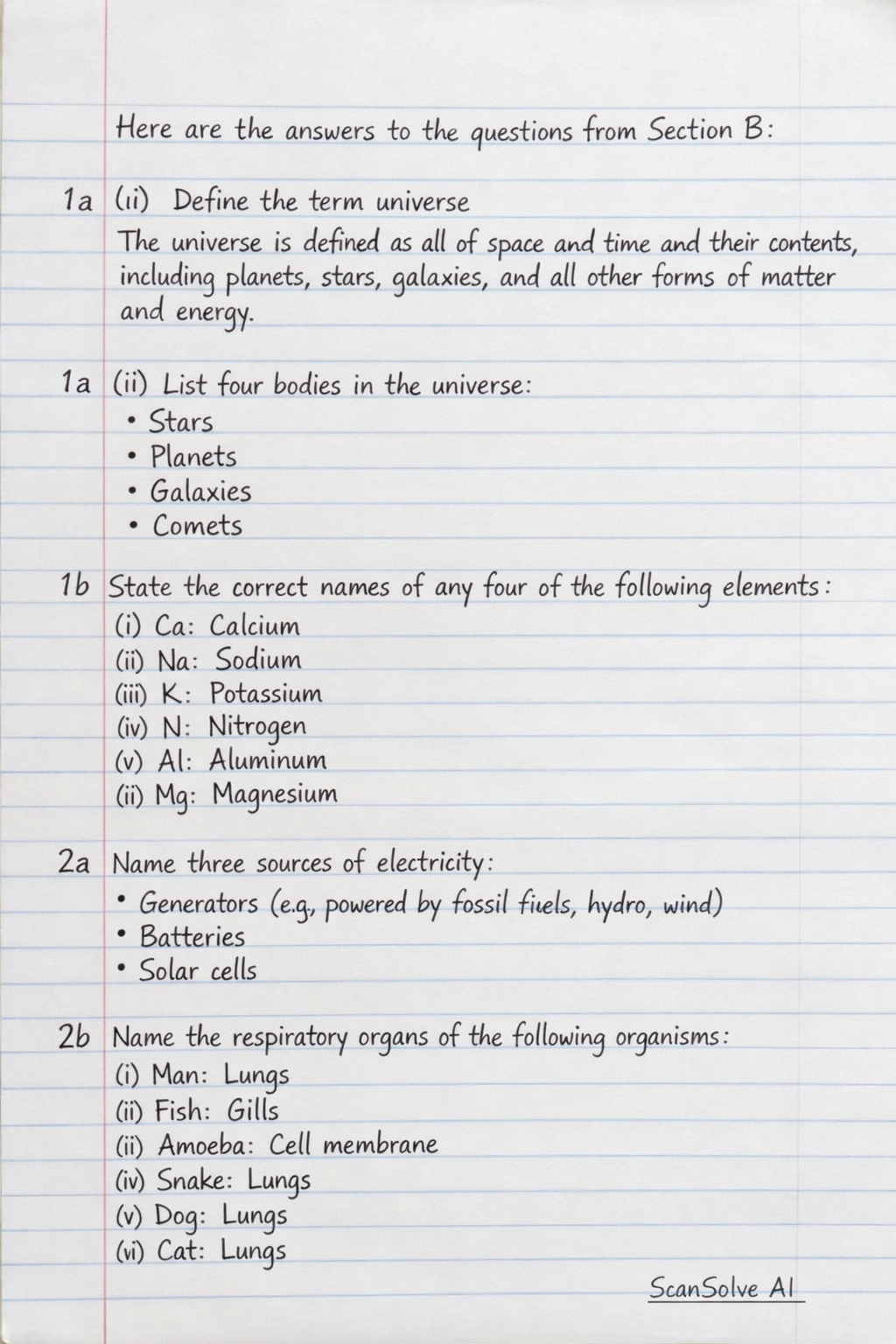
3 stepsHere are the answers to the questions from Section B:
1a (i) Define the term universe
The universe is defined as all of space and time and their contents, including planets, stars, galaxies, and all other forms of matter and energy.
1a (ii) List four bodies in the universe
- Stars
- Planets
- Galaxies
- Comets
1b State the correct names of any four of the following elements:
- (i) Ca: Calcium
- (ii) Na: Sodium
- (iii) K: Potassium
- (iv) N: Nitrogen
- (v) Al: Aluminum
- (vi) Mg: Magnesium
2a Name three sources of electricity
- Generators (e.g., powered by fossil fuels, hydro, wind)
- Batteries
- Solar cells
2b Name the respiratory organs of the following organisms:
- (i) Man: Lungs
- (ii) Fish: Gills
- (iii) Amoeba: Cell membrane
- (iv) Snake: Lungs
- (v) Dog: Lungs
- (vi) Cat: Lungs
3b (i) Briefly explain a simple test for carbon dioxide
To test for carbon dioxide, bubble the gas through limewater (calcium hydroxide solution). If carbon dioxide is present, the limewater will turn milky or cloudy due to the formation of insoluble calcium carbonate.
3b (ii) State two differences between inhaled and exhaled air
| Inhaled Air | Exhaled Air |
|---|---|
| Contains approximately oxygen. | Contains approximately oxygen. |
| Contains approximately carbon dioxide. | Contains approximately carbon dioxide. |
| Cooler and drier. | Warmer and saturated with water vapor. |
3c (i) Define force
Force is a push or a pull that can cause an object to accelerate, decelerate, change direction, or deform.
3c (ii) What is the SI Unit of force?
The SI unit of force is the Newton ().
3c (iii) Briefly explain how a rainbow is formed
A rainbow is formed when sunlight passes through water droplets in the atmosphere. The water droplets act like tiny prisms, refracting and reflecting the sunlight, causing it to split into its constituent colors (dispersion).
3c (iv) What are the colours of the rainbow?
The colors of the rainbow are Red, Orange, Yellow, Green, Blue, Indigo, and Violet (ROYGBIV).
4b (i) What are the conditions for the rusting of iron to occur
The two essential conditions for the rusting of iron to occur are the presence of oxygen and water.
4b (ii) State three characteristics of all living things
- Movement
- Respiration
- Growth
- Reproduction
- Excretion
- Nutrition
- Sensitivity
4a (i) What is matter?
Matter is anything that has mass and occupies space (has volume).
4a (ii) State three types of matter
- Solid
- Liquid
- Gas
4b State two functions of the following plant organs:
- (i) Flower:
- Reproduction (produces seeds and fruits)
- Attracts pollinators
- (ii) Leaves:
- Photosynthesis (produces food for the plant)
- Transpiration (releases excess water vapor)
4c A force of is applied to move a truck through a distance of . How much work is done?
Identify the given values.
Use the formula for work done.
Substitute the values and calculate.
The work done is .
5a (i) Define an alloy
An alloy is a mixture of two or more elements, at least one of which is a metal, combined to create a new substance with enhanced properties.5a (ii) Name one alloy and state its composition
- Brass: An alloy of copper and zinc.
5b (i) Define energy
Energy is the ability to do work or cause change.5b (ii) List four forms of energy
- Kinetic energy
- Potential energy
- Chemical energy
- Thermal energy
- Electrical energy
- Light energy
- Sound energy
5c (i) What is food?
Food is any nutritious substance that people or animals eat or drink, or that plants absorb, in order to maintain life and growth.5c (ii) State two importance for including carbohydrate in our diet
- Primary source of energy: Carbohydrates are broken down into glucose, which is the body's main fuel for daily activities and bodily functions.
- Fiber source: Some carbohydrates (like dietary fiber) aid in digestion, prevent constipation, and help maintain bowel health.
6a (i) Define the periodic table
The periodic table is a tabular arrangement of chemical elements, organized by their atomic number, electron configuration, and recurring chemical properties, showing periodic trends.6a (ii) Draw the atomic structure of oxygen with an atomic mass of 16
Oxygen has an atomic number of 8 and an atomic mass of 16.
This means it has:- 8 protons
- 8 electrons
- neutrons Electron configuration: 2 electrons in the first shell, 6 electrons in the second shell.
(Imagine a central nucleus with 8 protons and 8 neutrons, surrounded by two electron shells. The inner shell has 2 electrons, and the outer shell has 6 electrons.)
Still stuck on this one?
Ask a follow-up, and the answer starts from this question.
More Physics Questions
Handwritten Step-by-Step Solution
Get this as a handwritten image on WhatsApp — like a tutor wrote it for you.
Try on WhatsApp