
This physics problem tests your understanding of fundamental physical laws and their applications. The step-by-step solution below breaks down the problem using relevant equations and physical reasoning.
ScanSolve AI Answer
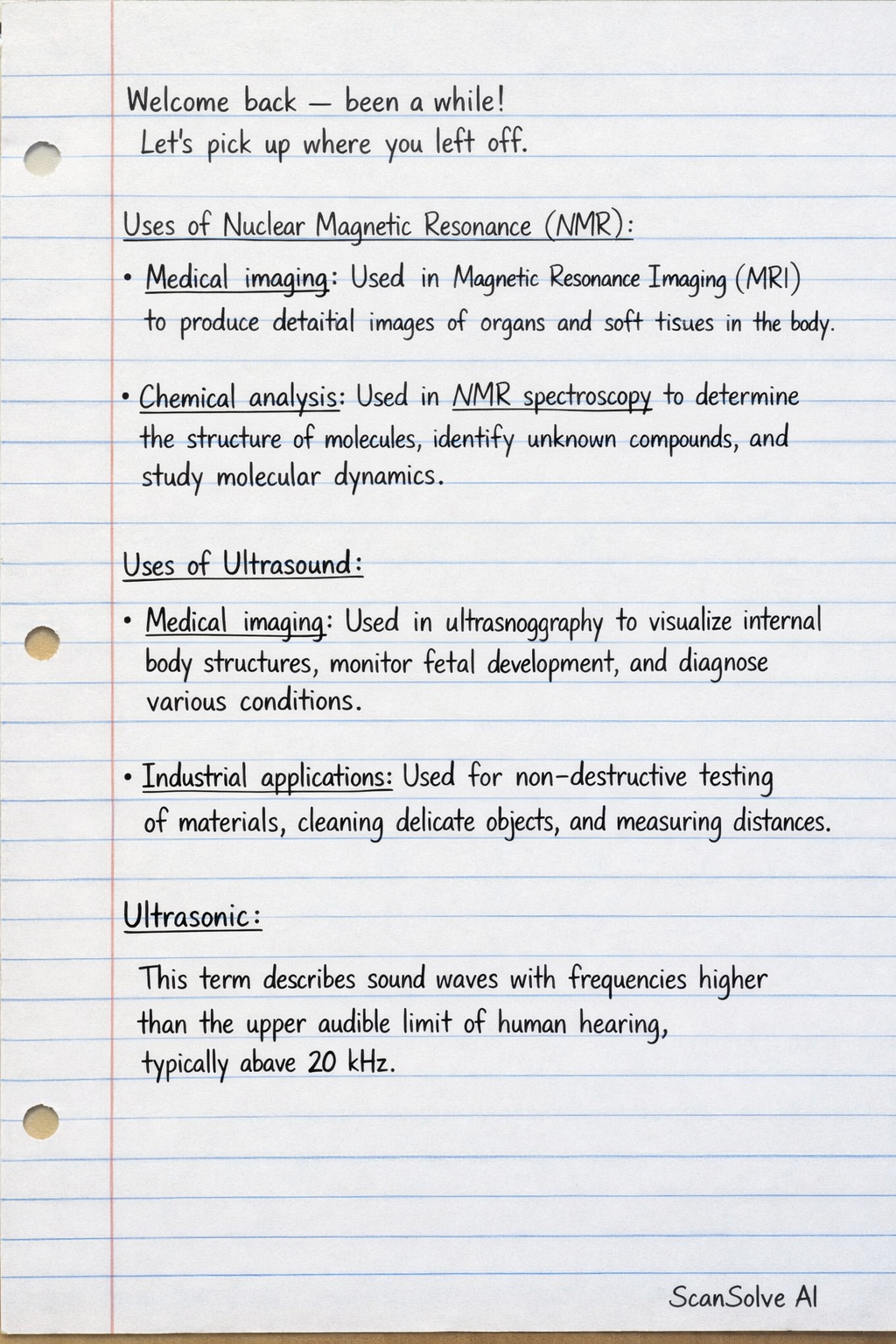
Uses of Nuclear Magnetic Resonance (NMR): • Medical imaging: Used in Magnetic Resonance Imaging (MRI) to produce detailed images of organs and soft tissues in the body. • Chemical analysis: Used in NMR spectroscopy to determine the structure of molecules, identify unknown compounds, and study molecular dynamics. Uses of Ultrasound: • Medical imaging: Used in ultrasonography to visualize internal body structures, monitor fetal development, and diagnose various conditions. • Industrial applications: Used for non-destructive testing of materials, cleaning delicate objects, and measuring distances. Ultrasonic: This term describes sound waves with frequencies higher than the upper audible limit of human hearing, typically above 20 kHz. Define full wave rectification: Full wave rectification is the process of converting the entire alternating current (AC) input waveform into a pulsating direct current (DC) output waveform, where both positive and negative half-cycles of the AC input are converted into positive pulses. State work-energy theorem: The work-energy theorem states that the net work done on an object by all forces acting on it is equal to the change in its kinetic energy. Mathematically, it is expressed as: W_net = K = K_f - K_i = (1)/(2)mv_f^2 - (1)/(2)mv_i^2 where W_net is the net work done, K is the change in kinetic energy, K_f and K_i are the final and initial kinetic energies, m is the mass, and v_f and v_i are the final and initial velocities. What is lateral inversion: Lateral inversion is the phenomenon where the left and right sides of an object appear to be interchanged when viewed in a plane mirror. For example, if you raise your right hand, your reflection appears to raise its left hand. What is optical path: The optical path is defined as the product of the geometric length of a path traversed by light in a medium and the refractive index of that medium. It represents the equivalent distance light would travel in a vacuum in the same amount of time it takes to travel through the medium. Mathematically, for a path of length d in a medium with refractive index n, the optical path length (OPL) is: OPL = n · d Send me the next one 📸