
We read your photo as:
Explain that "a magnetic monopole does not exist" using a sketch, and describe how electric energy is generated from chemical and solar energy.
ScanSolve AI Answer
Answer
Step-by-step solution
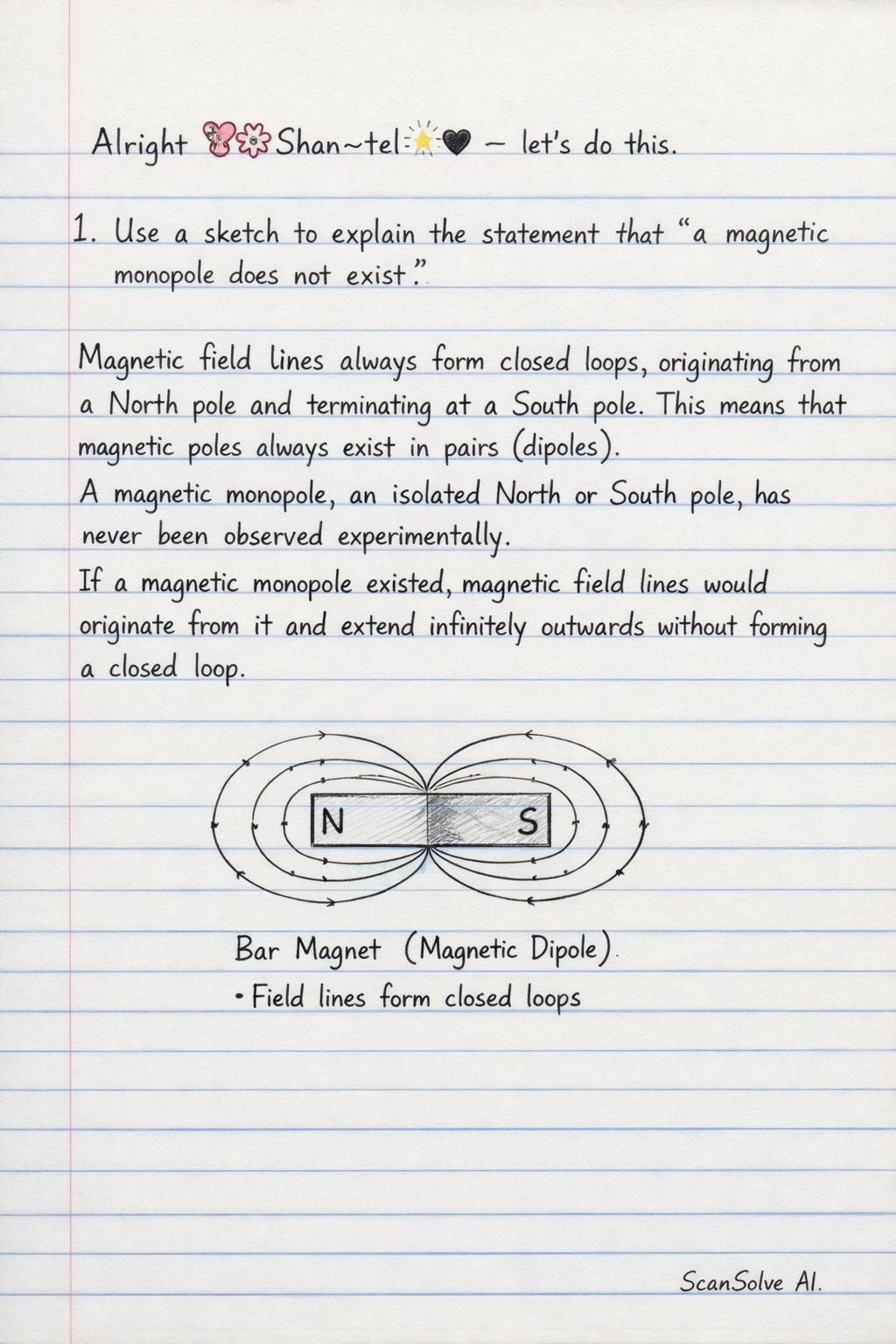
7 steps1. Use a sketch to explain the statement that "a magnetic monopole does not exist".
Magnetic field lines always form closed loops, originating from a North pole and terminating at a South pole. This means that magnetic poles always exist in pairs (dipoles). A magnetic monopole, an isolated North or South pole, has never been observed experimentally. If a magnetic monopole existed, magnetic field lines would originate from it and extend infinitely outwards without forming a closed loop.
(Imagine a bar magnet with field lines looping from N to S outside the magnet and S to N inside, forming continuous loops.)
(Imagine a single point labeled 'N' with field lines radiating outwards in all directions, never returning to a 'S' pole. This is what a monopole would look like, but it is not observed.)
6. How can electric energy be generated from;
Part i
Chemical energy
Part ii
Solar energy
- i. Chemical energy: Electric energy can be generated from chemical energy through electrochemical reactions in devices like batteries or fuel cells. Chemical reactions release electrons, creating a potential difference that drives an electric current.
- ii. Solar energy: Electric energy can be generated from solar energy using photovoltaic cells (solar cells). These cells convert sunlight directly into electricity through the photovoltaic effect, where photons from sunlight excite electrons in a semiconductor material, causing them to flow and generate a current.
9. A ray passing through a slab of thickness t at angle of incidence i. using a sketch derive the expression for the lateral displacement.
-
Sketch: Imagine a rectangular glass slab of thickness . Draw a normal line perpendicular to the top surface. Draw an incident ray striking the top surface at an angle with the normal. The ray refracts into the slab at an angle with the normal. Draw another normal line perpendicular to the bottom surface, parallel to the first normal. The ray travels through the slab and emerges from the bottom surface, parallel to the original incident ray, but laterally displaced. Draw the emergent ray. The perpendicular distance between the path of the incident ray (if it continued straight) and the emergent ray is the lateral displacement, .
Let's label the points:
A: Point of incidence on the top surface.
B: Point of refraction on the bottom surface.
C: Point on the extended incident ray such that BC is perpendicular to the extended incident ray.
D: Point on the normal at A, such that AD is perpendicular to the top surface. -
Derivation:
Apply Snell's Law at the first surface.
Let $n_1$ be the refractive index of air (approximately 1) and $n_2$ be the refractive index of the slab. $$ n_1 \sin i = n_2 \sin r $$ Since $n_1 \approx 1$, we have: $$ \sin i = n_2 \sin r $$From the geometry of the sketch, consider the right-angled triangle formed by the refracted ray inside the slab and the normal.
The distance along the normal inside the slab is $t$. The distance along the refracted ray from the point of incidence to the point of emergence is $AB$. In the right-angled triangle formed by the normal, the refracted ray, and the thickness $t$: $$ \cos r = \frac{t}{AB} \implies AB = \frac{t}{\cos r} $$Consider the triangle formed by the incident ray, the emergent ray, and the lateral displacement .
The angle between the incident ray and the normal is $i$. The angle between the refracted ray and the normal is $r$. The angle between the extended incident ray and the refracted ray inside the slab is $(i-r)$. In the right-angled triangle ABC, where $d = BC$: $$ \sin(i-r) = \frac{BC}{AB} = \frac{d}{AB} $$ Therefore, the lateral displacement $d$ is: $$ d = AB \sin(i-r) $$Substitute the expression for from Step 2 into the equation for .
$$ d = \left(\frac{t}{\cos r}\right) \sin(i-r) $$ The expression for the lateral displacement is: $$ \boxed{d = \frac{t \sin(i-r)}{\cos r}} $$10. If a radioactive source has a half-life of 1 minute. At time t=0, it is placed near a detector and the counting rate is observed to be 2000 counts/second. (a) Define the underline term (b) find the decay constant and the mean life of the source.
-
a) Define the underlined term: The underlined term is "counting rate". Counting rate refers to the number of radioactive decay events detected by a radiation detector per unit of time. It is a measure of the activity of a radioactive source.
-
b) Find the decay constant and the mean life of the source.
-
Convert the half-life to seconds.
Given half-life, $T_{1/2} = 1 \text{ minute} = 60 \text{ seconds}$.Calculate the decay constant ().
The relationship between half-life and decay constant is: $$ \lambda = \frac{\ln 2}{T_{1/2}} $$ $$ \lambda = \frac{0.693}{60 \text{ s}} $$ $$ \lambda = 0.01155 \text{ s}^{-1} $$ The decay constant is $\boxed{0.0116 \text{ s}^{-1}}$.Calculate the mean life ().
The mean life is the reciprocal of the decay constant:
$$
\tau = \frac{1}{\lambda}
$$
$$
\tau = \frac{1}{0.01155 \text{ s}^{-1}}
$$
$$
\tau = 86.58 \text{ s}
$$
The mean life is $\boxed{86.6 \text{ s}}$.
Try one yourself
A new problem that tests the same skill.
Still stuck on this one?
Ask a follow-up, and the answer starts from this question.
More Physics Questions
Handwritten Step-by-Step Solution
Get this as a handwritten image on WhatsApp — like a tutor wrote it for you.
Try on WhatsApp