
We read your photo as:
Show that the equation pi a v = (4)/(3) pi a3 ( - ') g is dimensionally homogeneous.
ScanSolve AI Answer
Step-by-step solution
4 stepsi. An equation is considered homogeneous if the dimensions of all terms on both sides of the equation are identical. This means that if you express each physical quantity in terms of its fundamental dimensions (mass , length , and time ), the resulting dimensional formula must be the same for every term in the equation.
ii. To show that the equation is homogeneous, we need to determine the dimensions of each term on both sides.
Identify the dimensions of each variable.
- (coefficient of viscosity): (given as )
- (radius):
- (speed):
- (density):
- (density):
- (acceleration due to gravity):
- and are dimensionless constants.
Calculate the dimension of the Left Hand Side (LHS).
The LHS is .
Calculate the dimension of the Right Hand Side (RHS).
The RHS is .
First, for terms to be subtracted, they must have the same dimensions. Since and are both densities, their dimensions are the same:Now, substitute all dimensions into the RHS expression:
Compare the dimensions of the LHS and RHS.
We found that:
Since the dimensions of both sides of the equation are identical, the equation is dimensionally homogeneous.
The equation is indeed homogeneous.
Still stuck on this one?
Ask a follow-up, and the answer starts from this question.
More Physics Questions
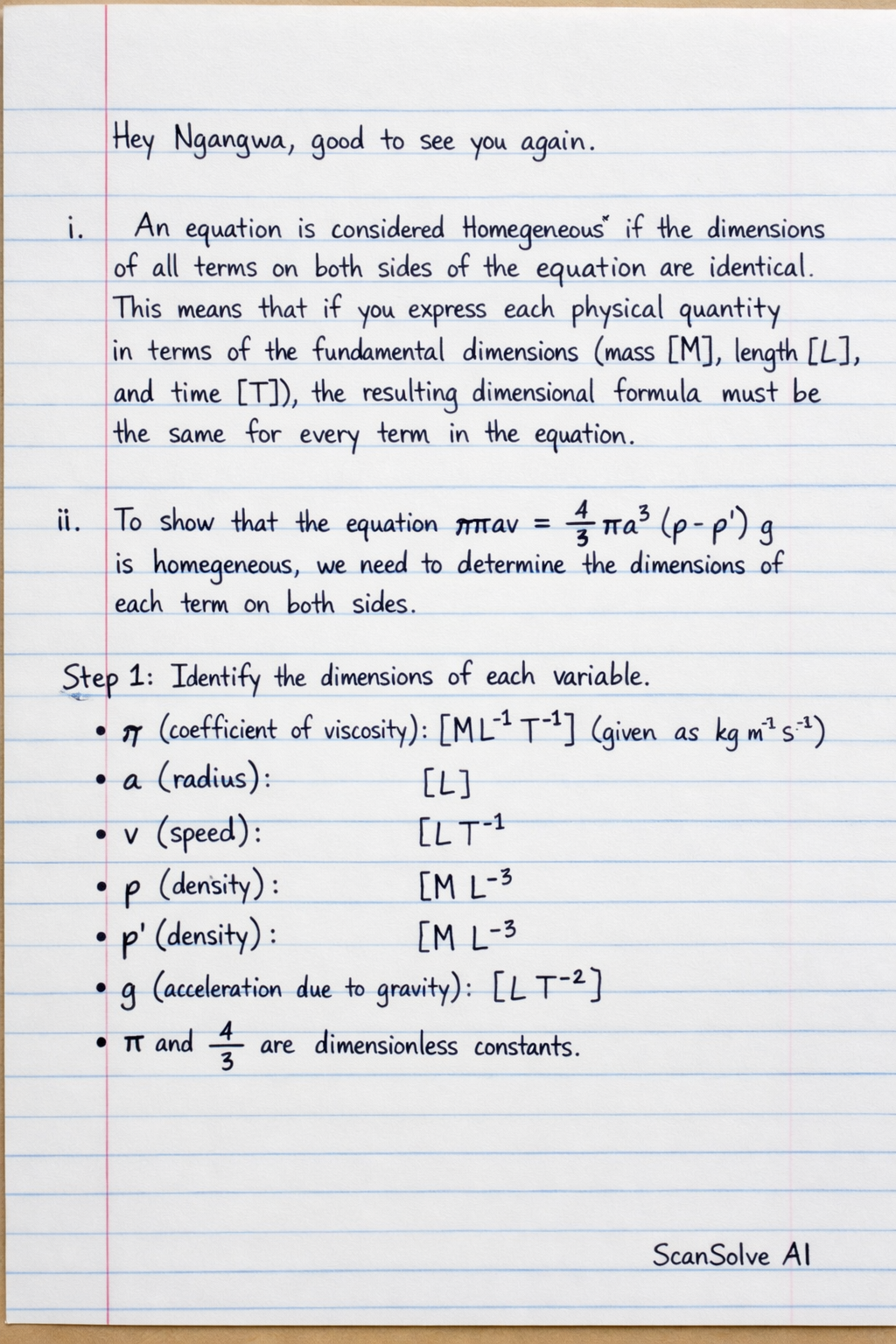
Handwritten Step-by-Step Solution
Get this as a handwritten image on WhatsApp — like a tutor wrote it for you.
Try on WhatsApp