Show that the vectors a = 1/7(2i + 3j + 6k), b = 1/7(3i - 6j + 2k), and c = 1/7(6i + 2j - 3k) are mutually perpendicular unit vectors.
|Physics
Show that the vectors a = 1/7(2i + 3j + 6k), b = 1/7(3i - 6j + 2k), and c = 1/7(6i + 2j - 3k) are mutually perpendicular unit vectors.
ScanSolve AI Answer
Answer
Each vector has a magnitude of 1, and the dot product of any two distinct vectors is 0, proving they are unit vectors and mutually perpendicular.
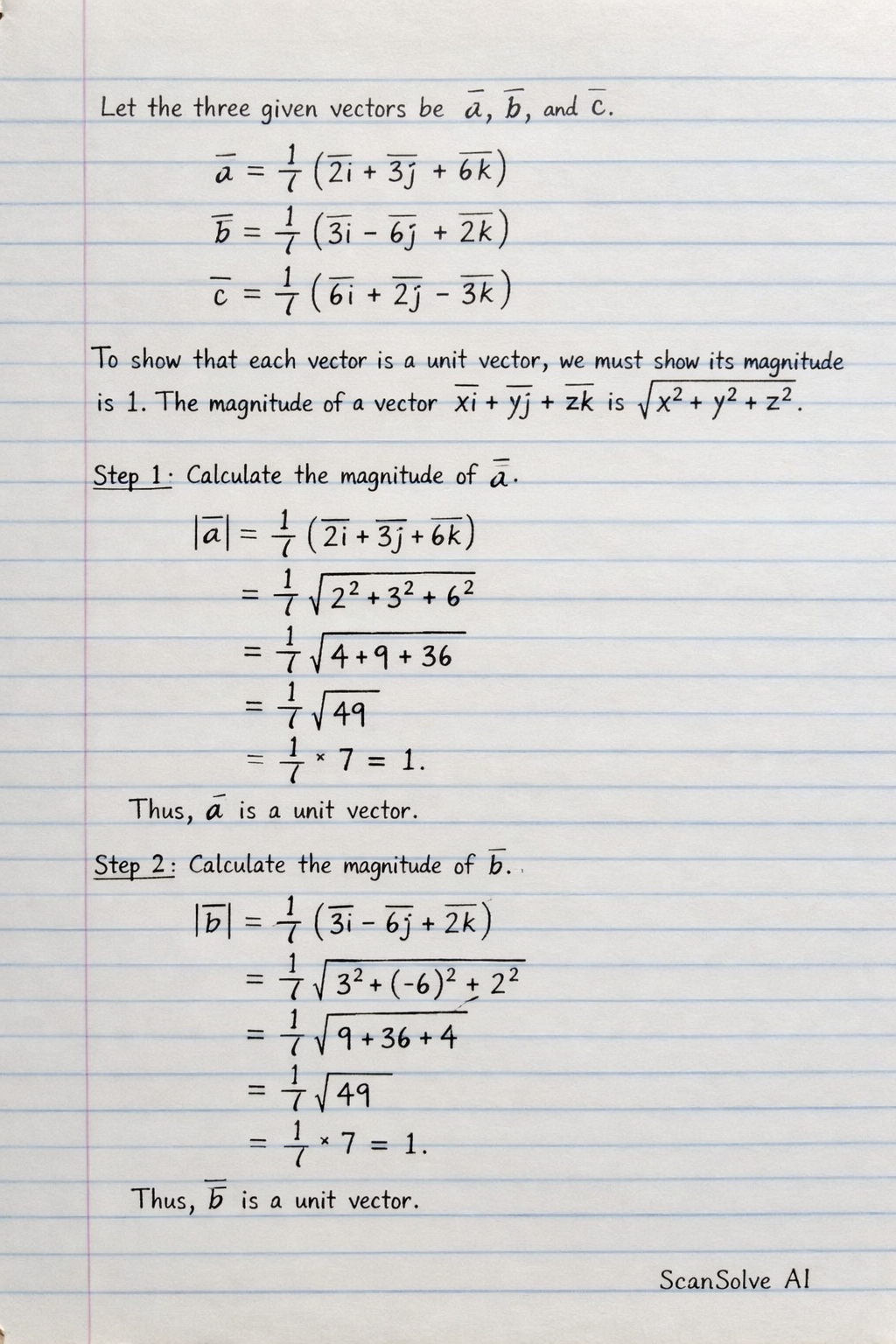
Let the three given vectors be a, b, and c.
a=71(2i^+3j^+6k^)b=71(3i^−6j^+2k^)c=71(6i^+2j^−3k^)
To show that each vector is a unit vector, we must show its magnitude is 1. The magnitude of a vector xi^+yj^+zk^ is x2+y2+z2.
Step 1: Calculate the magnitude of a.
∣a∣=71(2i^+3j^+6k^)=7122+32+62∣a∣=714+9+36=7149=71×7=1
Thus, a is a unit vector.
Step 2: Calculate the magnitude of b.
∣b∣=71(3i^−6j^+2k^)=7132+(−6)2+22∣b∣=719+36+4=7149=71×7=1
Thus, b is a unit vector.
Step 3: Calculate the magnitude of c.
∣c∣=71(6i^+2j^−3k^)=7162+22+(−3)2∣c∣=7136+4+9=7149=71×7=1
Thus, c is a unit vector.
All three vectors are unit vectors.
To show that they are mutually perpendicular, we must show that the dot product of any two distinct vectors is 0. The dot product of u=uxi^+uyj^+uzk^ and v=vxi^+vyj^+vzk^ is u⋅v=uxvx+uyvy+uzvz.
Step 4: Calculate the dot product of a and b.
a⋅b=(71(2i^+3j^+6k^))⋅(71(3i^−6j^+2k^))a⋅b=491((2)(3)+(3)(−6)+(6)(2))a⋅b=491(6−18+12)=491(0)=0
Thus, a and b are perpendicular.
Step 5: Calculate the dot product of b and c.
b⋅c=(71(3i^−6j^+2k^))⋅(71(6i^+2j^−3k^))b⋅c=491((3)(6)+(−6)(2)+(2)(−3))b⋅c=491(18−12−6)=491(0)=0
Thus, b and c are perpendicular.
Step 6: Calculate the dot product of a and c.
a⋅c=(71(2i^+3j^+6k^))⋅(71(6i^+2j^−3k^))a⋅c=491((2)(6)+(3)(2)+(6)(−3))a⋅c=491(12+6−18)=491(0)=0
Thus, a and c are perpendicular.
Since the dot product of every pair of distinct vectors is 0, the three vectors are mutually perpendicular to each other.
The final answer is Eachvectorhasamagnitudeof1,andthedotproductofanytwodistinctvectorsis0,provingtheyareunitvectorsandmutuallyperpendicular.
Send me the next one 📸
Was this helpful?
Need help with your own homework?
Get instant step-by-step solutions to any question. Free to start.
Let the three given vectors be a, b, and c. a = (1)/(7)(2i + 3j + 6k) b = (1)/(7)(3i - 6j + 2k) c = (1)/(7)(6i + 2j - 3k) To show that each vector is a unit vector, we must show its magnitude is 1.
Show that the vectors a = 1/7(2i + 3j + 6k), b = 1/7(3i - 6j + 2k), and c = 1/7(6i + 2j - 3k) are mutually perpendicular unit vectors.
This physics problem tests your understanding of fundamental physical laws and their applications. The step-by-step solution below breaks down the problem using relevant equations and physical reasoning.
ScanSolve AI Answer
Let the three given vectors be a, b, and c. a = (1)/(7)(2i + 3j + 6k) b = (1)/(7)(3i - 6j + 2k) c = (1)/(7)(6i + 2j - 3k) To show that each vector is a unit vector, we must show its magnitude is 1. The magnitude of a vector xi + yj + zk is sqrt(x^2 + y^2 + z^2). Step 1: Calculate the magnitude of a. |a| = | (1)/(7)(2i + 3j + 6k) | = (1)/(7) sqrt(2^2 + 3^2 + 6^2) |a| = (1)/(7) sqrt(4 + 9 + 36) = (1)/(7) sqrt(49) = (1)/(7) × 7 = 1 Thus, a is a unit vector. Step 2: Calculate the magnitude of b. |b| = | (1)/(7)(3i - 6j + 2k) | = (1)/(7) sqrt(3^2 + (-6)^2 + 2^2) |b| = (1)/(7) sqrt(9 + 36 + 4) = (1)/(7) sqrt(49) = (1)/(7) × 7 = 1 Thus, b is a unit vector. Step 3: Calculate the magnitude of c. |c| = | (1)/(7)(6i + 2j - 3k) | = (1)/(7) sqrt(6^2 + 2^2 + (-3)^2) |c| = (1)/(7) sqrt(36 + 4 + 9) = (1)/(7) sqrt(49) = (1)/(7) × 7 = 1 Thus, c is a unit vector. All three vectors are unit vectors. To show that they are mutually perpendicular, we must show that the dot product of any two distinct vectors is 0. The dot product of u = u_xi + u_yj + u_zk and v = v_xi + v_yj + v_zk is u · v = u_x v_x + u_y v_y + u_z v_z. Step 4: Calculate the dot product of a and b. a · b = ( (1)/(7)(2i + 3j + 6k) ) · ( (1)/(7)(3i - 6j + 2k) ) a · b = (1)/(49) ((2)(3) + (3)(-6) + (6)(2)) a · b = (1)/(49) (6 - 18 + 12) = (1)/(49) (0) = 0 Thus, a and b are perpendicular. Step 5: Calculate the dot product of b and c. b · c = ( (1)/(7)(3i - 6j + 2k) ) · ( (1)/(7)(6i + 2j - 3k) ) b · c = (1)/(49) ((3)(6) + (-6)(2) + (2)(-3)) b · c = (1)/(49) (18 - 12 - 6) = (1)/(49) (0) = 0 Thus, b and c are perpendicular. Step 6: Calculate the dot product of a and c. a · c = ( (1)/(7)(2i + 3j + 6k) ) · ( (1)/(7)(6i + 2j - 3k) ) a · c = (1)/(49) ((2)(6) + (3)(2) + (6)(-3)) a · c = (1)/(49) (12 + 6 - 18) = (1)/(49) (0) = 0 Thus, a and c are perpendicular. Since the dot product of every pair of distinct vectors is 0, the three vectors are mutually perpendicular to each other. The final answer is Each vector has a magnitude of 1, and the dot product of any two distinct vectors is 0, proving they are unit vectors and mutually perpendicular. Send me the next one 📸