
We read your photo as:
What are the basic principles of buoyancy and how do they apply to everyday examples like balloons and fish?
ScanSolve AI Answer
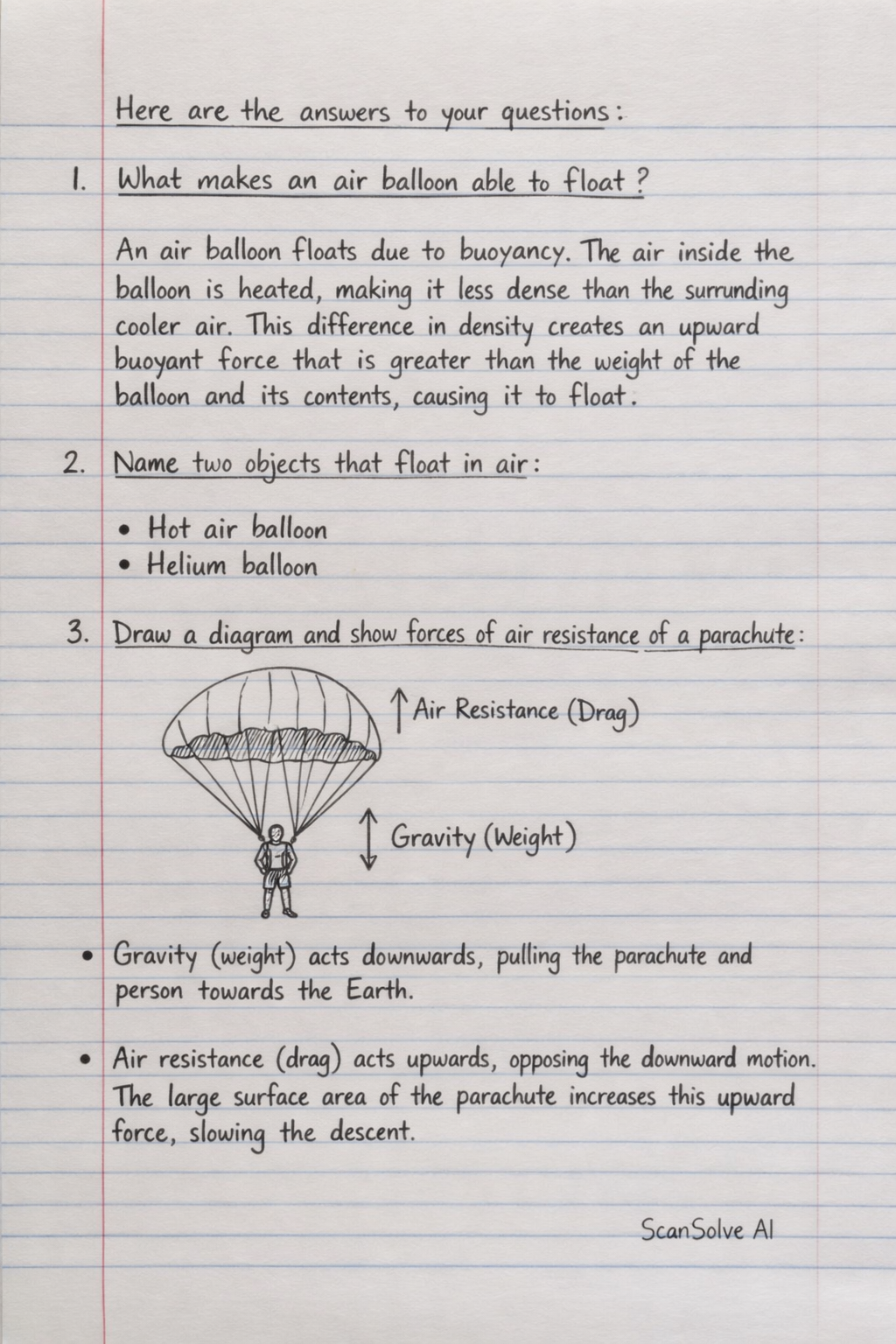
Here are the answers to your questions:
-
What makes an air balloon able to float? An air balloon floats due to buoyancy. The air inside the balloon is heated, making it less dense than the surrounding cooler air. This difference in density creates an upward buoyant force that is greater than the weight of the balloon and its contents, causing it to float.
-
Name two objects that float in air.
- Hot air balloon
- Helium balloon
-
Draw a diagram and show forces of air resistance of a parachute. I cannot draw diagrams, but I can describe the forces acting on a parachute:
- Gravity (weight) acts downwards, pulling the parachute and person towards the Earth.
- Air resistance (drag) acts upwards, opposing the downward motion. The large surface area of the parachute increases this upward force, slowing the descent.
-
Write the difference between upthrust force and gravity.
- Upthrust force (or buoyant force) is an upward force exerted by a fluid (liquid or gas) that opposes the weight of an immersed object. It is caused by the pressure difference within the fluid.
- Gravity is a downward force of attraction between any two objects with mass. On Earth, it pulls objects towards the center of the Earth.
-
Write two reasons that makes it possible for a fish to swim.
- Fins: Fish use their fins for propulsion (e.g., caudal fin), steering (e.g., pectoral fins), and stability.
- Swim bladder: Many fish have a swim bladder, a gas-filled organ that allows them to control their buoyancy and maintain a specific depth in the water without expending much energy.
-
Name the unit to measure force. The SI unit to measure force is the Newton ().
-
Write four examples. Assuming you are asking for examples of forces:
- Gravitational force
- Frictional force
- Normal force
- Tension force
-
Draw table and color the instrument used to measure force. I cannot draw or color. The instrument used to measure force is a spring balance (also known as a newton meter). It consists of a spring that stretches when a force is applied, and a scale that indicates the magnitude of the force in Newtons.
Still stuck on this one?
Ask a follow-up, and the answer starts from this question.
More Physics Questions
Handwritten Step-by-Step Solution
Get this as a handwritten image on WhatsApp — like a tutor wrote it for you.
Try on WhatsApp