
We read your photo as:
Q5A. Define the following i. Hydrostatics ii. Total pressure iii. Centre pressure iv. Meta-centre v. Meta-centre height B. Define flotation and state the principle of flotation. C. Calculate the buoyant force acting on an object with a displaced volume of 2.5m³ in sea water (density =1025Kg/m³).
ScanSolve AI Answer
Answer
Step-by-step solution
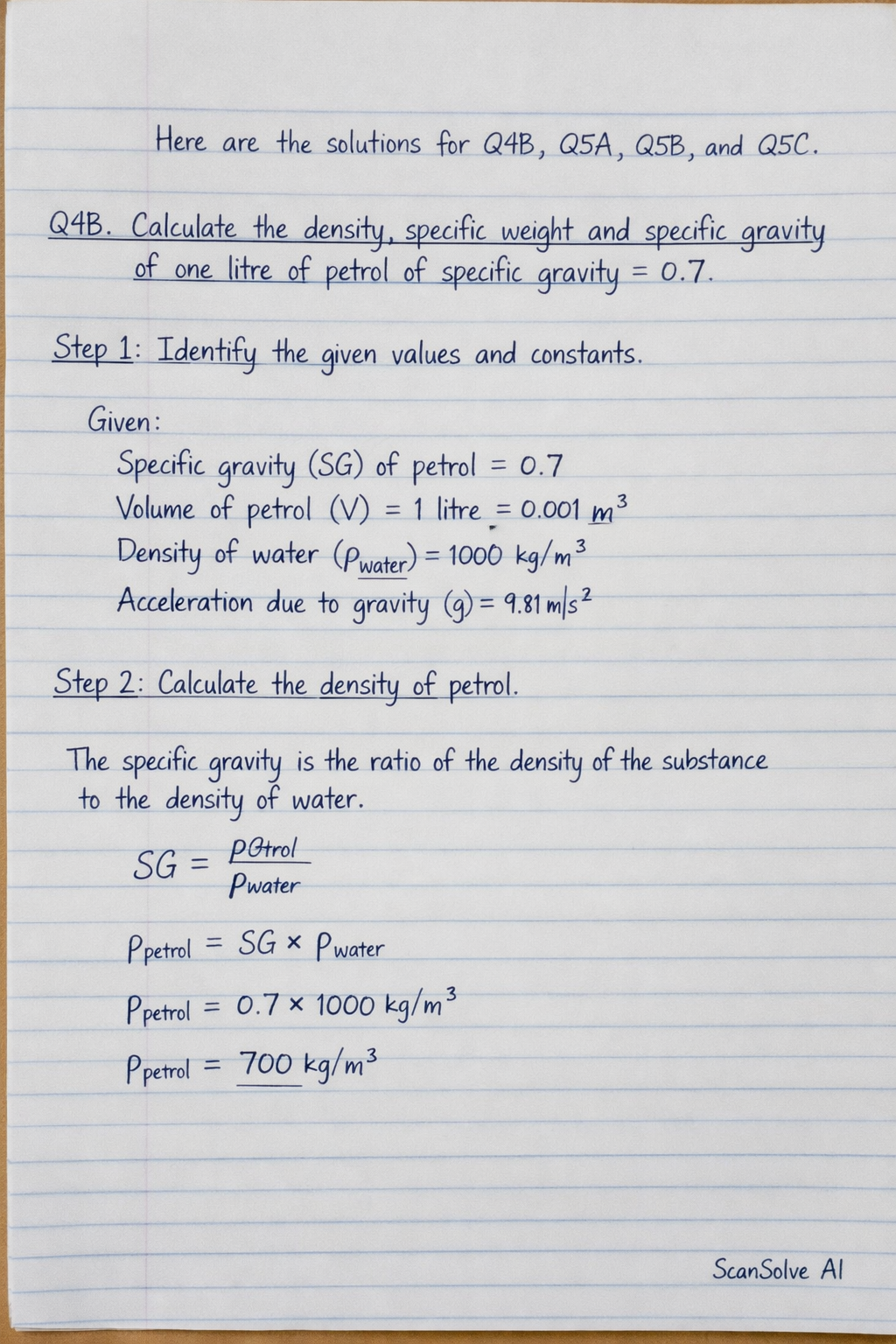
3 stepsHere are the solutions for Q4B, Q5A, Q5B, and Q5C.
Q4B. Calculate the density, specific weight and specific gravity of one litre of petrol of specific gravity = 0.7
Step 1: Identify the given values and constants.
Given:
Specific gravity () of petrol = 0.7
Volume of petrol () = 1 litre =
Density of water () =
Acceleration due to gravity () =
Step 2: Calculate the density of petrol.
The specific gravity is the ratio of the density of the substance to the density of water.
Step 3: Calculate the specific weight of petrol.
Specific weight () is the product of density and acceleration due to gravity.
Step 4: State the specific gravity.
The specific gravity is given in the problem.
The density of petrol is .
The specific weight of petrol is .
The specific gravity of petrol is .
Q5A. Define the following:
Part i
Hydrostatics
Hydrostatics is the branch of fluid mechanics that deals with the study of fluids at rest. It focuses on the pressure exerted by fluids and the forces acting on submerged or floating objects.
Part ii
Total pressure
Total pressure refers to the total force exerted by a static fluid on a submerged or partially submerged surface. It is calculated by integrating the pressure distribution over the entire area of the surface.
Part iii
Centre pressure
The centre of pressure is the point on a submerged surface where the resultant (total) hydrostatic force acts. If a single force were to replace the distributed pressure, it would act at this point.
Part iv
Meta-centre
The metacentre is a theoretical point used in the stability analysis of floating bodies. It is the point of intersection of the vertical line passing through the center of buoyancy (when the body is tilted by a small angle) and the original vertical line passing through the center of buoyancy (when the body is in its upright position).
Part v
Meta-centre height
Metacentric height () is the vertical distance between the metacentre (M) and the center of gravity (G) of a floating body. It is a crucial indicator of a vessel's initial stability; a positive metacentric height indicates stable equilibrium.
Q5B. Define flotation and state the principle of flotation.
Flotation is the phenomenon where an object remains suspended on the surface of a fluid, partially or wholly submerged, without sinking.
The Principle of Flotation states that for an object to float, the buoyant force acting on it must be equal to the weight of the object. This means that a floating object displaces a weight of fluid equal to its own weight.
Q5C. Calculate the buoyant force acting on an object with a displaced volume of in sea water (density = ).
Identify the given values and constants.
Given:
Displaced volume () =
Density of sea water () =
Acceleration due to gravity () =State the formula for buoyant force.
According to Archimedes' Principle, the buoyant force () is given by:
Substitute the values and calculate the buoyant force.
The buoyant force on the object is .
Try one yourself
A new problem that tests the same skill.
Still stuck on this one?
Ask a follow-up, and the answer starts from this question.
More Physics Questions
Handwritten Step-by-Step Solution
Get this as a handwritten image on WhatsApp — like a tutor wrote it for you.
Try on WhatsApp