
We read your photo as:
What are the definitions and units of equilibrium, center of gravity, moment of force, and simple harmonic motion?
ScanSolve AI Answer
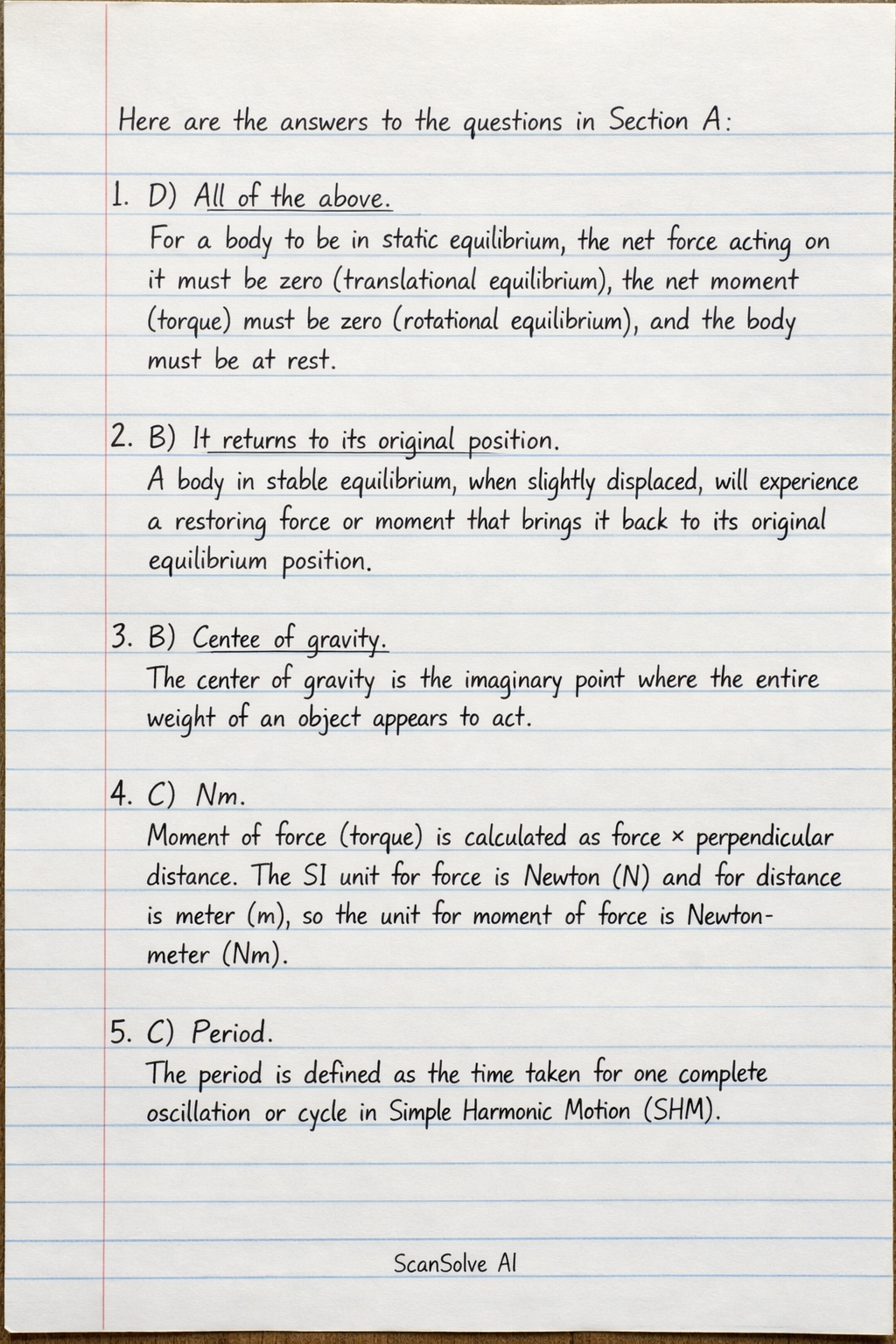
Here are the answers to the questions in Section A:
-
D) All of the above. For a body to be in static equilibrium, the net force acting on it must be zero (translational equilibrium), the net moment (torque) must be zero (rotational equilibrium), and the body must be at rest.
-
B) It returns to its original position. A body in stable equilibrium, when slightly displaced, will experience a restoring force or moment that brings it back to its original equilibrium position.
-
B) Center of gravity. The center of gravity is the imaginary point where the entire weight of an object appears to act.
-
C) Nm. Moment of force (torque) is calculated as force multiplied by perpendicular distance. The SI unit for force is Newton (N) and for distance is meter (m), so the unit for moment of force is Newton-meter (Nm).
-
C) Period. The period is defined as the time taken for one complete oscillation or cycle in Simple Harmonic Motion (SHM).
-
B) Hertz. The number of oscillations per second is the definition of frequency, and its SI unit is Hertz (Hz).
-
B) A simple pendulum. For small angles of displacement, the motion of a simple pendulum approximates Simple Harmonic Motion (SHM).
-
C) Length of the string. The period () of a simple pendulum (for small angles) is given by , where is the length of the string and is the acceleration due to gravity. It does not depend on the mass of the bob or the amplitude (for small angles).
-
C) Amplitude. In Simple Harmonic Motion (SHM), the amplitude is the maximum displacement or distance moved by a point on a vibrating body or wave measured from its equilibrium position.
-
B) A closed triangle. If a body is in equilibrium under the action of three concurrent forces, their vector sum must be zero. This means that if these three forces are represented as vectors, they can form the sides of a closed triangle, taken in order.
Still stuck on this one?
Ask a follow-up, and the answer starts from this question.
More Physics Questions
Handwritten Step-by-Step Solution
Get this as a handwritten image on WhatsApp — like a tutor wrote it for you.
Try on WhatsApp