
We read your photo as:
The density of a solid spherical ball varies directly as its mass & inversely as the cube of the radius. When the mass of the ball is 500g & the radius is 5cm, its density is 2g per cm3. Calculate radius of a solid spherical ball of mass 340g & density of 10g per cm3.
ScanSolve AI Answer
Answer
Step-by-step solution
3 stepsEstablish the relationship between density, mass, and radius.
The density of a solid spherical ball varies directly as its mass and inversely as the cube of its radius . This can be written as:
where is the constant of proportionality.
Calculate the constant of proportionality .
We are given the initial conditions: g, cm, and g/cm³. Substitute these values into the equation:
Divide by 4 to solve for :
Calculate the radius for the new conditions.
We need to find the radius when the mass g and the density g/cm³. Use the calculated value of :
Multiply both sides by and divide by 10 to solve for :
Take the cube root of both sides to find :
The radius of the solid spherical ball is approximately 2.57 cm.
Try one yourself
A new problem that tests the same skill.
Still stuck on this one?
Ask a follow-up, and the answer starts from this question.
More Physics Questions
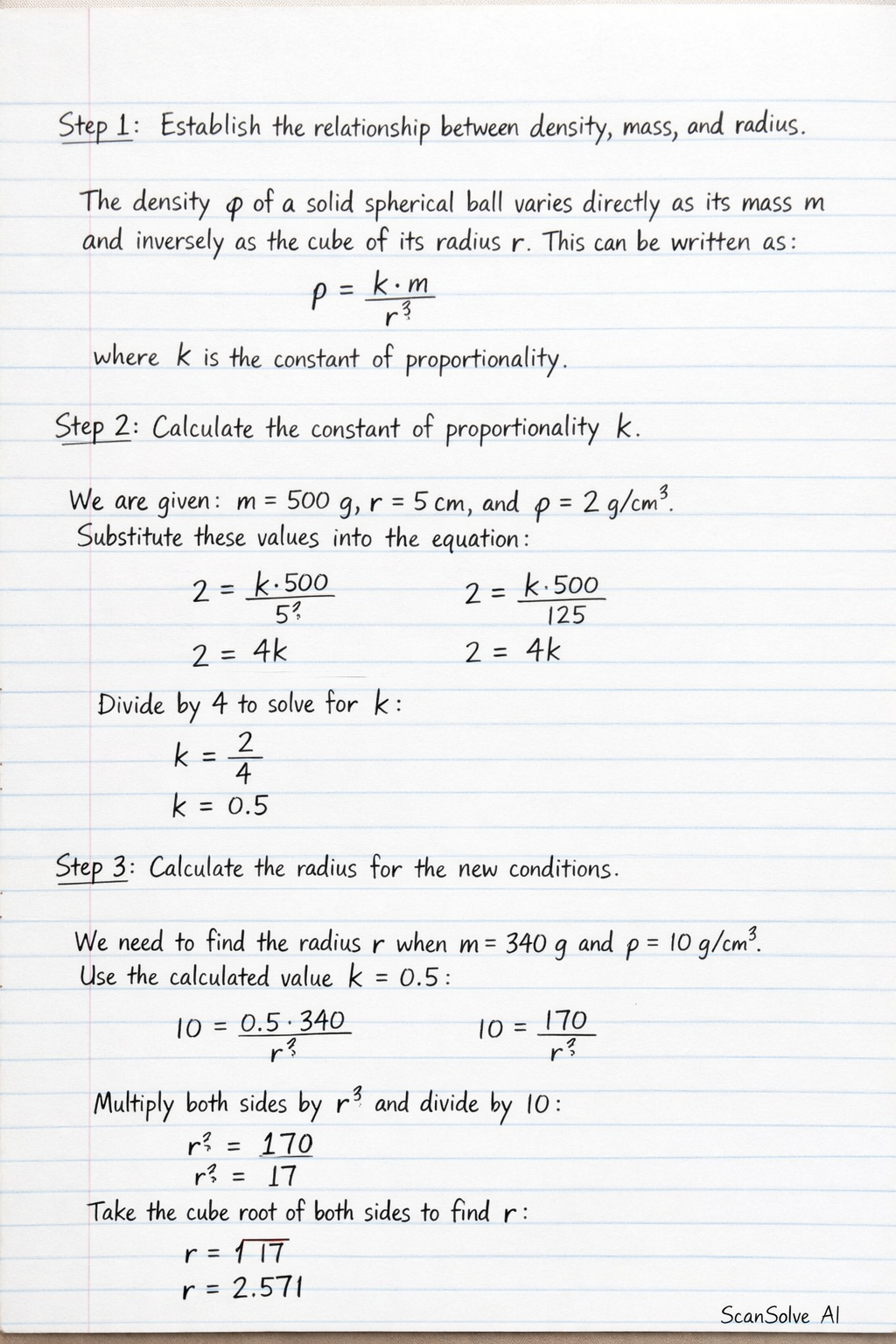
Handwritten Step-by-Step Solution
Get this as a handwritten image on WhatsApp — like a tutor wrote it for you.
Try on WhatsApp