
We read your photo as:
The diagram shows a glass container with water and cooking oil. Identify Q and R, suggest a separation method, and explain why Q is on top of R.
ScanSolve AI Answer
Step-by-step solution
5 stepshere are the solutions to your questions:
9. The diagram below shows a glass container into which water and cooking oil were poured. The two liquids settled as shown. Study and use it to answer the questions that follow.
- a) Which of the two liquids is represented by:
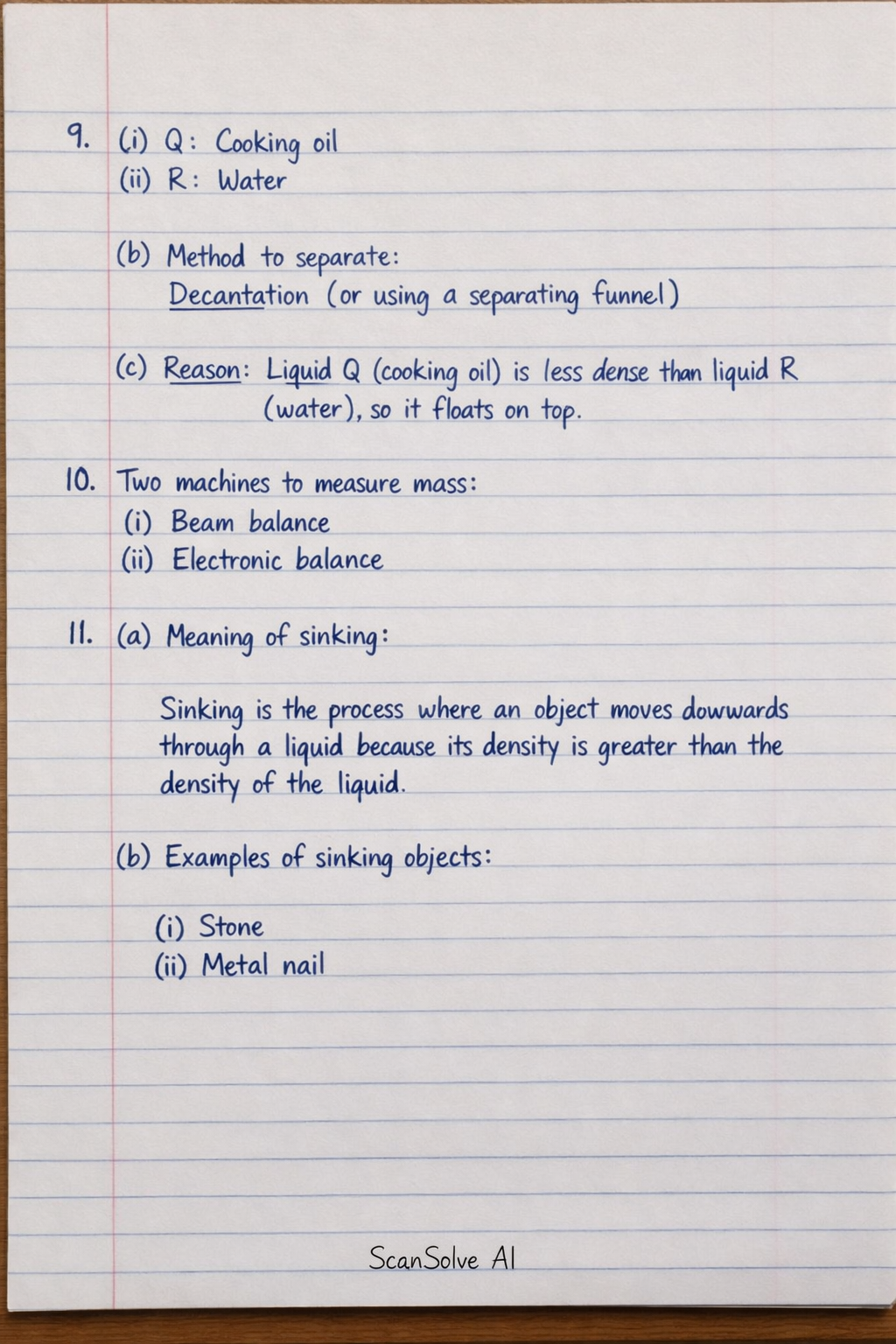
- (i) Q: Cooking oil
- (ii) R: Water
- b) State any one method that can be used to separate the two liquids.
- Decantation (or using a separating funnel).
- c) Why has liquid Q settled on top of liquid R?
- Liquid Q (cooking oil) is less dense than liquid R (water), causing it to float on top.
10. State any two machines that can be used to measure mass.
- (i) Beam balance
- (ii) Electronic balance
11. (a) What is the meaning of the term sinking?
-
Sinking is the process where an object moves downwards through a liquid because its density is greater than the density of the liquid.
-
b) Give any two examples of sinking objects.
- (i) Stone
- (ii) Metal nail
-
c) Why do some objects sink in water?
- Some objects sink in water because their density is greater than the density of water.
12. Moses wanted to find the volume of an irregular object. He had the following materials for the experiment; an irregular object, thread, overflow can and water.
- a) Name one material Moses forgot to include on the list of his materials.
- Measuring cylinder (or beaker).
- b) What is the use of the thread in the experiment?
- The thread is used to gently lower the irregular object into the water without splashing and to ensure it is fully submerged.
- c) Describe how Moses will get the volume of the irregular object in this experiment.
Fill the overflow can with water until it just begins to overflow from the spout.
Place a measuring cylinder at the spout of the overflow can to collect any displaced water.
Gently lower the irregular object, tied with the thread, into the water until it is completely submerged.
Collect all the water that overflows into the measuring cylinder.
The volume of the collected water in the measuring cylinder is equal to the volume of the irregular object.
Still stuck on this one?
Ask a follow-up, and the answer starts from this question.
More Physics Questions
Handwritten Step-by-Step Solution
Get this as a handwritten image on WhatsApp — like a tutor wrote it for you.
Try on WhatsApp