
We read your photo as:
The displacement of a particle moving in straight line is given as function of time as s = (t3/3 - 3t2/2 + 2t), s is in m and t is in s. The particle comes to momentary rest n times. Find the value of n.
Physics
ScanSolve AI Answer
Answer
Step-by-step solution
4 stepsB. 2
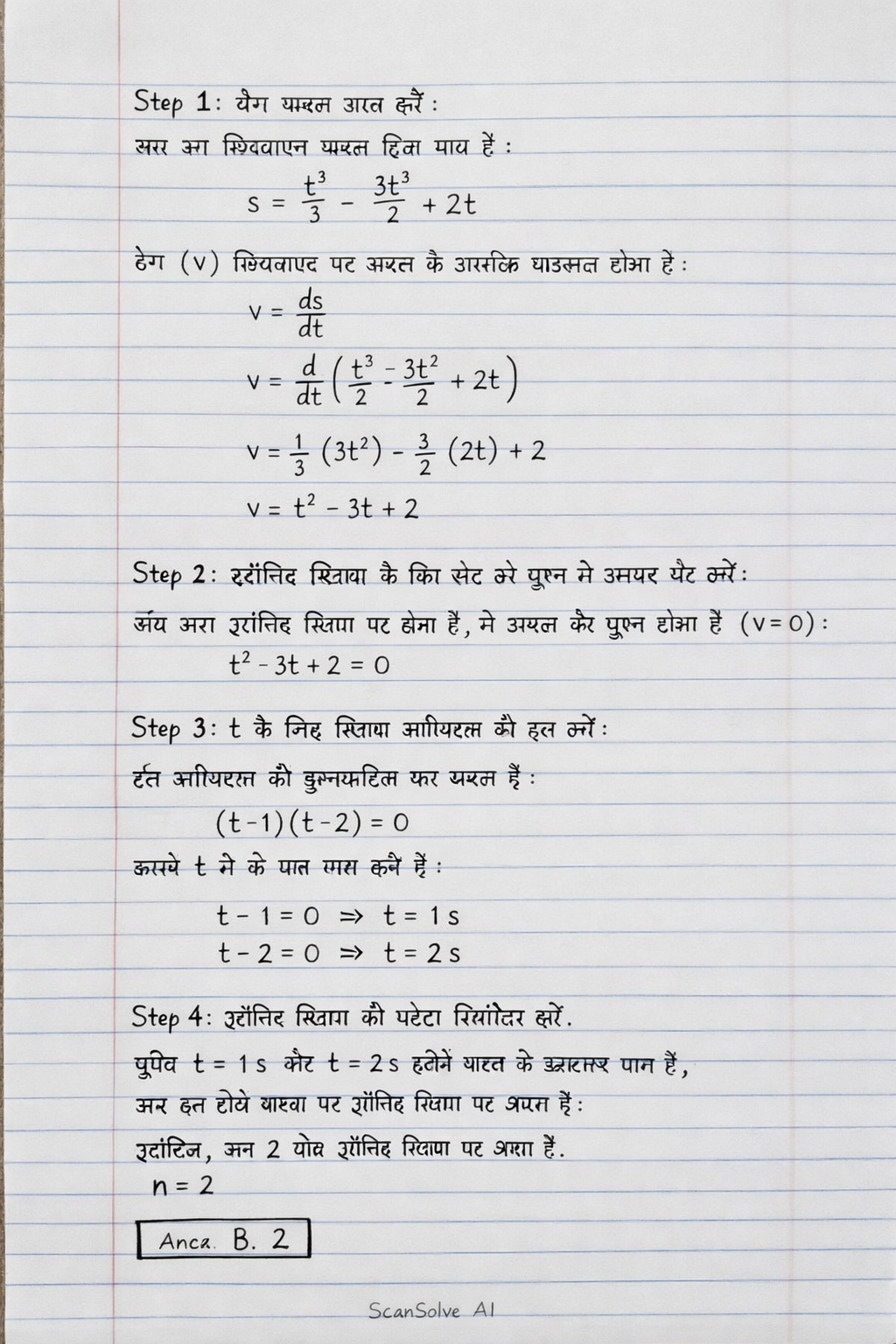
वेग फलन ज्ञात करें.
कण का विस्थापन फलन दिया गया है:
वेग () विस्थापन का समय के सापेक्ष अवकलज होता है:
क्षणिक विराम के लिए वेग को शून्य के बराबर सेट करें.
जब कण क्षणिक विराम पर होता है, तो उसका वेग शून्य होता है ():
के लिए द्विघात समीकरण को हल करें.
हम समीकरण को गुणनखंडित कर सकते हैं:
इससे के दो मान प्राप्त होते हैं:
क्षणिक विराम की संख्या निर्धारित करें.
चूंकि s और s दोनों समय के धनात्मक मान हैं, कण इन दोनों समय पर क्षणिक विराम पर आता है।
इसलिए, कण 2 बार क्षणिक विराम पर आता है।
The final answer is .
Was this helpful?
Try one yourself
A new problem that tests the same skill.
Still stuck on this one?
Ask a follow-up, and the answer starts from this question.
Got a different question?Ask your own question
More Physics Questions
QThe displacement s metres of a particle moving along a straight line after t seconds is given by…QThe displacement of a particle from a fixed source is given as x(t) = t³ − 2t² − 4t + 5 (m). How far…QA particle moves in a straight line. Its velocity, v m/s, at time t seconds is given by v = 3t²…QA particle p is moving on a straight line. The end O is the fixed point on the line. The…QThe distance covered by moving particle through point O is given by the equation, s=t3-15t2+63t−10…
Browse by topic:Mechanics
Handwritten Step-by-Step Solution
Get this as a handwritten image on WhatsApp — like a tutor wrote it for you.
Try on WhatsApp