
We read your photo as:
What is the experimental setup and procedure for measuring the speed of sound in trapped air using a tuning fork and a resonance column?
ScanSolve AI Answer
Answer
Step-by-step solution
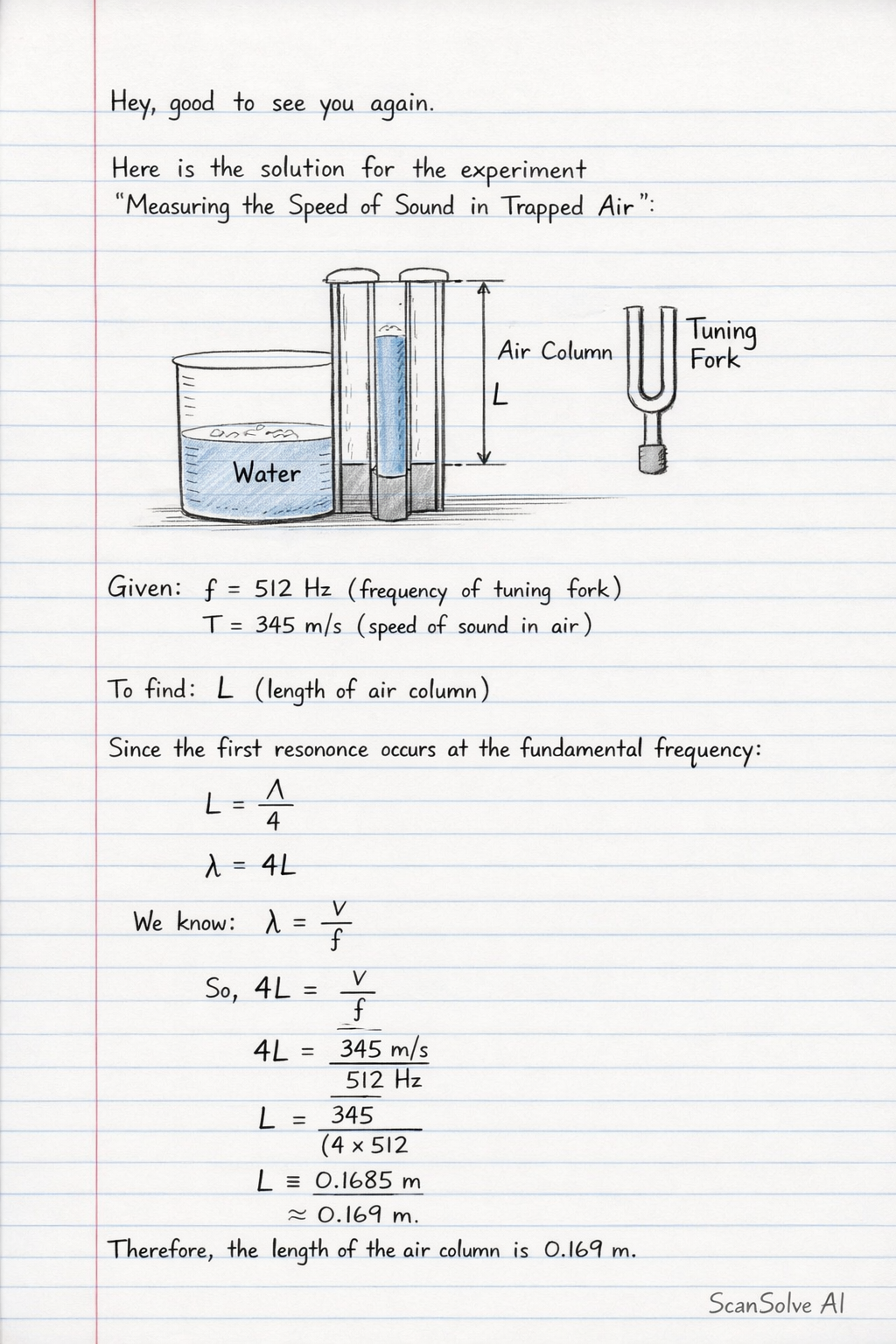
3 stepsHere is the solution for the experiment "Measuring the Speed of Sound in Trapped Air":
Diagram
\begin{tikzpicture}[scale=0.8]
    % Beaker
    \draw (0,0) -- (0,5) -- (4,5) -- (4,0) -- cycle;
    \draw[fill=blue!20] (0.1,0.5) rectangle (3.9,2.5); % Water level
    \node at (2,1.5) {Water};

    % Pipe
    \draw[thick] (1.5,2.5) -- (1.5,6.5);
    \draw[thick] (2.5,2.5) -- (2.5,6.5);
    \draw[thick] (1.5,6.5) arc (180:0:0.5); % Top arc
    \draw[thick] (1.5,2.5) arc (180:360:0.5); % Bottom arc (hidden)
    \node at (2,4.5) {Pipe};

    % Air column
    \draw[dashed] (2.5,2.5) -- (2.5,6.5); % Inner line for air column
    \draw[<->] (2.8,2.5) -- (2.8,6.5) node[right, midway] {$L$};
    \node at (2,5.5) {Air Column};

    % Tuning Fork
    \draw[thick] (5,6) -- (5,6.5);
    \draw[thick] (5,6.5) -- (5.5,6.5);
    \draw[thick] (5,6.5) -- (4.5,6.5);
    \draw[thick] (5,6) -- (5,5.5);
    \draw[thick] (5,5.5) arc (90:270:0.25);
    \node at (5,7) {Tuning Fork};

    % Sound waves
    \draw[decorate,decoration={snake,amplitude=.5mm,segment length=2mm}] (4.5,6.5) -- (2,6.5);
    \draw[decorate,decoration={snake,amplitude=.5mm,segment length=2mm}] (5.5,6.5) -- (2,6.5);
\end{tikzpicture}
Procedure
- Set up the apparatus by placing the plastic pipe vertically into a tall measuring cylinder partially filled with water.
- Measure the room temperature using a thermometer and the internal diameter of the pipe using a vernier caliper (or use the given value).
- Strike a tuning fork of known frequency (e.g., ) gently on a rubber pad and hold it horizontally just above the open end of the pipe.
- Adjust the water level in the pipe by slowly raising or lowering the pipe in the cylinder until a loud resonant sound is heard. This corresponds to the first resonance.
- Measure the length of the air column () from the top of the pipe to the water surface using a metre rule. Record this value.
- Continue to lower the water level until a second, louder resonance is heard.
- Measure the length of this air column () from the top of the pipe to the water surface. Record this value.
- Repeat steps 4-7 several times to obtain multiple readings for and , and calculate their average values.
Observations/Results
- Frequency of tuning fork,
- Internal diameter of the pipe,
- Room temperature,
| Reading | First Resonance Length () | Second Resonance Length () |
|---|---|---|
| 1 | ||
| 2 | ||
| 3 | ||
| Average |
Average
Average
Calculations
Calculate the wavelength () of the sound wave.
The difference between consecutive resonance lengths corresponds to half a wavelength:
Substitute the average values:
Calculate the speed of sound () using the formula .
Calculate the theoretical speed of sound at the measured temperature for comparison.
The speed of sound in air at temperature (in ) is approximately given by:
For :
Inference
The speed of sound in air at was determined to be approximately .
Conclusion
The experiment successfully determined the speed of sound in air at room temperature () to be . This value is in close agreement with the theoretical value of for sound in air at .
Precautions
- Ensure the tuning fork is struck gently on a rubber pad to produce a clear, pure tone and avoid damage.
- Hold the vibrating tuning fork horizontally and as close as possible to the open end of the pipe to maximize the transfer of sound energy.
- Ensure the pipe is held perfectly vertical to maintain a consistent and accurate length of the air column.
- Take multiple readings for the resonance lengths ( and ) and calculate their averages to minimize random errors.
- Accurately identify the point of maximum loudness for resonance, as this indicates the precise resonance length.
- Read the metre rule at eye level to avoid parallax errors when measuring the air column lengths.
- Record the room temperature accurately using a thermometer, as the speed of sound is temperature-dependent.
Try one yourself
A new problem that tests the same skill.
Still stuck on this one?
Ask a follow-up, and the answer starts from this question.
More Physics Questions
Handwritten Step-by-Step Solution
Get this as a handwritten image on WhatsApp — like a tutor wrote it for you.
Try on WhatsApp