
We read your photo as:
What are the factors limiting accuracy in a simple pendulum experiment, and what are the relationships between T, L, and g?
ScanSolve AI Answer
Here are the answers to the questions:
-
-
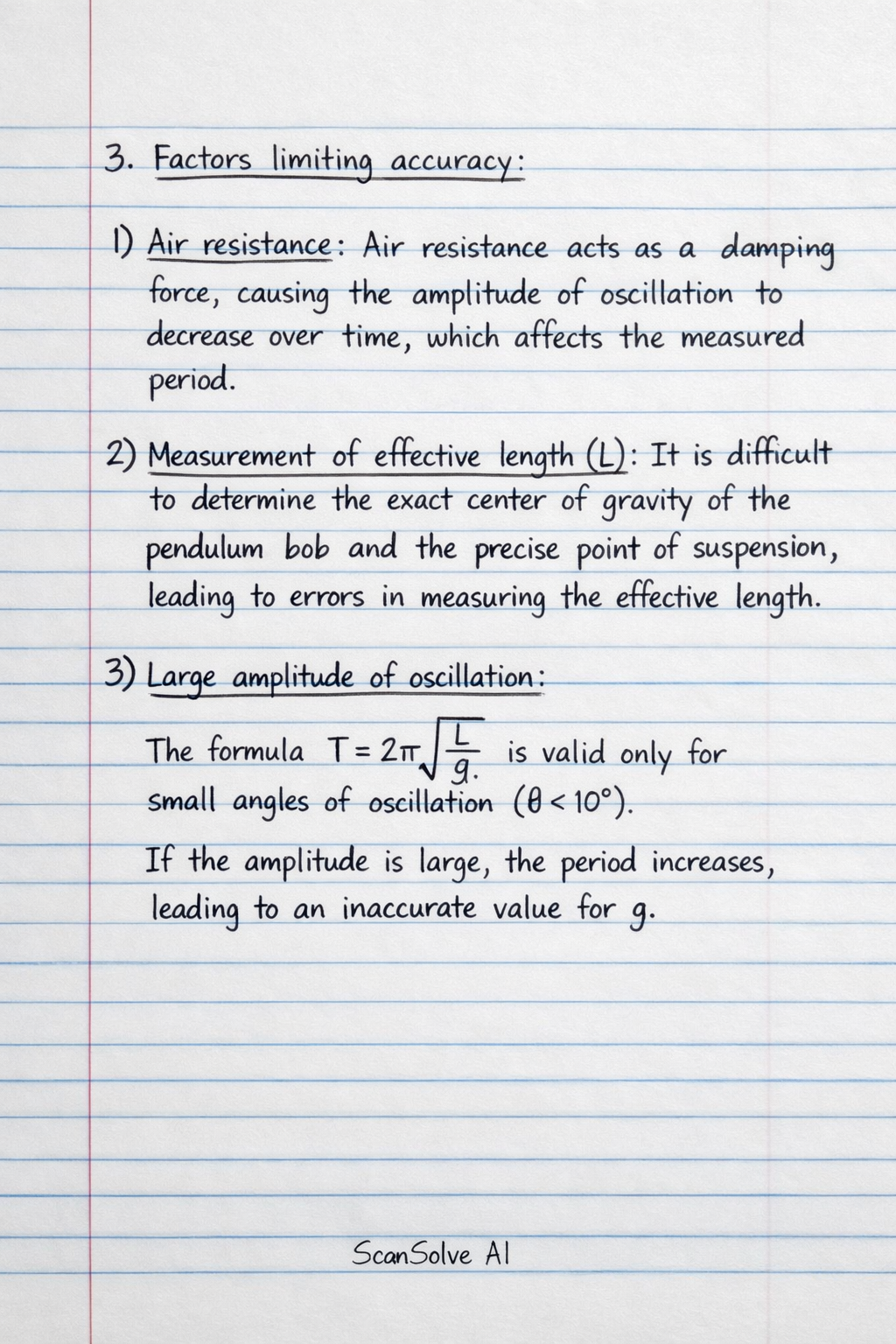
Factors limiting accuracy:
-
Air resistance: Air resistance acts as a damping force, causing the amplitude of oscillation to decrease over time, which can affect the measured period.
-
Measurement of effective length (L): It is difficult to precisely determine the exact center of gravity of the pendulum bob and the exact point of suspension, leading to errors in measuring the effective length.
-
Large amplitude of oscillation: The formula is valid only for small angles of oscillation (typically less than ). If the amplitude is large, the period increases, leading to an inaccurate value for .
-
Relationship between T, L, and g: The period of oscillation () of a simple pendulum is given by the formula:
- Relationship between T and L: The period is directly proportional to the square root of the length of the pendulum (). This means that as the length of the pendulum increases, its period of oscillation also increases.
- Relationship between T and g: The period is inversely proportional to the square root of the acceleration due to gravity (). This means that in a region with higher gravitational acceleration, the period of oscillation of the pendulum will be shorter.
-
-
Precautions in this experiment:
- Ensure the amplitude of oscillation is kept small (less than ) to maintain simple harmonic motion and the validity of the formula.
- Time a large number of oscillations (e.g., 20 or 50) and then divide the total time by the number of oscillations to obtain the average period. This minimizes the percentage error due to human reaction time when starting and stopping the stopwatch.
-
Conclusions: The experiment demonstrates that the period of a simple pendulum is directly proportional to the square root of its length and inversely proportional to the square root of the acceleration due to gravity. By plotting against , the acceleration due to gravity, , can be determined from the slope of the graph.
Still stuck on this one?
Ask a follow-up, and the answer starts from this question.
More Physics Questions
Handwritten Step-by-Step Solution
Get this as a handwritten image on WhatsApp — like a tutor wrote it for you.
Try on WhatsApp