
We read your photo as:
The first question is incomplete. Assuming it asks to calculate the Laspeyres Price Index and Paasche Price Index for the current year (2025) with the base year (2024).
ScanSolve AI Answer
Answer
Step-by-step solution
4 stepsThe first question is incomplete. Assuming it asks to calculate the Laspeyres Price Index and Paasche Price Index for the current year (2025) with the base year (2024).
Data from the table:
| Goods | Base year (2024) Price () | Base year (2024) Quantity () | Current year (2025) Price () | Current year (2025) Quantity () |
|---|---|---|---|---|
| A | 20 | 3 | 30 | 4 |
| B | 70 | 5 | 80 | 5 |
| C | 50 | 5 | 40 | 4 |
| D | 20 | 2 | 30 | 4 |
Calculate the products for each good.
- For Good A:
- For Good B:
- For Good C:
- For Good D:
- For Good A:
Calculate the sums.
Calculate the Laspeyres Price Index.
The formula for the Laspeyres Price Index is:
Substitute the values:
The Laspeyres Price Index is .
Calculate the Paasche Price Index.
The formula for the Paasche Price Index is:
Substitute the values:
The Paasche Price Index is .
Question: Nepal is rich in natural resource. Does it play vital role in the growth and economic development of the country?
Yes, natural resources play a vital role in the growth and economic development of a country like Nepal. They provide raw materials for industries, support key sectors such as agriculture, forestry, and tourism, and can be a source of export earnings. Effective management and sustainable utilization of these resources are crucial for long-term economic prosperity and improving living standards.
Try one yourself
A new problem that tests the same skill.
Still stuck on this one?
Ask a follow-up, and the answer starts from this question.
More Physics Questions
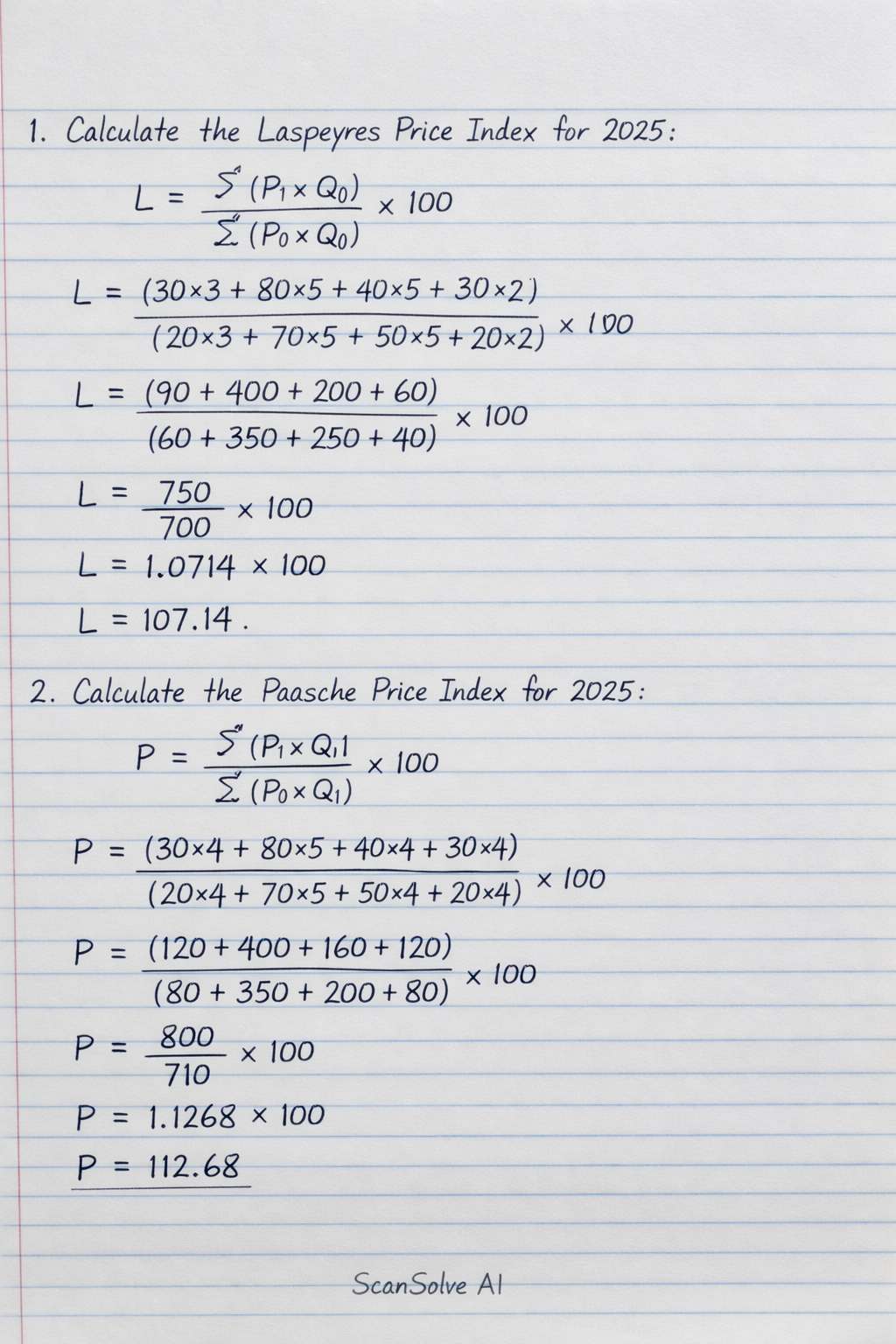
Handwritten Step-by-Step Solution
Get this as a handwritten image on WhatsApp — like a tutor wrote it for you.
Try on WhatsApp