
We read your photo as:
The potential difference (voltage) of one cell is 1,5 V. Determine the readings on V₁, V₂ and V₃ with reasons.
ScanSolve AI Answer
Step-by-step solution
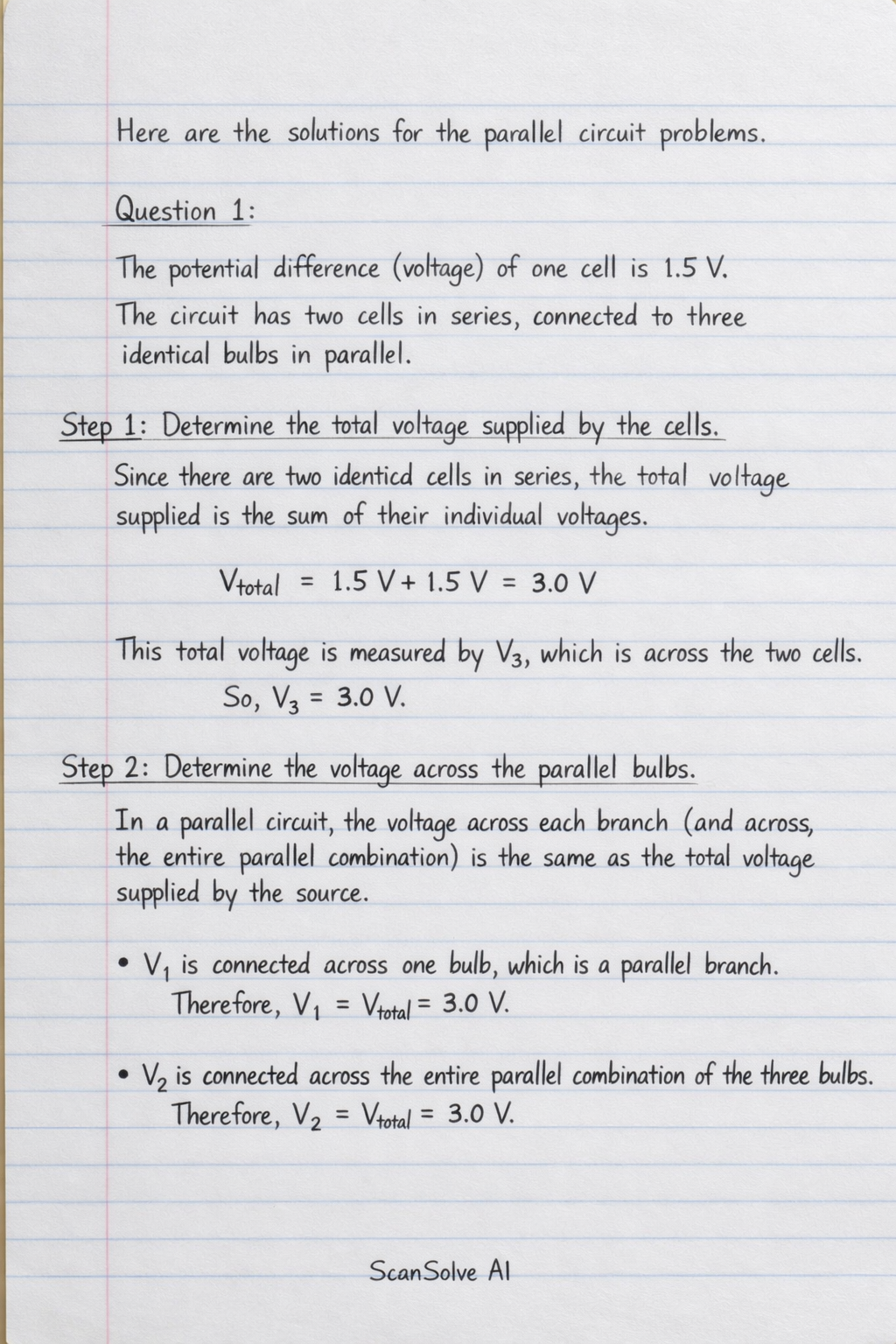
5 stepsHere are the solutions for the parallel circuit problems.
Part 1· 2 steps
The potential difference (voltage) of one cell is . The circuit has two cells in series, connected to three identical bulbs in parallel.
Determine the total voltage supplied by the cells.
Since there are two identical cells in series, the total voltage supplied is the sum of their individual voltages.
This total voltage is measured by , which is across the two cells. So, .
Determine the voltage across the parallel bulbs.
In a parallel circuit, the voltage across each branch (and across the entire parallel combination) is the same as the total voltage supplied by the source.
- is connected across one bulb, which is a parallel branch. Therefore, .
- is connected across the entire parallel combination of the three bulbs. Therefore, .
Here is the completed table for Question 1:
Part 2· 3 steps
In the circuit below, the resistors are identical. The reading on is .
Determine the current through .
Ammeter is in series with the two resistors in the lower branch. In a series circuit, the current is the same at all points. Since measures the current in this branch, will have the same reading as .
Determine the current through .
Let the resistance of one resistor be .
- The lower branch has two identical resistors in series, so its total resistance is .
- The upper branch has one resistor, so its resistance is .
- In a parallel circuit, the voltage across both branches is the same. Let this voltage be .
- For the lower branch: .
- For the upper branch: .
- Solving for : .
Determine the current through .
Ammeter measures the total current flowing from the battery. In a parallel circuit, the total current is the sum of the currents in the individual parallel branches.
Here is the completed table for Question 2:
Still stuck on this one?
Ask a follow-up, and the answer starts from this question.
More Physics Questions
Handwritten Step-by-Step Solution
Get this as a handwritten image on WhatsApp — like a tutor wrote it for you.
Try on WhatsApp