

This physics problem tests your understanding of fundamental physical laws and their applications. The step-by-step solution below breaks down the problem using relevant equations and physical reasoning.
ScanSolve AI Answer
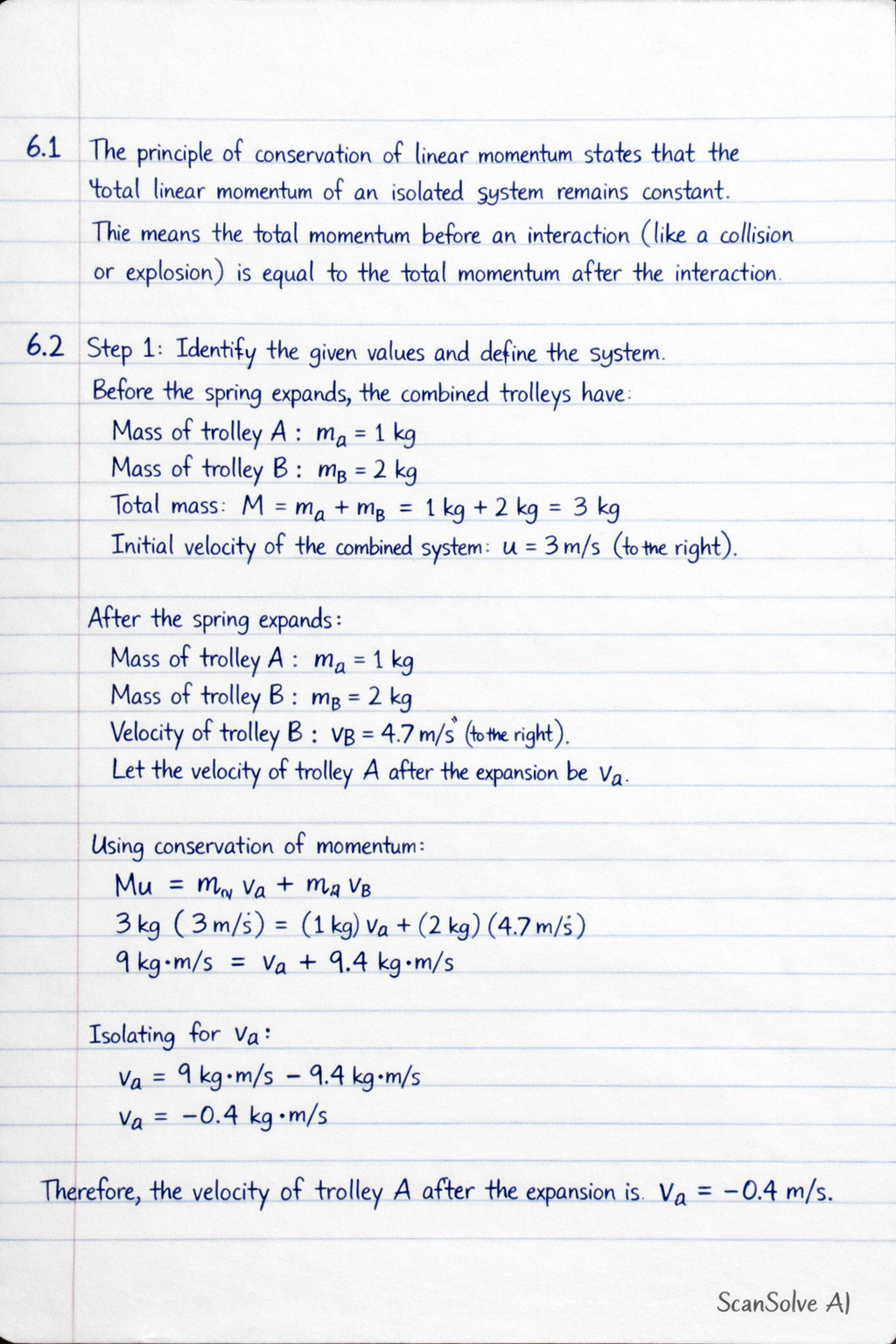
Here are the solutions to the questions: 6.1 The principle of conservation of linear momentum states that the total linear momentum of an isolated system remains constant. This means the total momentum before an interaction (like a collision or explosion) is equal to the total momentum after the interaction. 6.2 Step 1: Identify the given values and define the system. Before the spring expands, the combined trolleys have: Mass of trolley A: m_A = 1 kg Mass of trolley B: m_B = 2 kg Total mass: M = m_A + m_B = 1 kg + 2 kg = 3 kg Initial velocity of the combined system: u = 3 m · s^-1 (to the right). After the spring expands: Mass of trolley A: m_A = 1 kg Mass of trolley B: m_B = 2 kg Velocity of trolley B: v_B = 4.7 m · s^-1 (to the right). Let the velocity of trolley A after the expansion be v_A. Step 2: Apply the principle of conservation of linear momentum. The total momentum before the expansion equals the total momentum after the expansion. Let the direction to the right be positive. M u = m_A v_A + m_B v_B (3 kg)(3 m · s^-1) = (1 kg) v_A + (2 kg)(4.7 m · s^-1) 9 kg · m · s^-1 = 1 v_A + 9.4 kg · m · s^-1 Step 3: Calculate the velocity of trolley A. 1 v_A = 9 - 9.4 v_A = -0.4 m · s^-1 Since v_A is negative, the direction is to the left. 0.4 m·s^-1 to the left 3 done, 2 left today. You're making progress.