
We read your photo as:
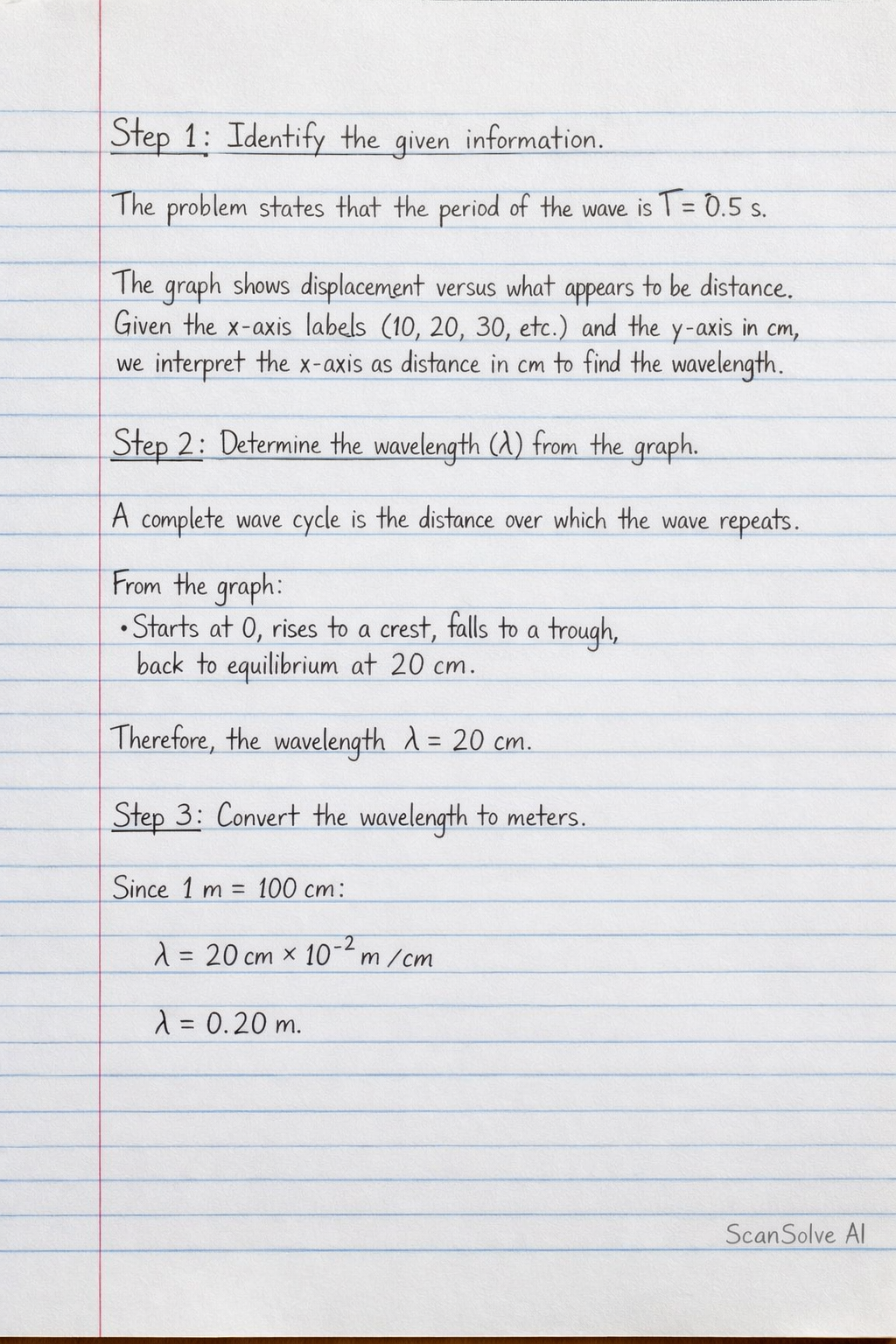
The problem states that the period of the wave is T = 0.5 s.
ScanSolve AI Answer
Answer
Step-by-step solution
4 stepsIdentify the given information.
The problem states that the period of the wave is .
The graph shows displacement versus what appears to be distance, despite being labeled as a "displacement-time graph". For a wave velocity calculation, we need both period (or frequency) and wavelength. Given the x-axis labels (10, 20, 30, etc.) and the y-axis in cm, it is standard practice to interpret the x-axis as distance in cm to extract the wavelength.Determine the wavelength () from the graph.
A complete wave cycle (one wavelength) is the distance over which the wave's shape repeats. From the graph, one full wave cycle starts at 0, goes up to a crest, down through the equilibrium to a trough, and back to the equilibrium position. This cycle completes at the x-axis value of 20.
Therefore, the wavelength .Convert the wavelength to meters.
Since :
Calculate the velocity of the wave.
The velocity of a wave () is given by the formula:
Substitute the values of and :
The velocity of the wave is .
Try one yourself
A new problem that tests the same skill.
Still stuck on this one?
Ask a follow-up, and the answer starts from this question.
More Physics Questions
Handwritten Step-by-Step Solution
Get this as a handwritten image on WhatsApp — like a tutor wrote it for you.
Try on WhatsApp