
We read your photo as:
What is the procedure to determine the density of a wire using a metre rule, micrometer screw gauge, and electronic balance?
Physics
ScanSolve AI Answer
Step-by-step solution
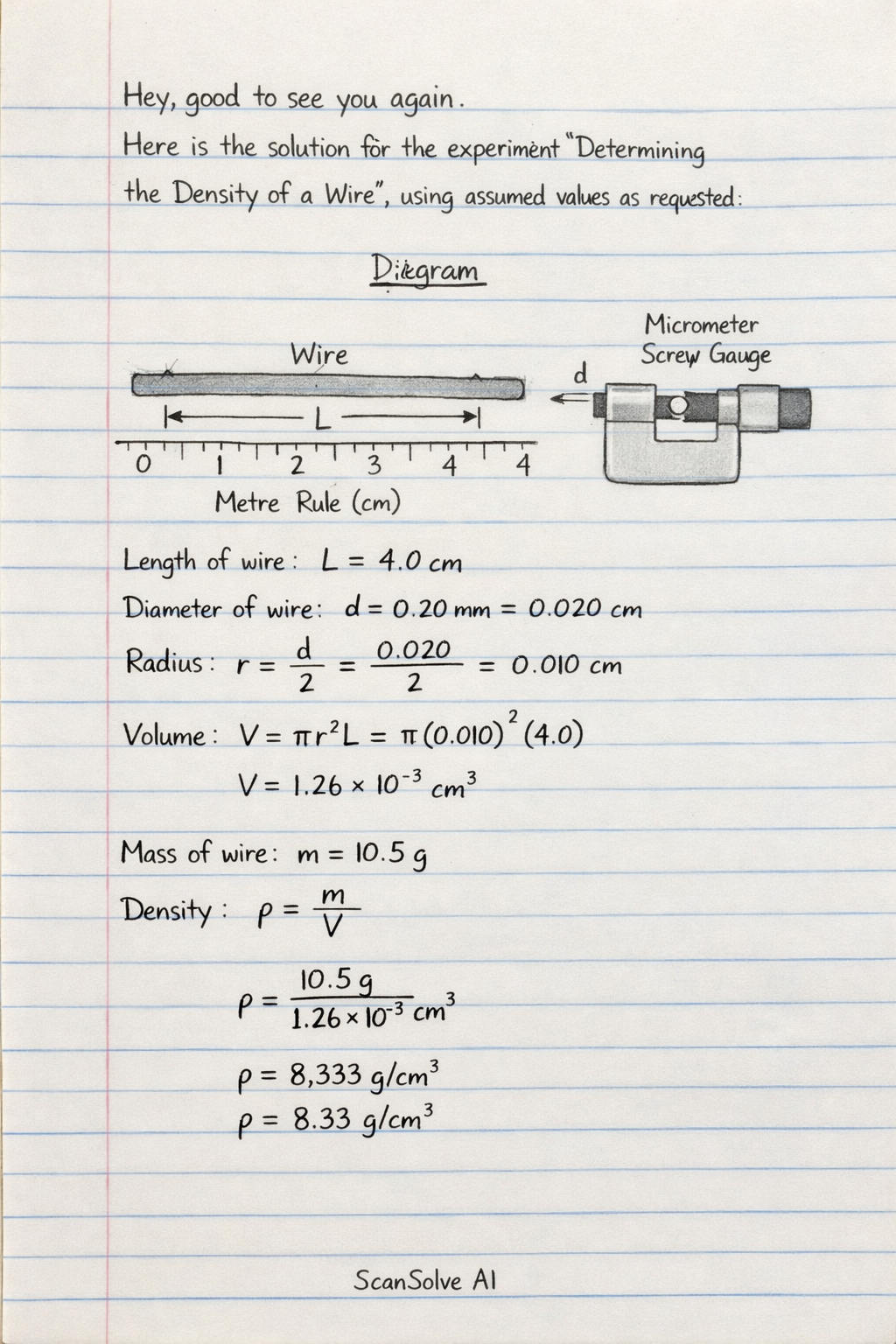
4 stepsHere is the solution for the experiment "Determining the Density of a Wire", using assumed values as requested:
Diagram
\begin{tikzpicture}[scale=1.0]
    % Wire
    \draw[thick, gray] (0,0) -- (4,0);
    \node at (2,0.3) {Wire};

    % Metre Rule
    \draw[thick] (0,-0.5) -- (4,-0.5);
    \foreach \x in {0,1,2,3,4}
        \draw (\x,-0.5) -- (\x,-0.6) node[below] {\x};
    \node at (2,-1) {Metre Rule (cm)};
    \draw[<->] (0,0.5) -- (4,0.5) node[above, midway] {$L$};

    % Micrometer Screw Gauge (simplified)
    \draw[thick] (5,0) rectangle (6,1);
    \draw[thick] (6,0.5) -- (7,0.5);
    \draw[thick] (7,0) rectangle (8,1);
    \draw[thick, gray] (6.5,0.5) circle (0.1); % Wire inside
    \node at (6.5,1.3) {Micrometer};
    \node at (6.5,0.2) {Screw Gauge};
    \draw[<->] (6.4,0.7) -- (6.6,0.7) node[above] {$d$};

    % Electronic Balance (simplified)
    \draw[thick] (9,0) rectangle (10,1);
    \draw[thick] (9.5,1) -- (9.5,1.5);
    \draw[thick] (9.2,1.5) rectangle (9.8,1.8);
    \node at (9.5,0.5) {Balance};
    \node at (9.5,1.65) {$m$};
\end{tikzpicture}
Procedure
- Measure the mass () of the given piece of wire using an electronic balance. Record the reading.
- Place the wire on a flat surface and use a metre rule to measure its total length (). Take multiple readings along the wire if it's not perfectly straight, and calculate the average.
- Use a micrometer screw gauge to measure the diameter () of the wire. Take at least three readings at different points along the wire and at different orientations (e.g., rotating the wire) to account for any non-uniformity. Calculate the average diameter.
- Calculate the radius () of the wire using the average diameter ().
- Calculate the volume () of the wire using the formula for the volume of a cylinder, .
- Calculate the density () of the wire using the formula .
Observations/Results
- Assumed mass of the wire,
- Assumed length of the wire,
| Reading | Diameter () |
|---|---|
| 1 | |
| 2 | |
| 3 | |
| Average |
Average diameter,
Calculations/Conclusion
Convert all measurements to consistent units (e.g., SI units
kg, m).
Calculate the radius () of the wire.
Calculate the volume () of the wire.
Calculate the density () of the wire.
Rounding to a reasonable number of significant figures (e.g., 3 sig figs based on mass and length):
The density of the wire was determined to be
\boxed{\text{6.25 \times 10^4 kg/m^3}}.Precautions
- Ensure the electronic balance is zeroed before measuring the mass of the wire.
- Take multiple readings for the length of the wire and calculate the average to minimize random errors.
- When using the micrometer screw gauge, ensure it is properly calibrated (check for zero error) and apply gentle pressure to avoid deforming the wire.
- Take multiple readings for the diameter at different points along the wire and at different orientations to account for any irregularities in the wire's thickness.
- Read all instruments at eye level to avoid parallax errors.
- Ensure the wire is straight when measuring its length.
Was this helpful?
Still stuck on this one?
Ask a follow-up, and the answer starts from this question.
Got a different question?Ask your own question
More Physics Questions
QWhat are the precautions to take when determining the density of a wireQA metre rule is pivoted at the 40 cm mark. A 15 g mass is suspended at the 15 cm mark. The rule is…QDescribe the procedure for an experiment to determine the mass of an object using an uncalibrated…QHow can I accurately determine the diameter of a wire using a spring?QThe calculations the mass of the metre rule using the formula above. (b) Using the data from the…
Handwritten Step-by-Step Solution
Get this as a handwritten image on WhatsApp — like a tutor wrote it for you.
Try on WhatsApp