

This physics problem tests your understanding of fundamental physical laws and their applications. The step-by-step solution below breaks down the problem using relevant equations and physical reasoning.
ScanSolve AI Answer
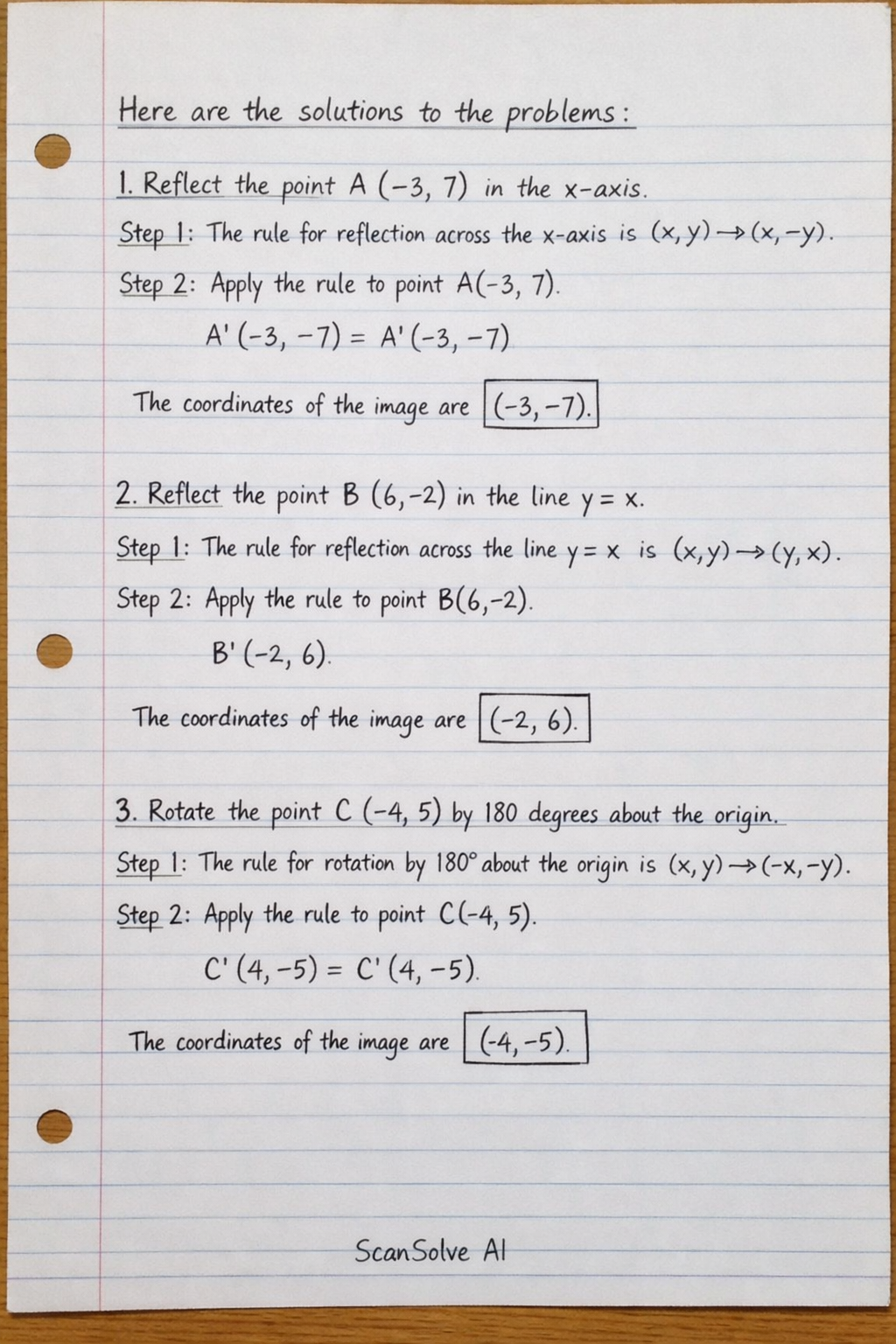
Here are the solutions to the problems: 1. Reflect the point A (-3, 7) in the x-axis. Step 1: The rule for reflection across the x-axis is (x, y) (x, -y). Step 2: Apply the rule to point A(-3, 7). A'(-3, -(7)) = A'(-3, -7) The coordinates of the image are (-3, -7). 2. Reflect the point B (6, -2) in the line y = x. Step 1: The rule for reflection across the line y = x is (x, y) (y, x). Step 2: Apply the rule to point B(6, -2). B'(-2, 6) The coordinates of the image are (-2, 6). 3. Rotate the point C (-4, 5) by 180 degrees about the origin. Step 1: The rule for rotation by 180 degrees about the origin is (x, y) (-x, -y). Step 2: Apply the rule to point C(-4, 5). C'(-(-4), -(5)) = C'(4, -5) The coordinates of the image are (4, -5). 4. Rotate the point D (2, -3) by 90 degrees counter-clockwise about the origin. Step 1: The rule for rotation by 90 degrees counter-clockwise about the origin is (x, y) (-y, x). Step 2: Apply the rule to point D(2, -3). D'(-(-3), 2) = D'(3, 2) The coordinates of the image are (3, 2). 5. A square has vertices at (0, 0), (2, 0), (2, 2), and (0, 2). Find the image after reflecting in the y-axis. Step 1: The rule for reflection across the y-axis is (x, y) (-x, y). Step 2: Apply the rule to each vertex. For (0, 0): (-0, 0) = (0, 0) For (2, 0): (-2, 0) For (2, 2): (-2, 2) For (0, 2): (-0, 2) = (0, 2) The coordinates of the image are (0, 0), (-2, 0), (-2, 2), (0, 2). 6. Reflect the point E (-5, -8) in the line y = -x. Step 1: The rule for reflection across the line y = -x is (x, y) (-y, -x). Step 2: Apply the rule to point E(-5, -8). E'(-(-8), -(-5)) = E'(8, 5) The coordinates of the image are (8, 5). 7. Reflect the point F (7, -3) in the y-axis. Then reflect that image in the x-axis. Step 1: First, reflect F(7, -3) in the y-axis. The rule is (x, y) (-x, y). F'(-7, -3) Step 2: Next, reflect F'(-7, -3) in the x-axis. The rule is (x, y) (x, -y). F''(-7, -(-3)) = F''(-7, 3) The final coordinates are (-7, 3). 8. Rotate the point G (6, 2) by 270 degrees counter-clockwise about the origin. Step 1: The rule for rotation by 270 degrees counter-clockwise about the origin is (x, y) (y, -x). Step 2: Apply the rule to point G(6, 2). G'(2, -6) The coordinates of the image are (2, -6). 9. A triangle has vertices at P (-2, 1), Q (0, 4), and R (3, -1). Rotate the triangle by 90 degrees counter-clockwise about the origin. Step 1: The rule for rotation by 90 degrees counter-clockwise about the origin is (x, y) (-y, x). Step 2: Apply the rule to each vertex. For P(-2, 1): P'(-1, -2) For Q(0, 4): Q'(-4, 0) For R(3, -1): R'(-(-1), 3) = R'(1, 3) The coordinates of the image triangle P'Q'R' are P'(-1, -2), Q'(-4, 0), R'(1, 3). 10. A rectangle has vertices at (-4, 1), (-4, 5), (3, 5), and (3, 1). Reflect the rectangle in the line y = x. Step 1: The rule for reflection across the line y = x is (x, y) (y, x). Step 2: Apply the rule to each vertex. For (-4, 1): (1, -4) For (-4, 5): (5, -4) For (3, 5): (5, 3) For (3, 1): (1, 3) The coordinates of the image rectangle are (1, -4), (5, -4), (5, 3), (1, 3).