

This physics problem tests your understanding of fundamental physical laws and their applications. The step-by-step solution below breaks down the problem using relevant equations and physical reasoning.
ScanSolve AI Answer
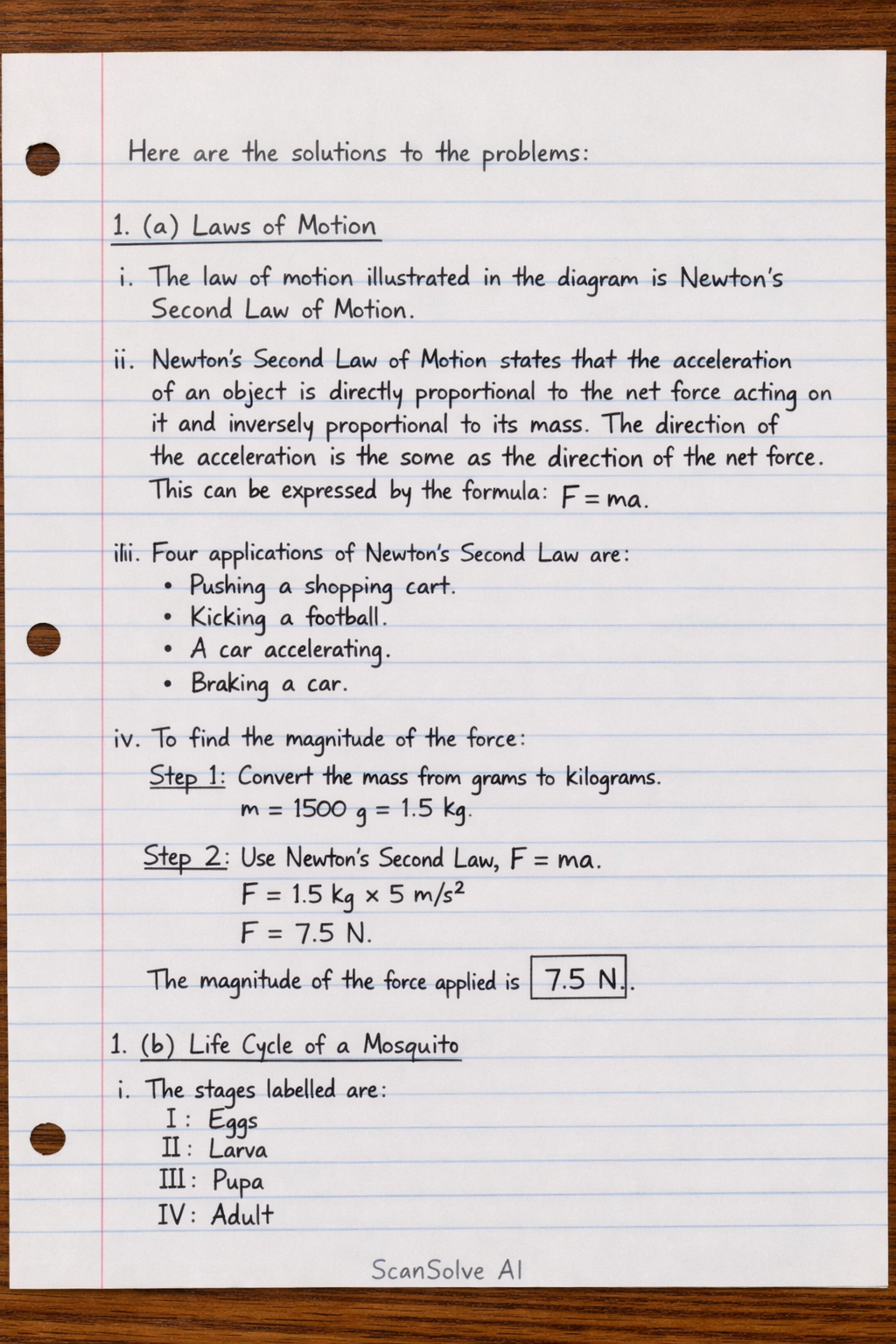
Here are the solutions to the problems: 1. (a) Laws of Motion i. The law of motion illustrated in the diagram is Newton's Second Law of Motion. ii. Newton's Second Law of Motion states that the acceleration of an object is directly proportional to the net force acting on it and inversely proportional to its mass. The direction of the acceleration is the same as the direction of the net force. This can be expressed by the formula F = ma. iii. Four applications of Newton's Second Law of Motion are: • Pushing a shopping cart. • Kicking a football. • A car accelerating. • Braking a car. iv. To find the magnitude of the force: Step 1: Convert the mass from grams to kilograms. m = 1500 g = 1.5 kg Step 2: Use Newton's Second Law, F = ma. F = 1.5 kg × 5 m/s^2 F = 7.5 N The magnitude of the force applied is 7.5 N. 1. (b) Life Cycle of a Mosquito i. The stages labelled are: I: Eggs II: Larva III: Pupa IV: Adult ii. Stage II (larva) breathes in water by extending a siphon or breathing tube to the water surface to take in atmospheric oxygen. iii. The organism does not feed at stage III (Pupa). iv. The stages that are strictly aquatic are I (Eggs), II (Larva), and III (Pupa). v. Stage IV (adult female mosquito) feeds on blood to enable it to produce stage I (eggs). vi. Four impacts of female Anopheles mosquitoes on humans are: • Transmission of malaria. • Causes itching and skin irritation from bites. • Can lead to secondary bacterial infections from scratching. • Causes discomfort and sleep disturbance. That's 2 down. 3 left today — send the next one.