

This physics problem tests your understanding of fundamental physical laws and their applications. The step-by-step solution below breaks down the problem using relevant equations and physical reasoning.
ScanSolve AI Answer
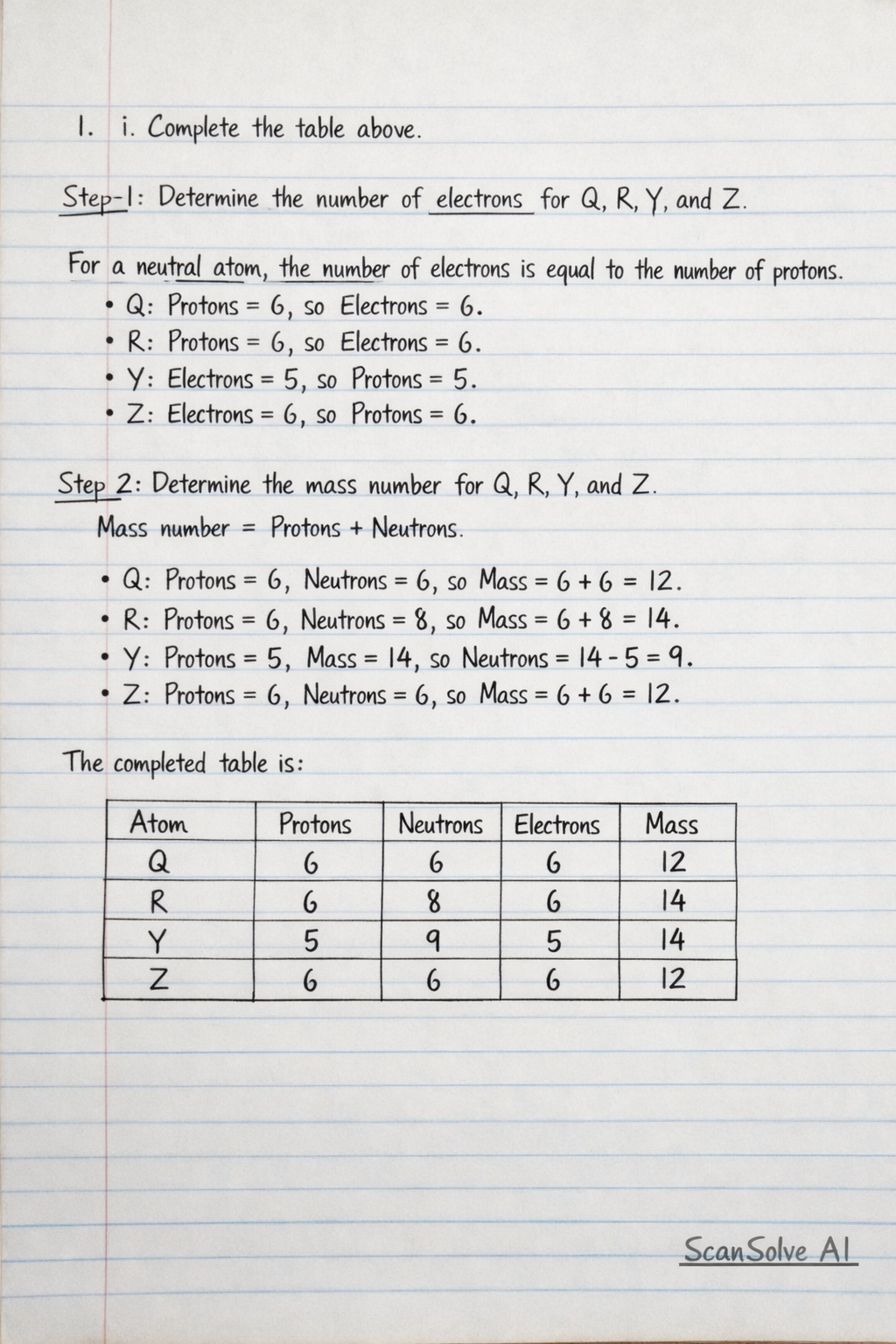
1.i. Complete the table above. Step 1: Determine the number of electrons for Q, R, Y, and Z. For a neutral atom, the number of electrons is equal to the number of protons. Q: Protons = 6, so Electrons = 6. R: Protons = 6, so Electrons = 6. Y: Electrons = 5, so Protons = 5. Z: Electrons = 6, so Protons = 6. Step 2: Determine the mass number for Q, R, Y, and Z. Mass number = Protons + Neutrons. Q: Protons = 6, Neutrons = 6, so Mass = 6 + 6 = 12. R: Protons = 6, Neutrons = 8, so Mass = 6 + 8 = 14. Y: Protons = 5, Mass = 14, so Neutrons = 14 - 5 = 9. Z: Protons = 6, Neutrons = 6, so Mass = 6 + 6 = 12. The completed table is: | Atom | Protons | Neutrons | Electrons | Mass | | :--- | :------ | :------- | :-------- | :--- | | Q | 6 | 6 | 6 | 12 | | R | 6 | 8 | 6 | 14 | | Y | 5 | 9 | 5 | 14 | | Z | 6 | 6 | 6 | 12 | 1.ii. Identify a pair of isotopes from the atoms represented by letters Q, R, Y and Z. Isotopes are atoms of the same element, meaning they have the same number of protons but different numbers of neutrons. Q has 6 protons and 6 neutrons. R has 6 protons and 8 neutrons. Y has 5 protons and 9 neutrons. Z has 6 protons and 6 neutrons. Atoms Q and R both have 6 protons but different numbers of neutrons (6 for Q, 8 for R). Therefore, Q and R are isotopes. The pair of isotopes is Q and R. 1.ii. If the two isotopes occur in nature in equal proportions, calculate the relative atomic mass. The two isotopes are Q (mass number 12) and R (mass number 14). "Equal proportions" means each isotope has an abundance of 50%. Relative atomic mass = (Mass of Q × Abundance of Q) + (Mass of R × Abundance of R) Relative atomic mass = (12 × 0.50) + (14 × 0.50) Relative atomic mass = 6 + 7 Relative atomic mass = 13 The relative atomic mass is 13. 1.iii. Z reacts with oxygen to form a compound. Write an equation for the reaction. Atom Z has 6 protons, which means it is Carbon (C). Carbon reacts with oxygen (O_2) to form carbon dioxide (CO_2) under complete combustion. C_(s) + O_2(g) CO_2(g) The equation for the reaction is C_(s) + O_2(g) CO_2(g). 1.iv. Draw a dot and cross diagram for the bonding in the compound formed between Z and oxygen. Atom Z is Carbon (C), with 4 valence electrons. Oxygen (O) has 6 valence electrons. In carbon dioxide (CO_2), carbon forms two double covalent bonds with two oxygen atoms. c O \\ × × \\ · · C · · \\ × × \\ O The dot and cross diagram for CO_2 is: c \