
We read your photo as:
The table below shows the number of protons, neutrons, electrons and the mass numbers of some atoms Q, R, Y and Z. The letters used are not the usual symbols of the elements. Complete the table above. i. Identify a pair of isotopes from the atoms represented by letters Q, R, Y and Z. ii. If the two isotopes occur in nature in equal proportions, calculate the relative atomic mass. iii. Draw a dot and cross diagram for the bonding in the compound formed between Z and oxygen. Write an equation for the reaction. Z reacts with oxygen to form a compound. Write an equation for the reaction.
Chemistry
ScanSolve AI Answer
Step-by-step solution
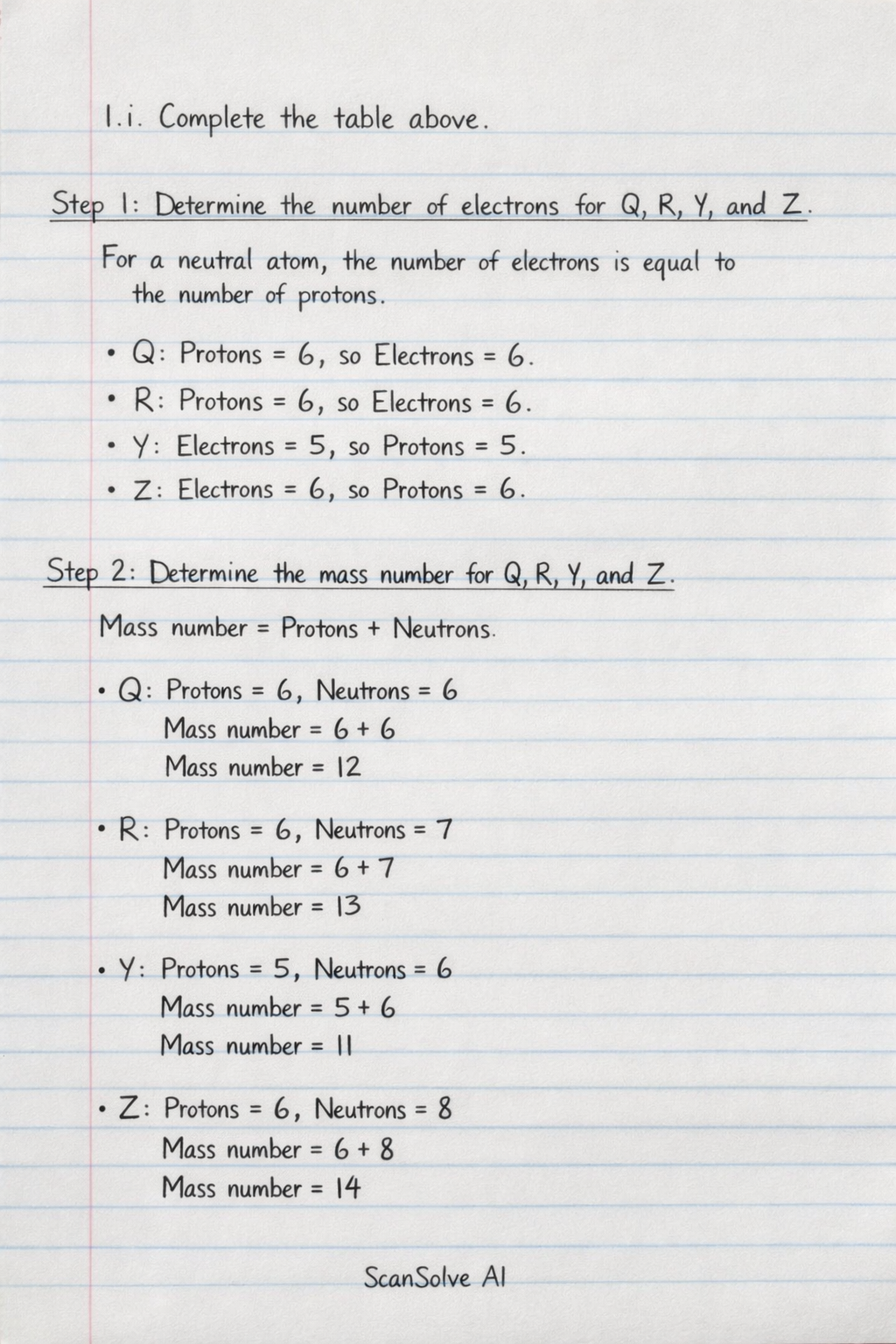
2 steps1.i. Complete the table above.
Determine the number of electrons for Q, R, Y, and Z.
For a neutral atom, the number of electrons is equal to the number of protons.
- Q: Protons = 6, so Electrons = 6.
- R: Protons = 6, so Electrons = 6.
- Y: Electrons = 5, so Protons = 5.
- Z: Electrons = 6, so Protons = 6.
Determine the mass number for Q, R, Y, and Z.
Mass number = Protons + Neutrons.
- Q: Protons = 6, Neutrons = 6
Was this helpful?
Still stuck on this one?
Ask a follow-up, and the answer starts from this question.
Got a different question?Ask your own question
More Chemistry Questions
QThe table below shows the number of protons, neutrons, electrons and the mass numbers of some atoms…QA) Complete the table...i) X (Neutron number for A) ...ii) Y (Electron number for B) ...iii) Z (Mass…QA) Represent element Y using the atomic symbol notation ^A_Z Y. b) Draw the atomic structure of…QComplete the table for atom X and ions Y³⁻ and Z²⁺.QA) Define: i) Atomic number ii) Mass number. b) Calculate the relative atomic mass of element X. c)…
Handwritten Step-by-Step Solution
Get this as a handwritten image on WhatsApp — like a tutor wrote it for you.
Try on WhatsApp