

This physics problem tests your understanding of fundamental physical laws and their applications. The step-by-step solution below breaks down the problem using relevant equations and physical reasoning.
ScanSolve AI Answer
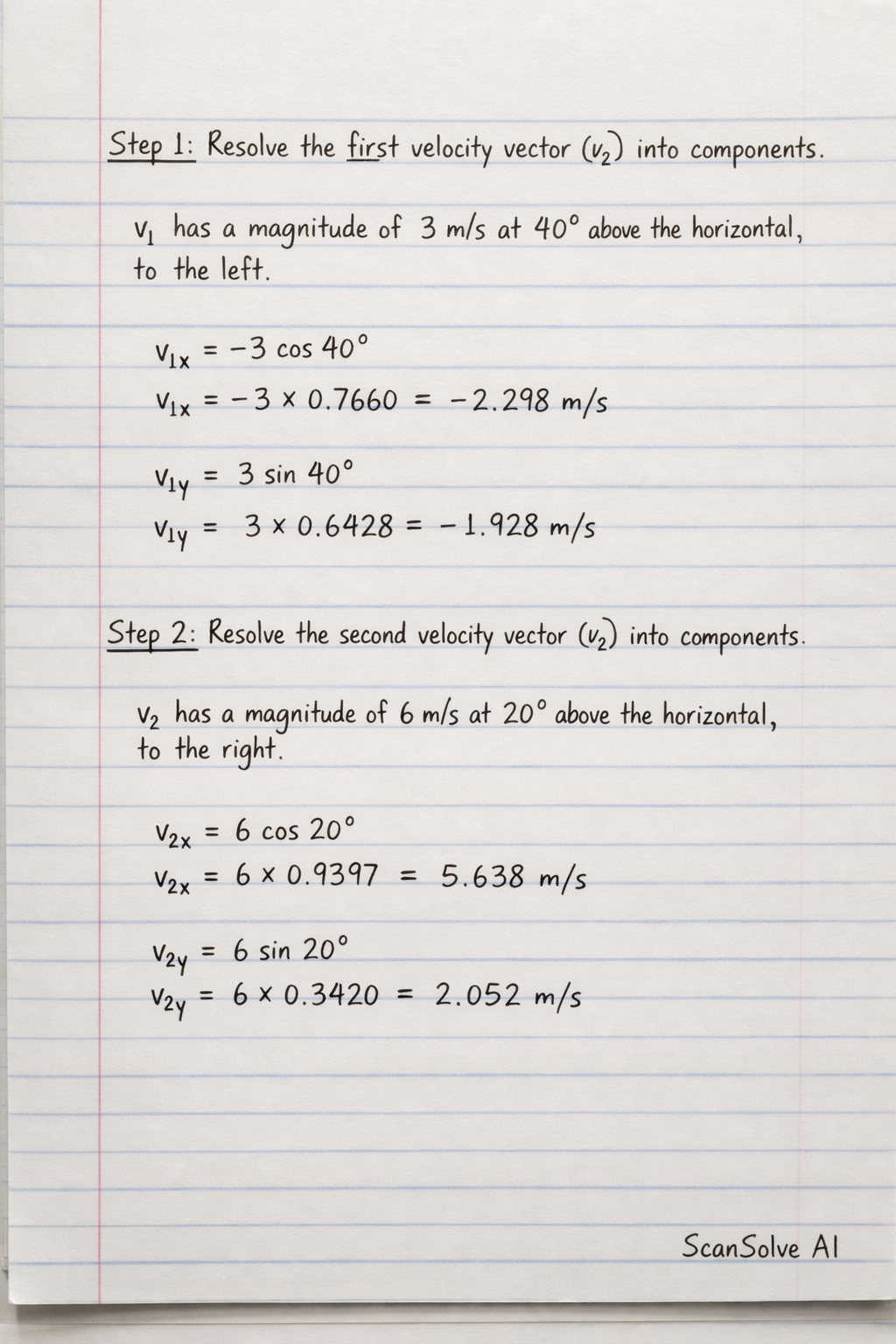
To find the resultant velocity, we need to break each velocity vector into its horizontal (x) and vertical (y) components, sum these components, and then find the magnitude and direction of the resultant vector. Step 1: Resolve the first velocity vector (v_1) into components. The first vector has a magnitude of 3 m/s at 40^ above the horizontal, pointing to the left. v_1x = -3 (40^) v_1y = 3 (40^) Using approximate values: v_1x = -3 × 0.7660 ≈ -2.298 m/s v_1y = 3 × 0.6428 ≈ 1.928 m/s Step 2: Resolve the second velocity vector (v_2) into components. The second vector has a magnitude of 6 m/s at 20^ above the horizontal, pointing to the right. v_2x = 6 (20^) v_2y = 6 (20^) Using approximate values: v_2x = 6 × 0.9397 ≈ 5.638 m/s v_2y = 6 × 0.3420 ≈ 2.052 m/s Step 3: Sum the x-components and y-components to find the resultant components (R_x, R_y). R_x = v_1x + v_2x = -2.298 + 5.638 = 3.340 m/s R_y = v_1y + v_2y = 1.928 + 2.052 = 3.980 m/s Step 4: Calculate the magnitude of the resultant velocity (|R|). |R| = sqrt(R_x^2 + R_y^2) |R| = sqrt((3.340)^2 + (3.980)^2) |R| = sqrt(11.1556 + 15.8404) |R| = sqrt(26.996) |R| ≈ 5.196 m/s Step 5: Calculate the direction of the resultant velocity (). Since both R_x and R_y are positive, the resultant vector is in the first quadrant. = (R_y)/(R_x) = (3.980)/(3.340) ≈ 1.1916 = (1.1916) ≈ 50.0^ The resultant velocity has a magnitude of 5.20 m/s and a direction of 50.0^ above the horizontal. Drop the next question.