
We read your photo as:
What are the units for inductance and G? Show that P = mv2t/d is dimensionally correct, assuming P is momentum.
ScanSolve AI Answer
Step-by-step solution
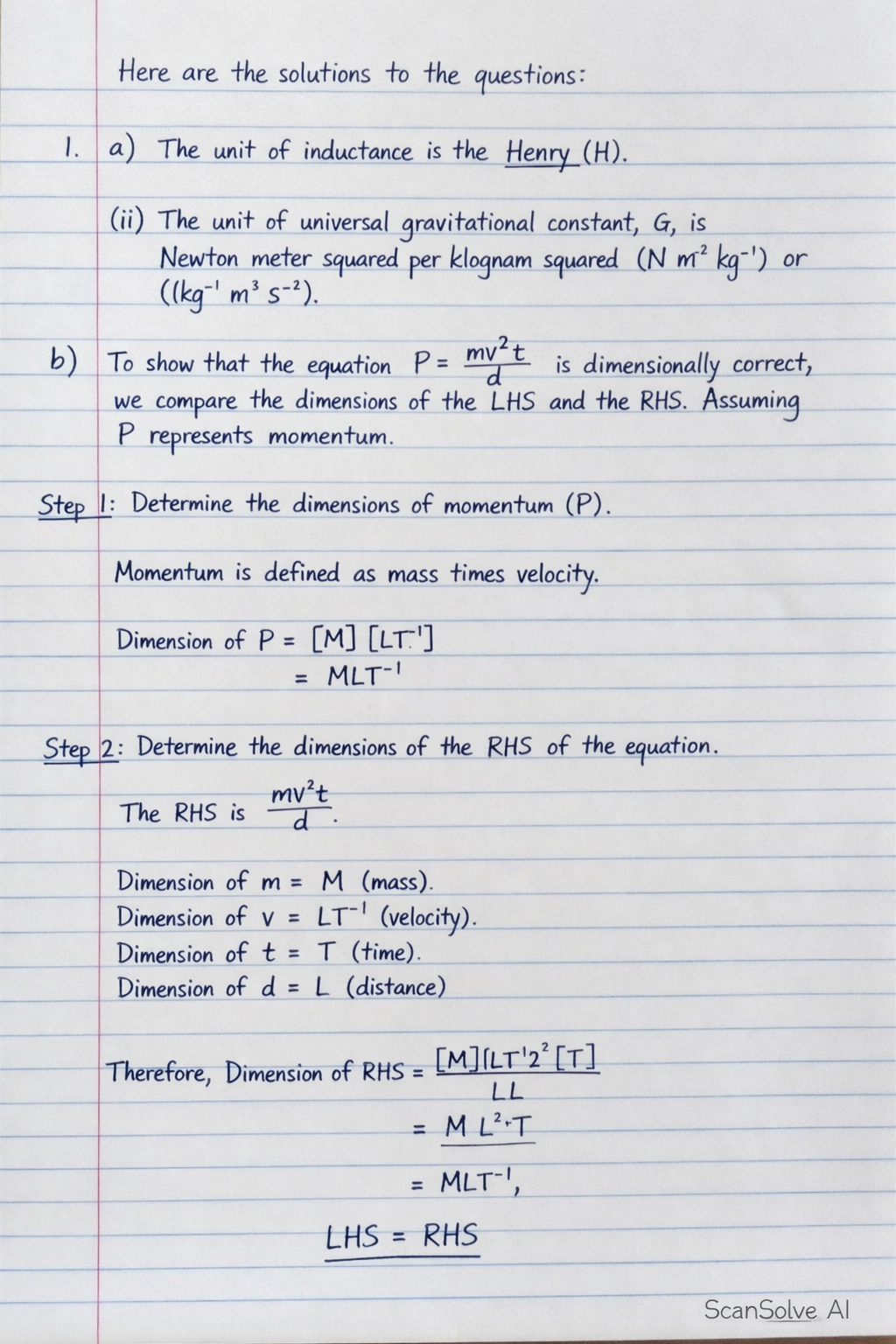
3 stepsHere are the solutions to the questions:
1.
a)
i) The unit of inductance is the Henry ().
ii) The unit of universal gravitational constant, , is Newton meter squared per kilogram squared () or ().
b)
To show that the equation is dimensionally correct, we compare the dimensions of the left-hand side (LHS) and the right-hand side (RHS). Assuming represents momentum.
Determine the dimensions of momentum ().
Momentum is defined as mass times velocity.
Determine the dimensions of the right-hand side (RHS) of the equation.
The RHS is .
Dimension of (mass)
Dimension of (velocity)
Dimension of (time)
Dimension of (distance)Substitute these into the RHS expression:
Compare the dimensions of LHS and RHS.
Dimension of LHS () =
Dimension of RHS =
Since the dimensions of LHS and RHS are the same, the equation is dimensionally correct.2.
a)
i) A real image is formed when light rays actually converge at a point after reflection or refraction. It can be projected onto a screen.
ii) A virtual image is formed when light rays appear to diverge from a point after reflection or refraction, but do not actually converge. It cannot be projected onto a screen.
b)
i) Two differences between umbra and penumbra regions of a shadow:
- The umbra is the darkest part of a shadow where all light from the source is blocked. The penumbra is the lighter, outer part of a shadow where only some light from the source is blocked.
- The umbra is formed when the light source is completely obscured by an opaque object. The penumbra is formed when the light source is partially obscured.
ii) Ray diagrams showing how parallel rays of light close to the principal axis are reflected:
. Concave mirror: Parallel rays of light incident on a concave mirror, close to and parallel to the principal axis, will converge and pass through the principal focus (F) after reflection.
. Convex mirror: Parallel rays of light incident on a convex mirror, close to and parallel to the principal axis, will diverge after reflection. When extended backward, these reflected rays will appear to originate from the principal focus (F) behind the mirror.c) A hypermetropic (long-sighted) person has an eyeball that is too short or a lens that is too weak, causing light from near objects to focus behind the retina. However, for distant objects, the light rays
Still stuck on this one?
Ask a follow-up, and the answer starts from this question.
More Physics Questions
Handwritten Step-by-Step Solution
Get this as a handwritten image on WhatsApp — like a tutor wrote it for you.
Try on WhatsApp