
Solve this physics exercise question
Physics
ScanSolve AI Answer
Step-by-step solution
7 stepsIdentify the given information.
Mass of the object () = 10 kg
Initial velocity () = 5 m/s
Final velocity () = 15 m/s
Time interval () = 4 sDetermine the acceleration of the object.
Acceleration () is the rate of change of velocity. The formula is:
Substitute the given values into the acceleration formula.
Calculate the acceleration.
Calculate the net force acting on the object.
According to Newton's second law of motion, the net force () is the product of mass and acceleration:
Substitute the mass and calculated acceleration into the formula.
Calculate the net force.
Since 1 Newton (N) is equal to 1 kg·m/s², the net force is:
The net force acting on the object is 25 N.
Was this helpful?
Still stuck on this one?
Ask a follow-up, and the answer starts from this question.
Got a different question?Ask your own question
More Physics Questions
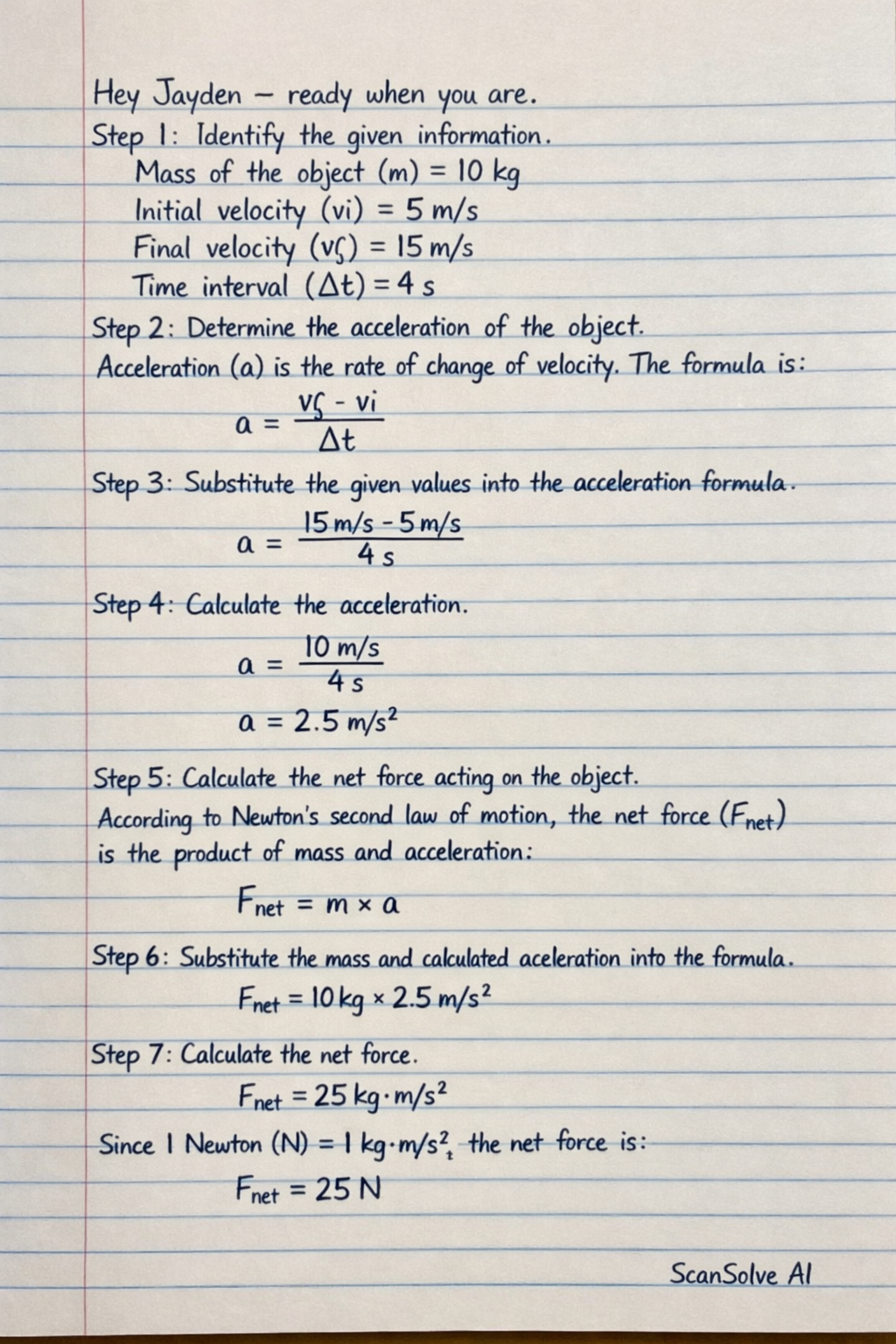
Handwritten Step-by-Step Solution
Get this as a handwritten image on WhatsApp — like a tutor wrote it for you.
Try on WhatsApp