
Solve for me this physics
ScanSolve AI Answer
Answers
4 partsStep-by-step solution
6 stepsHere's the solution to the physics problem:
Given:
- Voltage of the battery () =
- Resistance
- Resistance
- Resistance
Part a· 2 steps
Total resistance of the circuit
Calculate the equivalent resistance of and which are connected in parallel.
The formula for two resistors in parallel is .
To add these fractions, find a common denominator, which is 12.
Calculate the total resistance of the circuit.
The equivalent resistance is in series with . The formula for resistors in series is .
The total resistance of the circuit is .
Part b
Total current flowing from the battery
Use Ohm's Law to find the total current.
Ohm's Law states , so .
The total current flowing from the battery is .
Part c
Current flowing through
Calculate the potential difference (voltage) across the parallel combination ().
The total current flows through and then through the parallel combination . So, the voltage across is .
Calculate the current flowing through .
Using Ohm's Law for : .
The current flowing through is .
Part d
Potential difference across
Recognize that resistors in parallel have the same potential difference across them.
Since and are in parallel, the potential difference across () is the same as the potential difference across and the parallel combination ().
The potential difference across is .
Try one yourself
A new problem that tests the same skill.
Still stuck on this one?
Ask a follow-up, and the answer starts from this question.
More Physics Questions
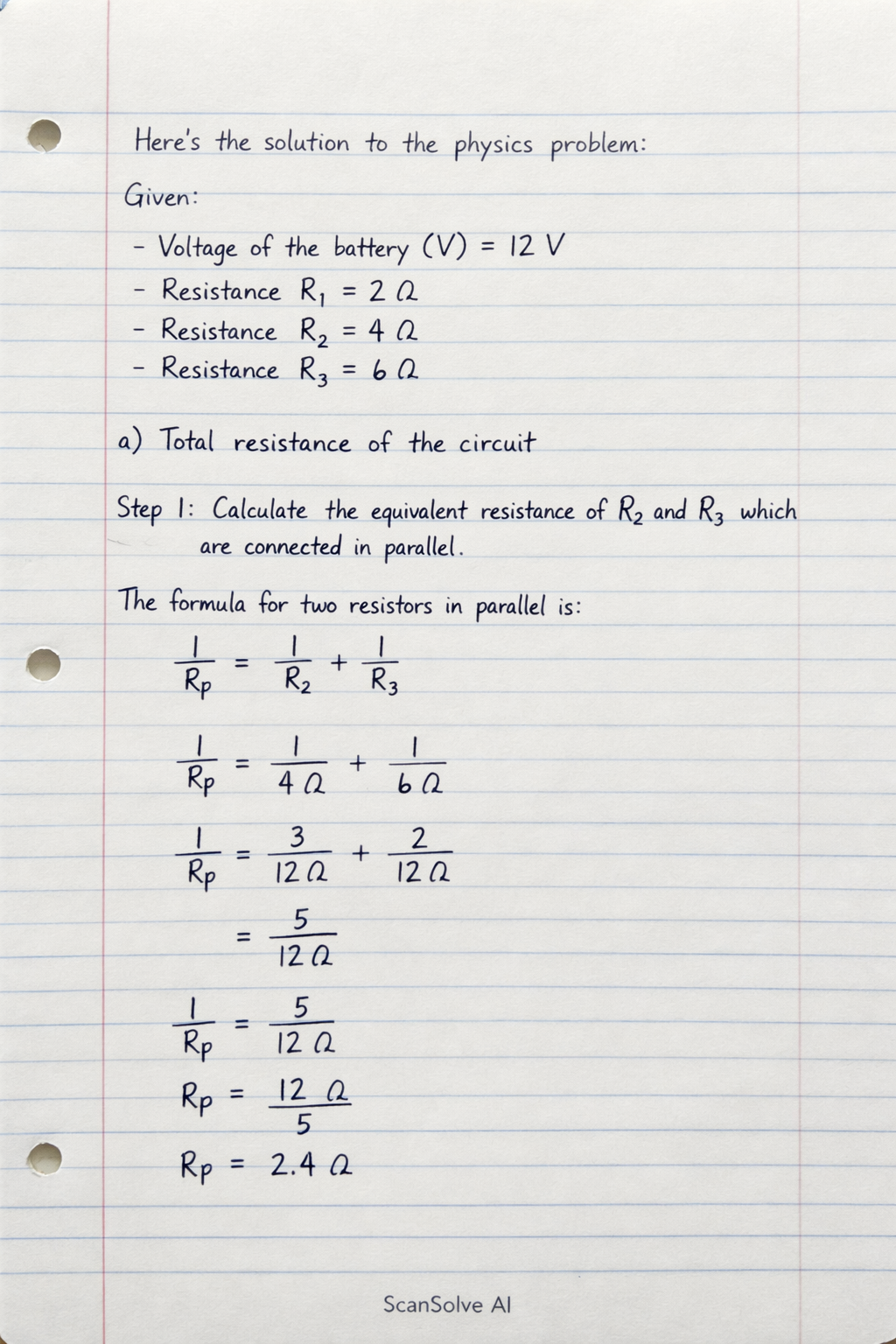
Handwritten Step-by-Step Solution
Get this as a handwritten image on WhatsApp — like a tutor wrote it for you.
Try on WhatsApp