
We read your photo as:
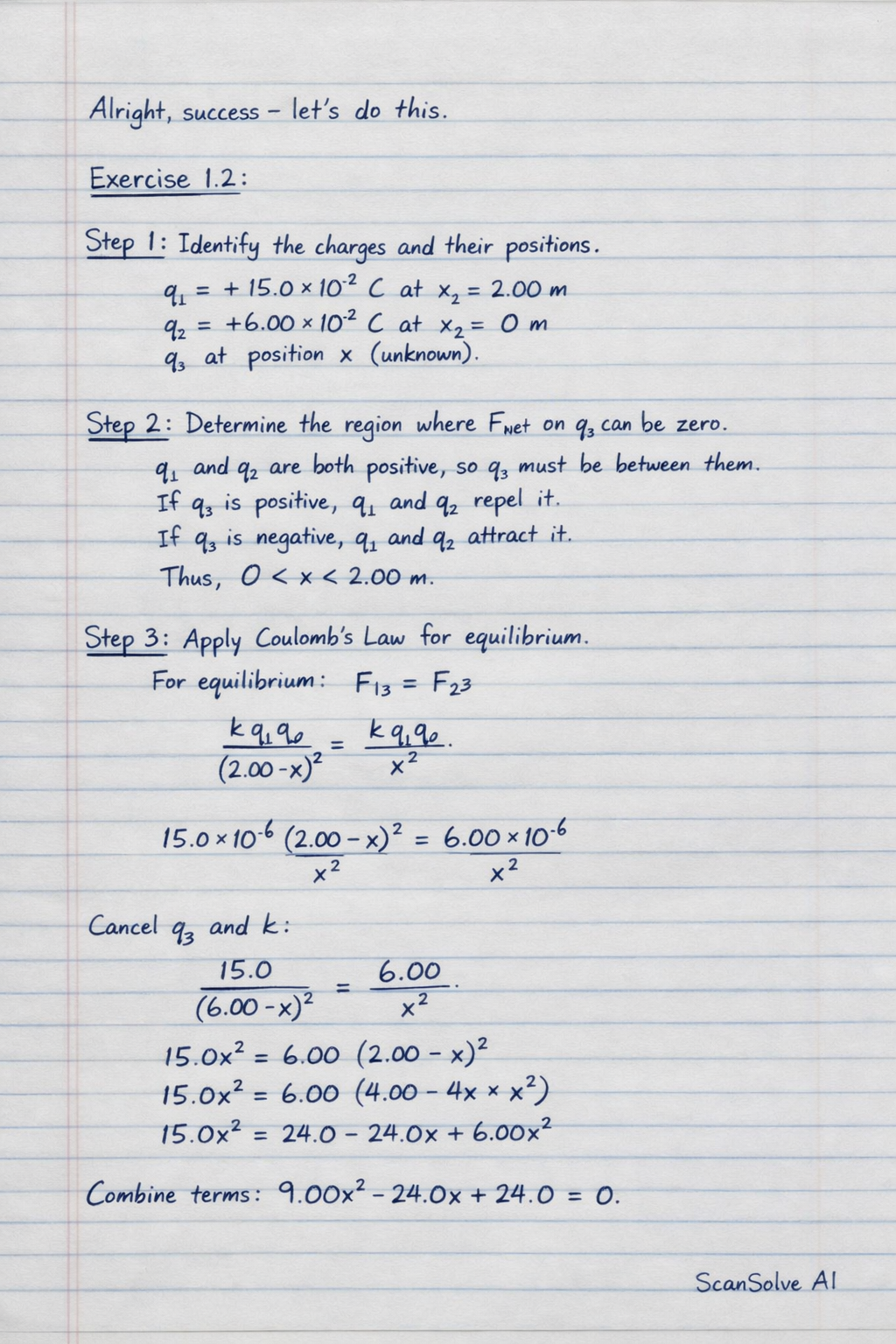
Three charges are placed along the x-axis. q1 = +15.0 μC is at x = 2.00 m, and q2 = +6.00 μC is at x = 0 m. Where must a third charge, q3, be placed so that the net force on it is zero?
ScanSolve AI Answer
Answer
Step-by-step solution
5 steps.2:
Identify the charges and their positions.
We have three charges along the x-axis:
- at
- at
- at an unknown position .
Determine the region where the net force on can be zero.
Since and are both positive, for the forces on to cancel, must be located between and . If is positive, and will both repel it, causing forces in opposite directions. If is negative, and will both attract it, also causing forces in opposite directions. Therefore, .
Apply Coulomb's Law for equilibrium.
For the net force on to be zero, the magnitude of the force exerted by on () must be equal to the magnitude of the force exerted by on ().
The distance between and is .
The distance between and is .Using Coulomb's Law, :
Substitute values and solve for .
Take the square root of both sides. Since , both and are positive, so we take the positive root.
The X coordinate of is .
.3:
Draw a free-body diagram for one sphere.
Each sphere is in equilibrium under three forces:
- Tension () in the string, acting along the string.
- Gravitational force (), acting vertically downwards
Try one yourself
A new problem that tests the same skill.
Still stuck on this one?
Ask a follow-up, and the answer starts from this question.
More Physics Questions
Handwritten Step-by-Step Solution
Get this as a handwritten image on WhatsApp — like a tutor wrote it for you.
Try on WhatsApp