

This physics problem tests your understanding of fundamental physical laws and their applications. The step-by-step solution below breaks down the problem using relevant equations and physical reasoning.
ScanSolve AI Answer
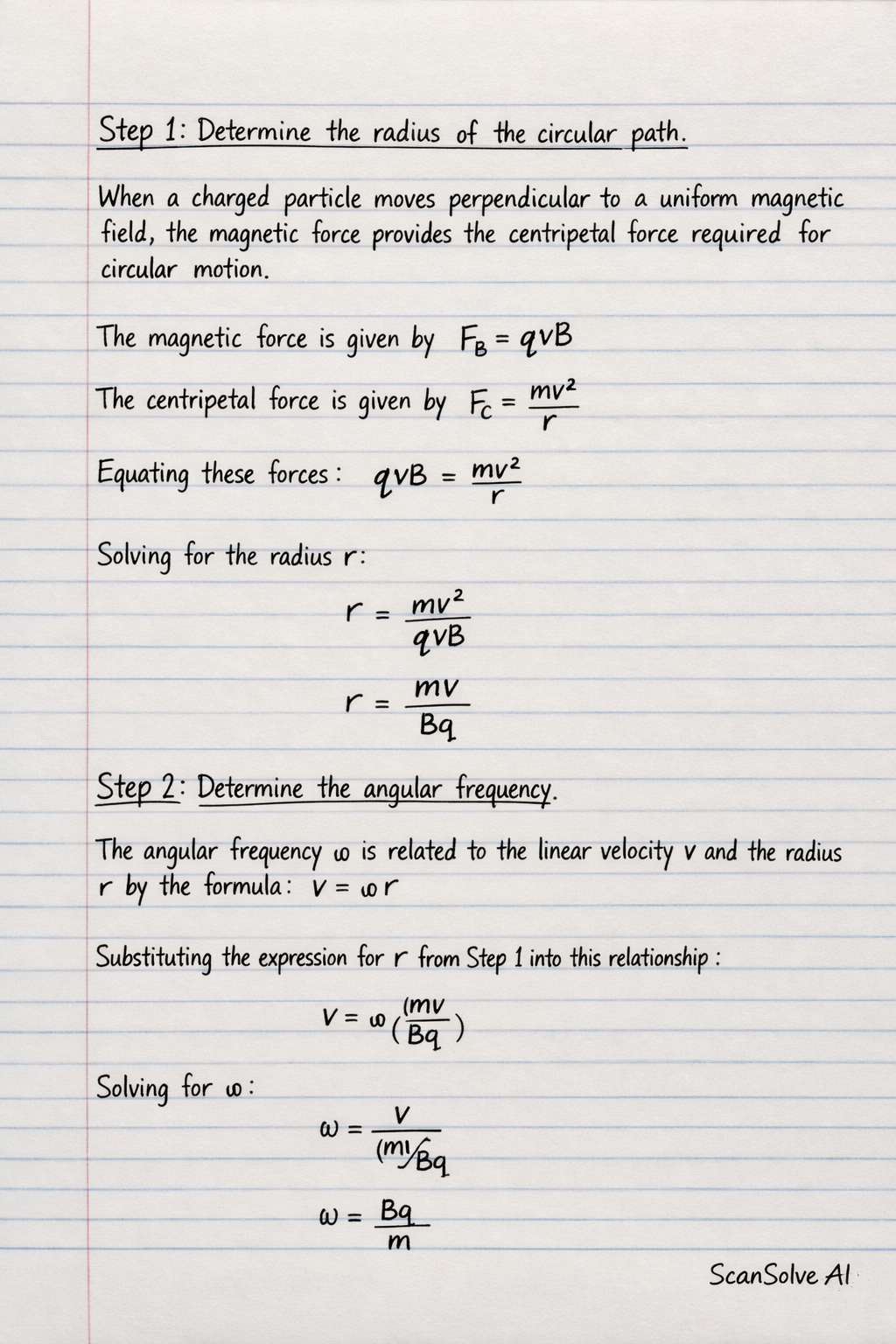
Step 1: Determine the radius of the circular path. When a charged particle moves perpendicular to a uniform magnetic field, the magnetic force provides the centripetal force required for circular motion. The magnetic force is given by F_B = qvB. The centripetal force is given by F_c = (mv^2)/(r). Equating these forces: qvB = (mv^2)/(r) Solving for the radius r: r = (mv^2)/(qvB) r = (mv)/(Bq) Step 2: Determine the angular frequency. The angular frequency is related to the linear velocity v and the radius r by the formula v = r. Substituting the expression for r from Step 1 into this relationship: v = ((mv)/(Bq)) Solving for : = (v)/((mv)Bq) = (Bq)/(m) Step 3: Determine the time period for a full revolution. The time period T is the time taken for one complete revolution, which corresponds to an angular displacement of 2 radians. The relationship between angular displacement , angular frequency , and time t is = t. For a full revolution, = 2 and t = T. 2 = T Substituting the expression for from Step 2: 2 = ((Bq)/(m)) T Solving for T: T = (2 m)/(Bq) Step 4: General time for an arbitrary angular displacement. The image also shows a general formula for time t for an angular displacement of (2 - 2): t = ((2 - 2)m)/(Bq) This formula is derived from = t, where = (2 - 2). If the particle completes a full circle, then = 0^ (or the angular displacement is 2). In this case, the formula simplifies to: t = ((2 - 0)m)/(Bq) t = (2 m)/(Bq) This confirms that the time for a full revolution is the time period T. The final expression for the time period is: T = (2 m)/(Bq) Send me the next one 📸