
We read your photo as:
To find the point where the electric potential is zero, we use the formula for the electric potential due to a point charge:
ScanSolve AI Answer
To find the point where the electric potential is zero, we use the formula for the electric potential due to a point charge:
where is Coulomb's constant, is the charge, and is the distance from the charge.
For two point charges, the total electric potential at a point is the algebraic sum of the potentials due to each charge:
We want to find the point where .
Given:
Distance between charges,
Let's consider a point on the line joining the charges. Since the charges have opposite signs, there are two regions where the potential can be zero:
- Between the charges.
- Outside the charges, on the side of the smaller magnitude charge (i.e., to the right of ).
Case 1: The point is between the charges.
Let the point be at a distance from .
Then the distance from will be .
Setting the total potential to zero:
Since is a non-zero constant, we can divide by :
Substitute the values for and :
Now, solve for :
This means the electric potential is zero at a point from the charge. This point is between the two charges.
Case 2: The point is outside the charges, to the right of .
Let the point be at a distance from .
Then the distance from will be .
Setting the total potential to zero:
This means the electric potential is also zero at a point from the charge (which is to the right of the charge).
Comparing our results with the given options:
(A) 10 cm from +4µC
(B) 20 cm from +4µC
(C) 15 cm from +4µC
(D) 25 cm from [partially visible]
The value from matches option (B).
The final answer is .
Still stuck on this one?
Ask a follow-up, and the answer starts from this question.
More Physics Questions
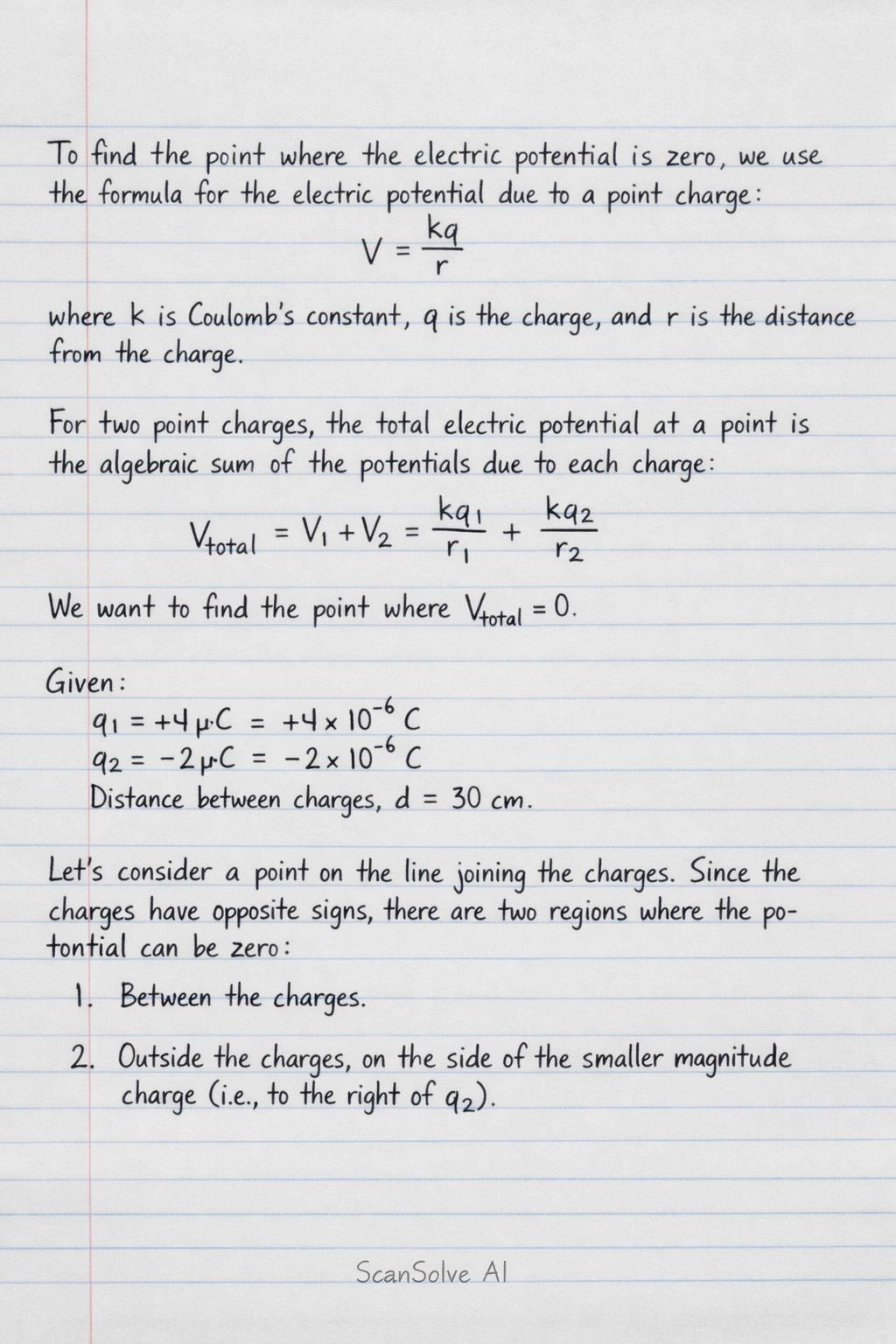
Handwritten Step-by-Step Solution
Get this as a handwritten image on WhatsApp — like a tutor wrote it for you.
Try on WhatsApp