
We read your photo as:
To find the weight of the water raised in the capillary tube, we can use the formula for weight, which is mass times acceleration due to gravity (W = mg). The mass of the water can be found by multi
ScanSolve AI Answer
This answer stops before the end.
It was cut off when it was first written. Ask ScanSolve this question again for the full working.
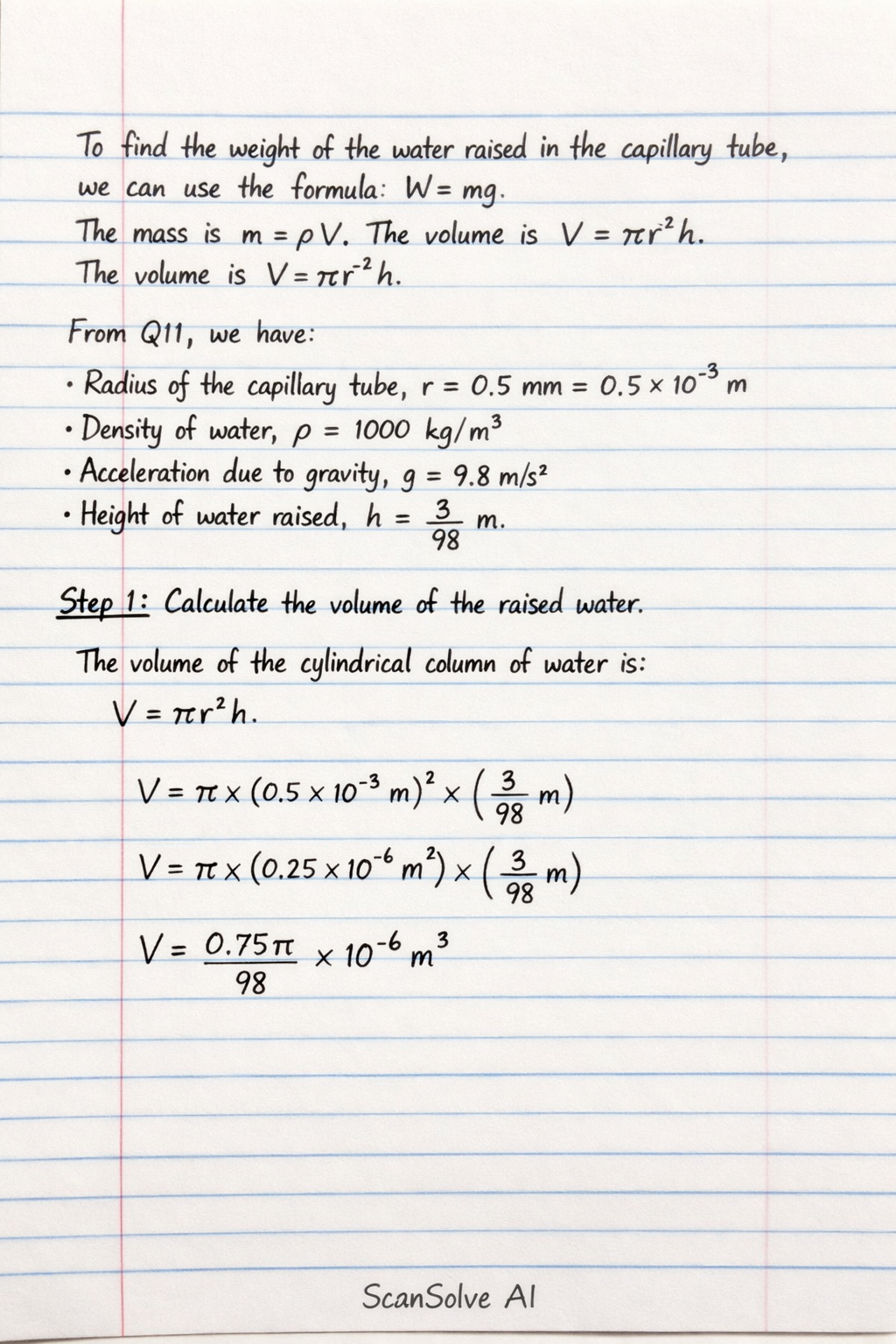
To find the weight of the water raised in the capillary tube, we can use the formula for weight, which is mass times acceleration due to gravity (). The mass of the water can be found by multiplying its density by its volume (). The volume of the water in the capillary tube is the volume of a cylinder, .
From the previous question (Q11), we have the following values:
- Radius of the capillary tube,
- Density of water,
- Acceleration due to gravity,
- Height of water raised, . From the previous calculation, we found .
Step 1: Calculate the volume of the raised water.
The volume of the cylindrical column of water is .
Step 2: Calculate the mass of the raised water.
The mass is .
Step 3: Calculate the weight of the raised water.
The weight is .
Still stuck on this one?
Ask a follow-up, and the answer starts from this question.
More Physics Questions
Handwritten Step-by-Step Solution
Get this as a handwritten image on WhatsApp — like a tutor wrote it for you.
Try on WhatsApp