

This physics problem tests your understanding of fundamental physical laws and their applications. The step-by-step solution below breaks down the problem using relevant equations and physical reasoning.
ScanSolve AI Answer
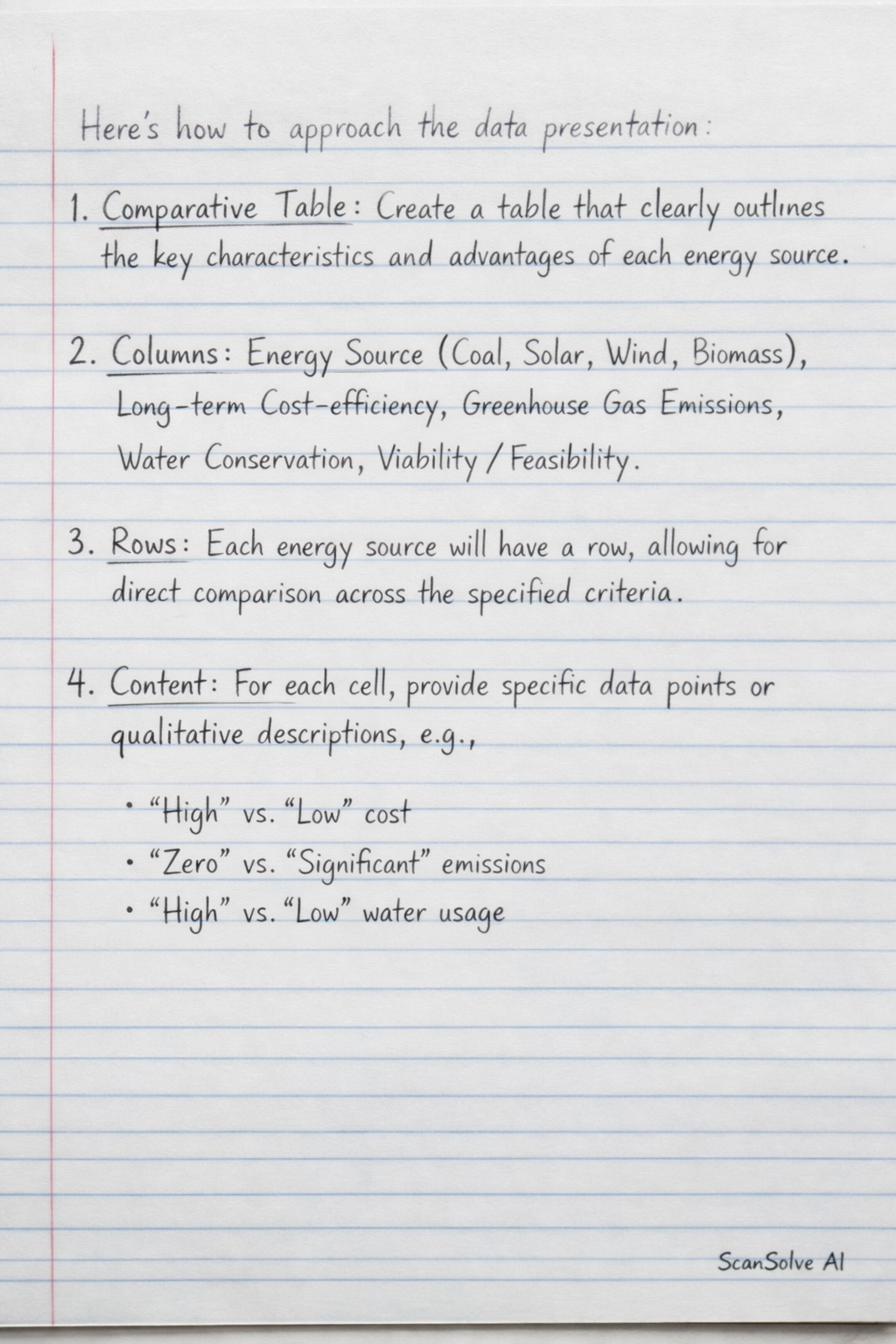
To present your data effectively, focus on comparing alternative energy sources (solar, wind, biomass) with coal-based power using structured tables and bar graphs. Here's how to approach the data presentation: Comparative Table: Create a table that clearly outlines the key characteristics and advantages of each energy source. Columns: Energy Source (Coal, Solar, Wind, Biomass), Long-term Cost-efficiency, Greenhouse Gas Emissions, Water Conservation, Viability/Feasibility. Rows: Each energy source will have a row, allowing for direct comparison across the specified criteria. Content: For each cell, provide specific data points or qualitative descriptions (e.g., "High" vs. "Low" cost, "Zero" vs. "Significant" emissions, "High" vs. "Low" water usage). Bar Graphs: Use bar graphs to visually highlight the distinct advantages of renewable sources over coal. Graph 1: Cost-Efficiency: A bar graph comparing the long-term cost per unit of energy* for coal, solar, wind, and biomass. This will visually demonstrate the cost savings of renewables over time. Graph 2: Environmental Impact: A bar graph comparing greenhouse gas emissions* (e.g., CO2 equivalent per kWh) for each energy source. This will clearly show the "zero emissions" advantage of solar and wind. Graph 3: Resource Consumption: A bar graph illustrating water consumption* (e.g., liters per MWh) for each energy source, emphasizing the significant water conservation benefits of renewables compared to coal. This approach will allow you to demonstrate how solar, wind, and biomass can replace coal-based power by highlighting their superior long-term cost-efficiency, zero greenhouse gas emissions, and significant water conservation. That's 2 down. 3 left today — send the next one.