
We read your photo as:
Determine the total resistance of the circuit.
ScanSolve AI Answer
Step-by-step solution
6 stepsDetermine the total resistance of the circuit.
The circuit consists of a voltage source connected to a series of resistors.
is in series with the rest of the circuit.
is in parallel with the series combination of , , , and .
Let's simplify the circuit from right to left.
is connected to ground.
is in series with . So, .
is in parallel with . So, .
is in series with . So, .
is in parallel with . So, .
Finally, is in series with .
Total Resistance .Calculate the total current from the source.
Calculate the voltage at point A ().
Point A is the voltage across the parallel combination of and .
The voltage drop across is .Calculate the voltage at point B ().
The current flowing into the parallel combination of and is . This current splits.
The current through the branch containing is .
The voltage drop across is .Calculate the voltage at point C ().
The current flowing into the parallel combination of and is . This current splits.
The voltage across is .
The current through the branch containing and is .
The voltage drop across is .Calculate the current through ().
The current flows into the node before and .
The voltage at point B is . The voltage at point C is .
The current through is if was connected to ground, but it's not.
The current through is the current that flows through itself.
The voltage across is if was between B and C, but it's not.
is in parallel with and . The voltage across this parallel combination is .
So, the current through is:
Still stuck on this one?
Ask a follow-up, and the answer starts from this question.
More Physics Questions
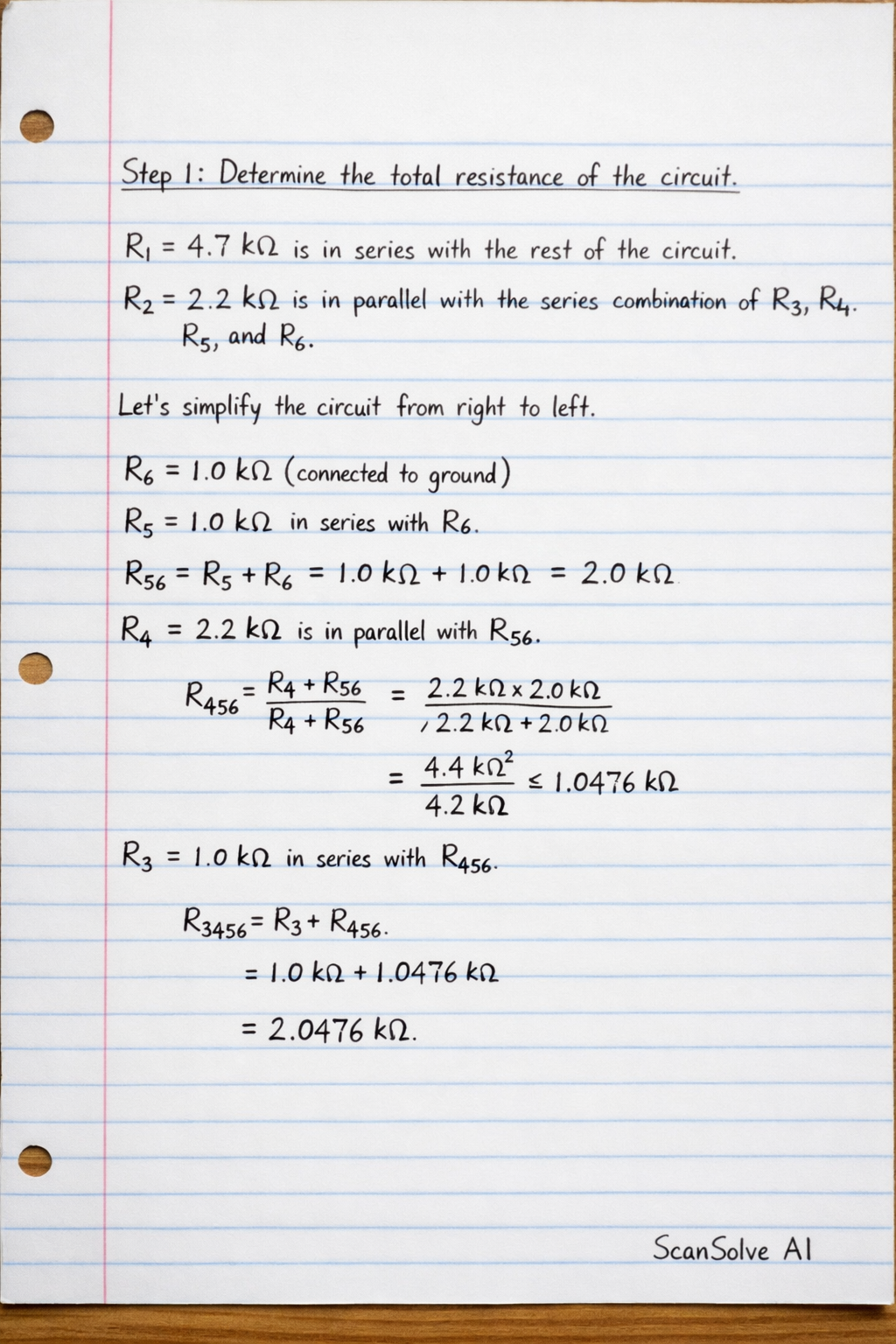
Handwritten Step-by-Step Solution
Get this as a handwritten image on WhatsApp — like a tutor wrote it for you.
Try on WhatsApp