
We read your photo as:
Two forces, 3 N due North and 4 N due East, act on an object. Calculate the resultant force and the equilibrium force.
ScanSolve AI Answer
Answer
Step-by-step solution
4 stepsIdentify the given forces and their directions.
The first force is acting Due North.
The second force is acting Due East.
Since North and East are perpendicular directions, the angle between the two forces is .Calculate the magnitude of the resultant force.
The magnitude of the resultant force of two perpendicular forces can be found using the Pythagorean theorem:
Determine the direction of the resultant force.
Let be the angle the resultant force makes with the East direction.
So, the resultant force is at an angle of approximately North of East.
Determine the equilibrium force.
The equilibrium force is a single force that, when added to the original forces, results in a net force of zero. Therefore, the equilibrium force has the same magnitude as the resultant force but acts in the exact opposite direction.
Magnitude of equilibrium force:Direction of equilibrium force:
Since the resultant force is North of East, the equilibrium force will be South of West.The equilibrium force is .
Try one yourself
A new problem that tests the same skill.
Still stuck on this one?
Ask a follow-up, and the answer starts from this question.
More Physics Questions
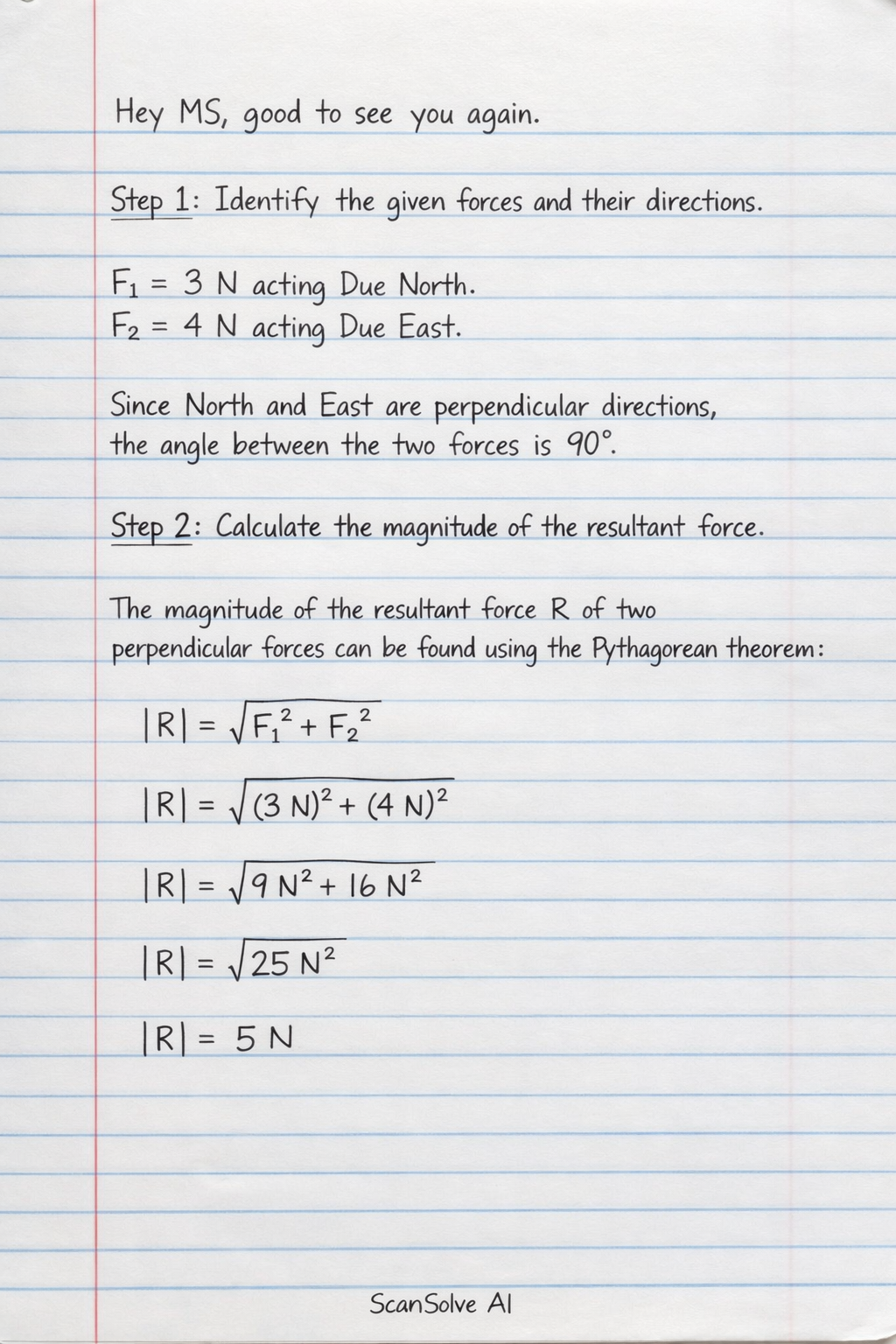
Handwritten Step-by-Step Solution
Get this as a handwritten image on WhatsApp — like a tutor wrote it for you.
Try on WhatsApp