

This physics problem tests your understanding of fundamental physical laws and their applications. The step-by-step solution below breaks down the problem using relevant equations and physical reasoning.
ScanSolve AI Answer
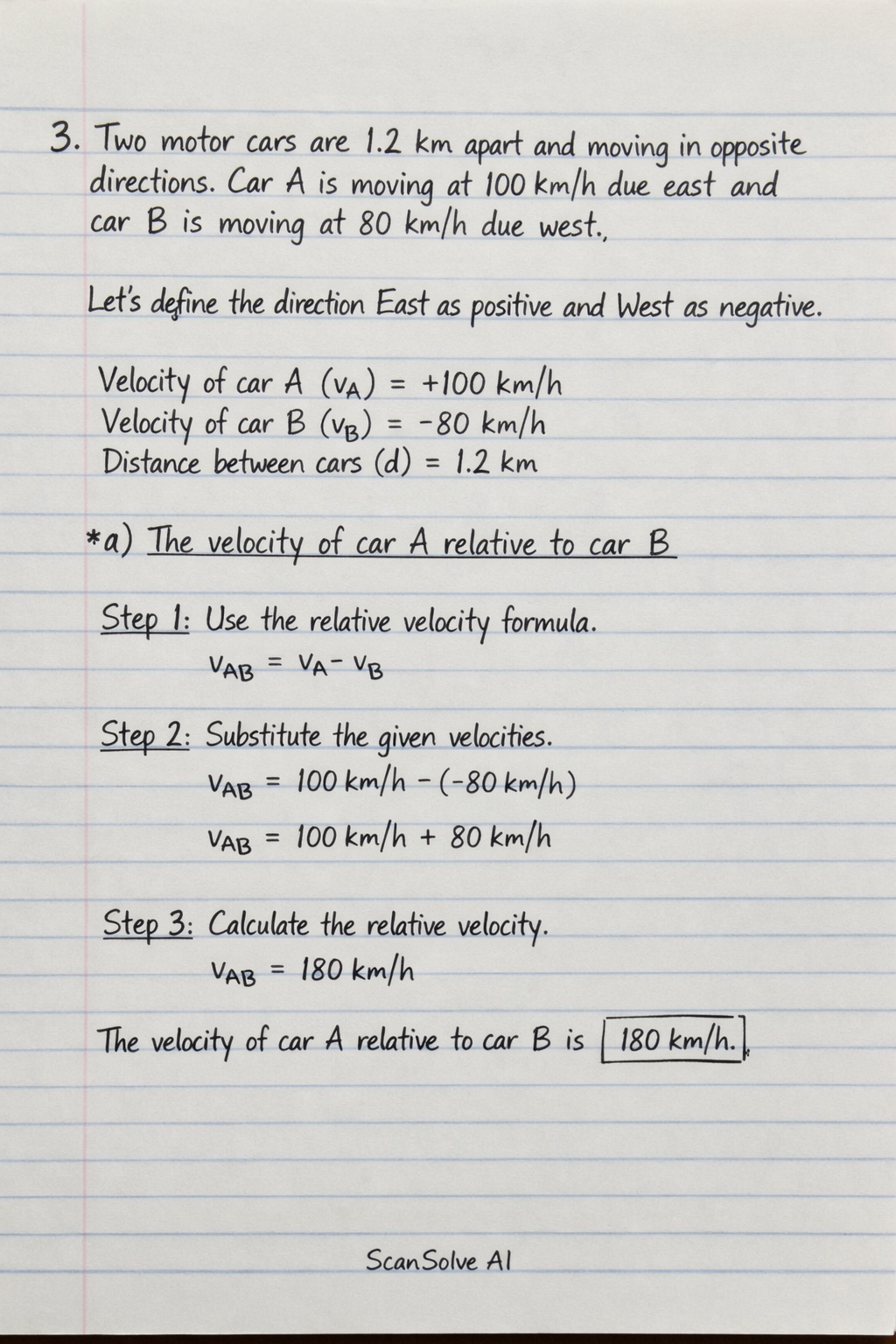
3. Two motor cars are 1.2 km apart and moving in opposite directions. Car A is moving at 100 km/h due east and car B is moving at 80 km/h due west. Let's define the direction East as positive and West as negative. Velocity of car A (v_A) = +100 km/h Velocity of car B (v_B) = -80 km/h Distance between cars (d) = 1.2 km a) The velocity of car A relative to car B. Step 1: Use the relative velocity formula. The velocity of car A relative to car B (v_AB) is given by: v_AB = v_A - v_B Step 2: Substitute the given velocities. v_AB = 100 km/h - (-80 km/h) v_AB = 100 km/h + 80 km/h Step 3: Calculate the relative velocity. v_AB = 180 km/h The velocity of car A relative to car B is 180 km/h. b) The time taken for the cars to reach each other. Step 1: Determine the relative speed of approach. Since the cars are moving towards each other, their relative speed of approach is the sum of their magnitudes, which is the magnitude of v_AB. v_rel = |v_A| + |v_B| = 100 km/h + 80 km/h = 180 km/h Step 2: Use the formula for time (t = distancespeed). t = (d)/(v_rel) Step 3: Substitute the distance and relative speed. t = 1.2 km180 km/h Step 4: Calculate the time. t = (1.2)/(180) hours t = (12)/(1800) hours t = (1)/(150) hours To express in minutes: t = (1)/(150) × 60 minutes = (60)/(150) minutes = (2)/(5) minutes = 0.4 minutes The time taken for the cars to reach each other is 0.4 minutes or (1)/(150) hours. c) The distance car A travels to reach car B. Step 1: Use the formula for distance (d = speed × time). d_A = v_A × t Step 2: Substitute the velocity of car A and the time calculated in part (b). d_A = 100 km/h × (1)/(150) hours Step 3: Calculate the distance. d_A = (100)/(150) km d_A = (2)/(3) km The distance car A travels is (2)/(3) km or approximately 0.667 km. What's next?