
We read your photo as:
Two-point charges +9q and -q are kept 10 cm apart. Find a point on the line joining the charges, where electric potential is zero.
ScanSolve AI Answer
This answer stops before the end.
It was cut off when it was first written. Ask ScanSolve this question again for the full working.
Step-by-step solution
4 stepsDefine the charges and their separation.
Let the first charge be and the second charge be .
The distance between the charges is cm.
The electric potential due to a point charge at a distance is given by , where is Coulomb's constant.Set up the equation for zero electric potential.
We are looking for a point where the total electric potential is zero. Let this point be .
The total potential at is the sum of the potentials due to and :where is the distance from to , and is the distance from to .
We want , so:Analyze the possible locations for point P.
There are two regions on the line joining the charges where the potential can be zero:
-
Region A: Between the charges. Let the point be at a distance from . Then . The distance from will be . Substitute these into the equation :
This means the point is 9 cm from . This is a valid solution as .
-
Region B: Outside the charges, to the right of . Let the point be at a distance from . Then . The distance from will be . Substitute these into the equation :
This means the point is 11.25 cm from . This is also a valid solution as .
-
Region C: Outside the charges, to the left of . Let the point be at a distance to the left of . Then . The distance from will be . Substitute these into the equation :
Since distance cannot be negative, there is no solution in this region. This is expected because the zero potential point must be closer to the charge with the smaller magnitude, which is .
-
Compare the solutions with the given options.
We found two points where the electric potential is zero:
- 9 cm from .
- 11.25 cm from (which is 1.25 cm from ).
Let's check the options:
(1) 1 cm from (Incorrect)
(2) 9 cm from . If this is between the charges, it means 1 cm from . (Incorrect)
(3) 9 cm from (Correct, matches our first solution)
(4) 5 cm from . If this is between the charges, it means 5 cm from . (Incorrect)
Still stuck on this one?
Ask a follow-up, and the answer starts from this question.
More Physics Questions
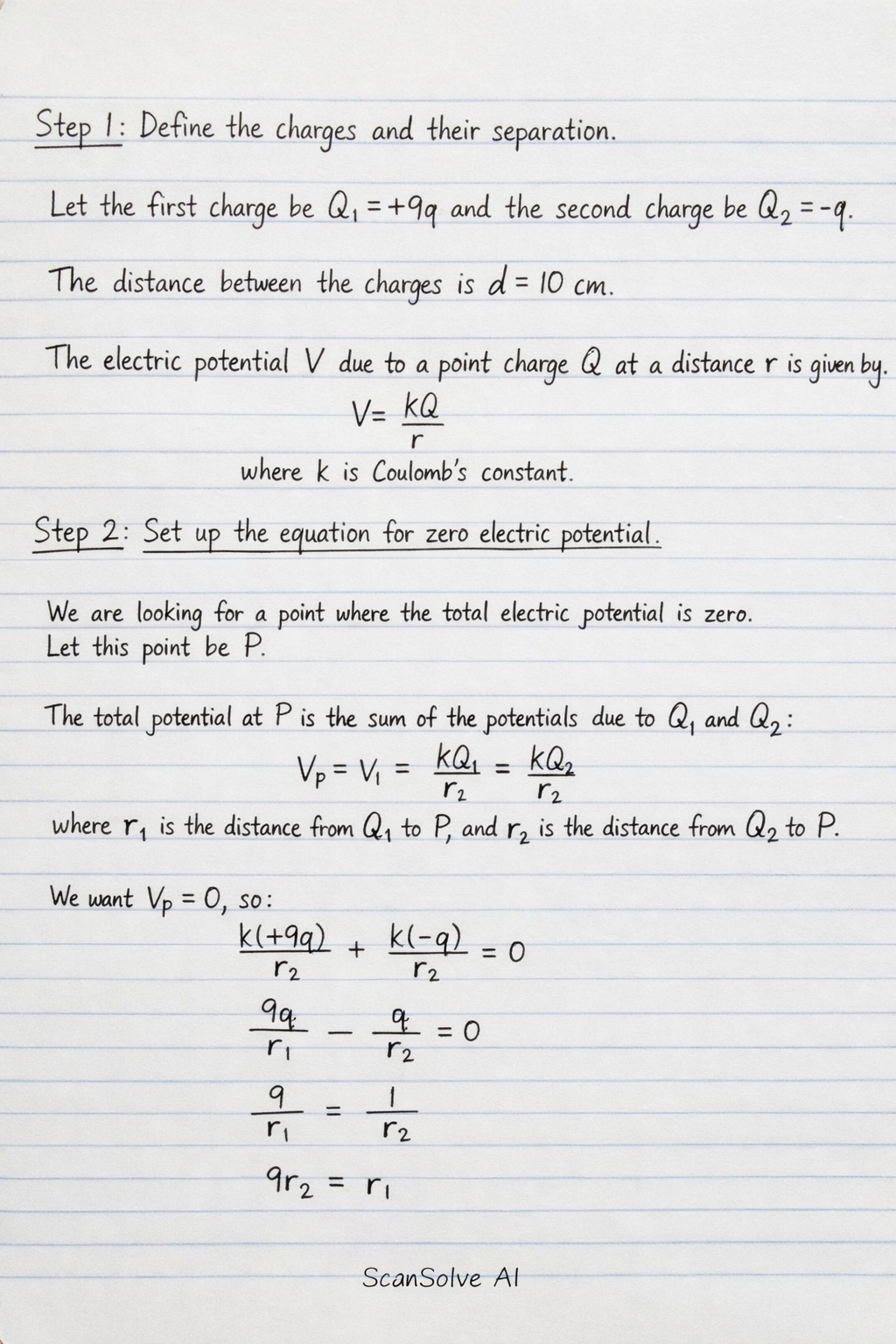
Handwritten Step-by-Step Solution
Get this as a handwritten image on WhatsApp — like a tutor wrote it for you.
Try on WhatsApp