
We read your photo as:
Two point charges, q1 = 2.1 imes 10⁻⁵ ext C and q2 = 4q1, are separated by a distance of 10 cm. Calculate the electric field intensity at point P, which is 8 cm from q1 and 6 cm from q2. Assume k = 9
Physics
ScanSolve AI Answer
Step-by-step solution
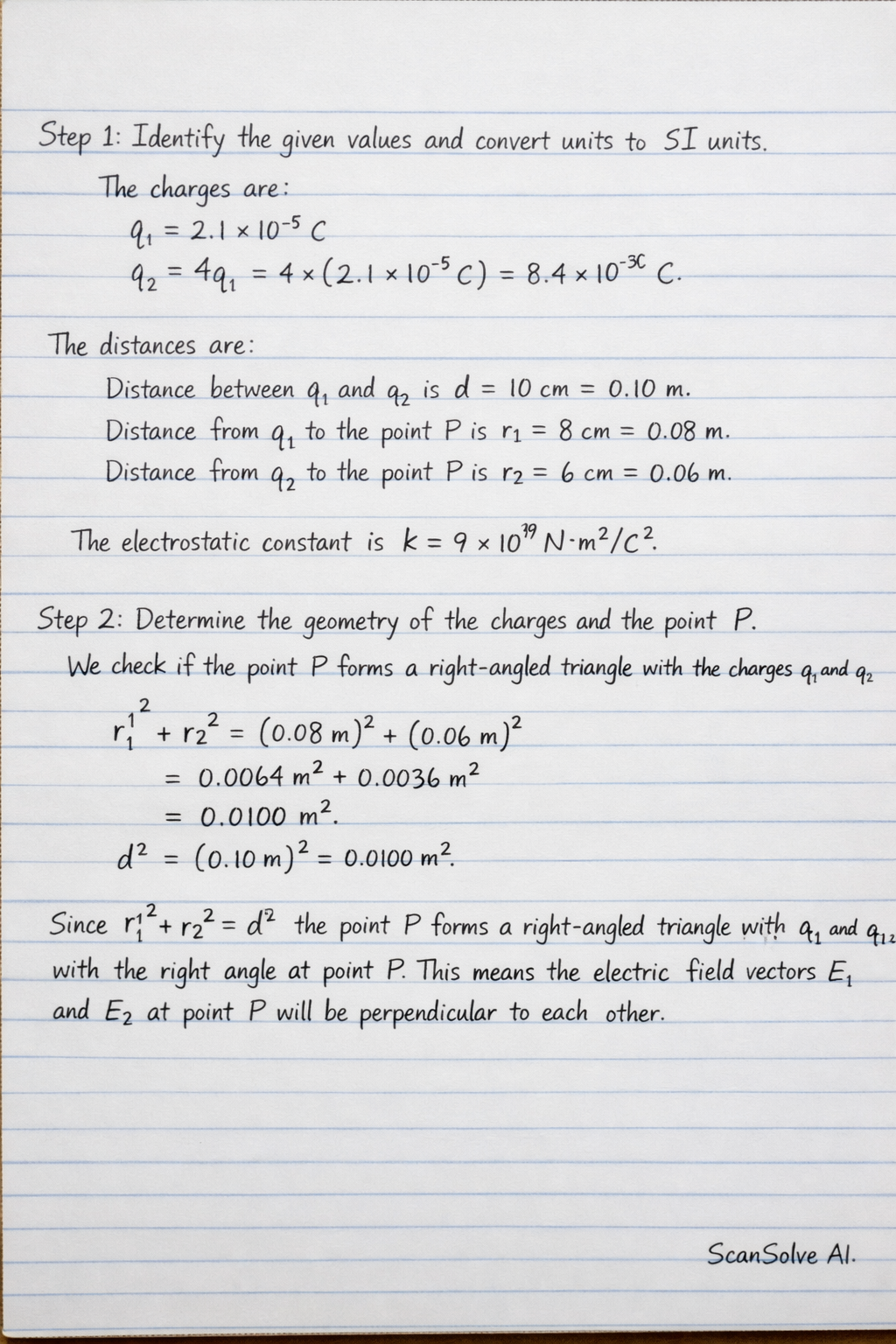
4 stepsIdentify the given values and convert units to SI units.
The charges are:
The distances are:
Distance between and is .
Distance from to the point P is .
Distance from to the point P is .The electrostatic constant is .
Determine the geometry of the charges and the point P.
We check if the point P forms a right-angled triangle with the charges and .
.
.
Since , the point P forms a right-angled triangle with and , with the right angle at point P. This means the electric field vectors and at point P will be perpendicular to each other.Calculate the electric field intensity due to each charge.
The formula for the electric field intensity due to a point charge is .
For charge :
For charge :
Calculate the resultant electric field intensity.
Since $
Was this helpful?
Still stuck on this one?
Ask a follow-up, and the answer starts from this question.
Got a different question?Ask your own question
More Physics Questions
QCalculate the electrostatic force between two point charges q1 = 2 imes 10⁻⁷ C and q2 = 3 imes 10⁻⁷…QTwo point charges, q1 at position (2, 2, 1) and q2 at the origin, exert an electrostatic force on…QCalculate the electrostatic force between two spheres with charges q1 = 2 × 10⁻⁷ C and q2 = 3 × 10⁻⁷…QTwo spheres have charges q1 = q2 = 6.5 imes 10⁻⁷ C and are separated by r = 50 cm. Calculate the…QIf point A is between the two charges. And charge q1 is 5cm from A and q2 is 15cm from A on the…
Browse by topic:Electromagnetism
Handwritten Step-by-Step Solution
Get this as a handwritten image on WhatsApp — like a tutor wrote it for you.
Try on WhatsApp