We read your photo as:

Two sheets of metal are bolted together with a bolt of diameter 12 mm. If the minimum force required to break the pin is 80 kN, calculate the maximum shear stress for the bolt.

Physics

ScanSolve AI Answer

Answers

6 parts
5

707.26 MPa\text{707.26 MPa}

a

75 kPa\text{75 kPa}

b

112.5 kPa\text{112.5 kPa}

7

30.66 mm2\text{30.66 mm}^2

24.53 mm2\text{24.53 mm}^2

8

282.78 kN\text{282.78 kN}

9

24.60 mm\text{24.60 mm}

Step-by-step solution

19 steps

Part 5· 3 steps

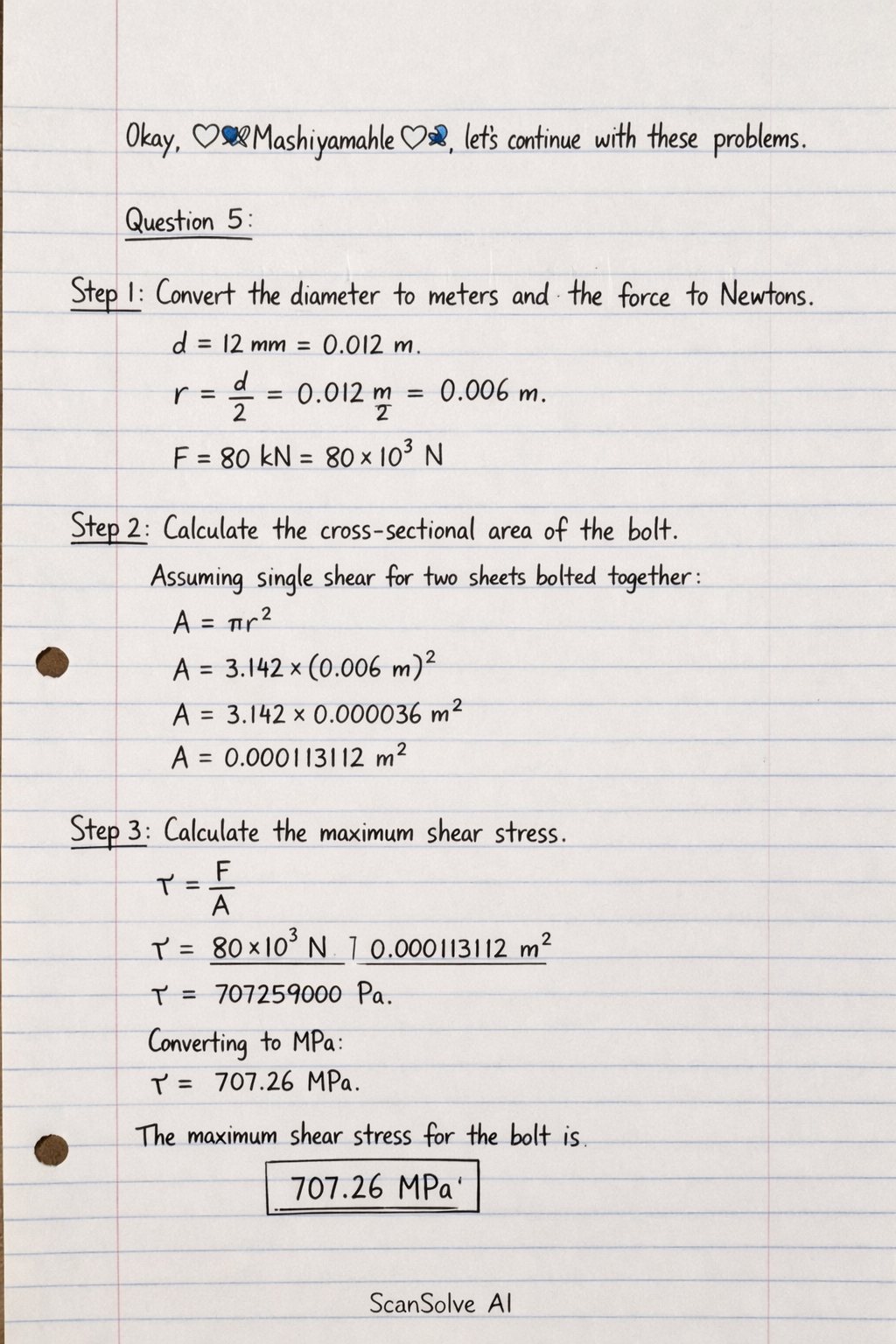
  1. Convert the diameter to meters and the force to Newtons.

    The diameter d=12 mm=0.012 md = 12 \text{ mm} = 0.012 \text{ m}.
    The radius r=d2=0.012 m2=0.006 mr = \frac{d}{2} = \frac{0.012 \text{ m}}{2} = 0.006 \text{ m}.
    The force F=80 kN=80×103 NF = 80 \text{ kN} = 80 \times 10^3 \text{ N}.

  2. Calculate the cross-sectional area of the bolt.

    Assuming single shear for two sheets bolted together:

    A=πr2=3.142×(0.006 m)2=3.142×0.000036 m2=0.000113112 m2A = \pi r^2 = 3.142 \times (0.006 \text{ m})^2 = 3.142 \times 0.000036 \text{ m}^2 = 0.000113112 \text{ m}^2
  3. Calculate the maximum shear stress.

    τ=FA=80×103 N0.000113112 m2=707259000 Pa\tau = \frac{F}{A} = \frac{80 \times 10^3 \text{ N}}{0.000113112 \text{ m}^2} = 707259000 \text{ Pa}

    Converting to MPa: τ=707.26 MPa\tau = 707.26 \text{ MPa}.
    The maximum shear stress for the bolt is 707.26 MPa\boxed{\text{707.26 MPa}}

Part 6

Part a

75 kPa\text{75 kPa}

The normal stress due to the axial force.

  1. Convert dimensions to meters and the axial force to Newtons.

    The width w=80 cm=0.80 mw = 80 \text{ cm} = 0.80 \text{ m}.
    The height h=20 cm=0.20 mh = 20 \text{ cm} = 0.20 \text{ m}.
    The axial force Faxial=12 kN=12×103 NF_{axial} = 12 \text{ kN} = 12 \times 10^3 \text{ N}.

  2. Calculate the cross-sectional area.

    A=w×h=0.80 m×0.20 m=0.16 m2A = w \times h = 0.80 \text{ m} \times 0.20 \text{ m} = 0.16 \text{ m}^2
  3. Calculate the normal stress.

    σ=FaxialA=12×103 N0.16 m2=75000 Pa\sigma = \frac{F_{axial}}{A} = \frac{12 \times 10^3 \text{ N}}{0.16 \text{ m}^2} = 75000 \text{ Pa}

    Converting to kPa: σ=75 kPa\sigma = 75 \text{ kPa}.
    The normal stress is 75 kPa\boxed{\text{75 kPa}}

Part b

112.5 kPa\text{112.5 kPa}

The shear stress due to a shear force of 18 kN.

  1. Convert the shear force to Newtons.

    The shear force Fshear=18 kN=18×103 NF_{shear} = 18 \text{ kN} = 18 \times 10^3 \text{ N}.
    The cross-sectional area is A=0.16 m2A = 0.16 \text{ m}^2 (from part a).

  2. Calculate the average shear stress.

    τ=FshearA=18×103 N0.16 m2=112500 Pa\tau = \frac{F_{shear}}{A} = \frac{18 \times 10^3 \text{ N}}{0.16 \text{ m}^2} = 112500 \text{ Pa}

    Converting to kPa: τ=112.5 kPa\tau = 112.5 \text{ kPa}.
    The shear stress is 112.5 kPa\boxed{\text{112.5 kPa}}

Part 7

30.66 mm2\text{30.66 mm}^2

  1. Calculate the total weight of the bar.

    The mass m=500 kgm = 500 \text{ kg}.
    Assume acceleration due to gravity g=9.81 m/s2g = 9.81 \text{ m/s}^2.
    The total weight W=m×g=500 kg×9.81 m/s2=4905 NW = m \times g = 500 \text{ kg} \times 9.81 \text{ m/s}^2 = 4905 \text{ N}.

  2. Determine the force supported by each cable.

    Since the bar is homogeneous and supported at both ends by two cables, the weight is evenly distributed.
    The force per cable Fcable=W2=4905 N2=2452.5 NF_{cable} = \frac{W}{2} = \frac{4905 \text{ N}}{2} = 2452.5 \text{ N}.

  3. Calculate the smallest area for a copper cable.

    The maximum allowable stress for copper σCu=80 MPa=80×106 Pa\sigma_{Cu} = 80 \text{ MPa} = 80 \times 10^6 \text{ Pa}.

    ACu=FcableσCu=2452.5 N80×106 Pa=0.00003065625 m2A_{Cu} = \frac{F_{cable}}{\sigma_{Cu}} = \frac{2452.5 \text{ N}}{80 \times 10^6 \text{ Pa}} = 0.00003065625 \text{ m}^2

    Converting to mm2^2: ACu=0.00003065625 m2×(1000 mm/m)2=30.65625 mm2A_{Cu} = 0.00003065625 \text{ m}^2 \times (1000 \text{ mm/m})^2 = 30.65625 \text{ mm}^2.
    The smallest area for a copper cable is 30.66 mm2\boxed{\text{30.66 mm}^2}

  4. Calculate the smallest area for a steel cable.

    The maximum allowable stress for steel σSt=100 MPa=100×106 Pa\sigma_{St} = 100 \text{ MPa} = 100 \times 10^6 \text{ Pa}.

    ASt=FcableσSt=2452.5 N100×106 Pa=0.000024525 m2A_{St} = \frac{F_{cable}}{\sigma_{St}} = \frac{2452.5 \text{ N}}{100 \times 10^6 \text{ Pa}} = 0.000024525 \text{ m}^2

    Converting to mm2^2: ASt=0.000024525 m2×(1000 mm/m)2=24.525 mm2A_{St} = 0.000024525 \text{ m}^2 \times (1000 \text{ mm/m})^2 = 24.525 \text{ mm}^2.
    The smallest area for a steel cable is 24.53 mm2\boxed{\text{24.53 mm}^2}

Part 8

282.78 kN\text{282.78 kN}

  1. Convert the diameter and thickness to meters, and shear strength to Pascals.

    The hole diameter d=15 mm=0.015 md = 15 \text{ mm} = 0.015 \text{ m}.
    The plate thickness t=20 mm=0.020 mt = 20 \text{ mm} = 0.020 \text{ m}.
    The shear strength τ=300 MN/m2=300×106 Pa\tau = 300 \text{ MN/m}^2 = 300 \times 10^6 \text{ Pa}.

  2. Calculate the shear area.

    A=πdt=3.142×0.015 m×0.020 m=0.0009426 m2A = \pi d t = 3.142 \times 0.015 \text{ m} \times 0.020 \text{ m} = 0.0009426 \text{ m}^2
  3. Calculate the force required.

    F=τ×A=300×106 Pa×0.0009426 m2=282780 NF = \tau \times A = 300 \times 10^6 \text{ Pa} \times 0.0009426 \text{ m}^2 = 282780 \text{ N}

    Converting to kN: F=282.78 kNF = 282.78 \text{ kN}.
    The force required is 282.78 kN\boxed{\text{282.78 kN}}

Part 9

24.60 mm\text{24.60 mm}

  1. Convert the force to Newtons and the shearing strength to Pascals.

    The force F=380 kN=380×103 NF = 380 \text{ kN} = 380 \times 10^3 \text{ N}.
    The shearing strength τ=400 MPa=400×106 Pa\tau = 400 \text{ MPa} = 400 \times 10^6 \text{ Pa}.

  2. Calculate the required total shear area.

    Atotal=Fτ=380×103 N400×106 Pa=0.00095 m2A_{total} = \frac{F}{\tau} = \frac{380 \times 10^3 \text{ N}}{400 \times 10^6 \text{ Pa}} = 0.00095 \text{ m}^2
  3. Calculate the area of one shear plane for a clevis joint (double shear).

    For a clevis, the force is resisted by two shear planes, so Atotal=2×ApinA_{total} = 2 \times A_{pin}.

    Apin=Atotal2=0.00095 m22=0.000475 m2A_{pin} = \frac{A_{total}}{2} = \frac{0.00095 \text{ m}^2}{2} = 0.000475 \text{ m}^2
  4. Calculate the diameter of the bolt.

    The area of one pin is Apin=π(d2)2A_{pin} = \pi (\frac{d}{2})^2.

    0.000475 m2=3.142×(d2)20.000475 \text{ m}^2 = 3.142 \times \left(\frac{d}{2}\right)^2 (d2)2=0.000475 m23.142=0.00015118 m2\left(\frac{d}{2}\right)^2 = \frac{0.000475 \text{ m}^2}{3.142} = 0.00015118 \text{ m}^2 d2=0.00015118 m2=0.01230 m\frac{d}{2} = \sqrt{0.00015118 \text{ m}^2} = 0.01230 \text{ m} d=2×0.01230 m=0.02460 md = 2 \times 0.01230 \text{ m} = 0.02460 \text{ m}

    Converting to millimeters: d=0.02460 m×1000 mm/m=24.60 mmd = 0.02460 \text{ m} \times 1000 \text{ mm/m} = 24.60 \text{ mm}.
    The smallest diameter bolt is 24.60 mm\boxed{\text{24.60 mm}}

Was this helpful?

Try one yourself

A new problem that tests the same skill.

Still stuck on this one?

Ask a follow-up, and the answer starts from this question.

Got a different question?Ask your own question
Handwritten step-by-step solution preview

Handwritten Step-by-Step Solution

Get this as a handwritten image on WhatsApp — like a tutor wrote it for you.

Try on WhatsApp