
We read your photo as:
Two soap bubbles of radii 3 cm and 6 cm coalesce in a vacuum under isothermal conditions. What is the radius of the resulting bubble?
ScanSolve AI Answer
Step-by-step solution
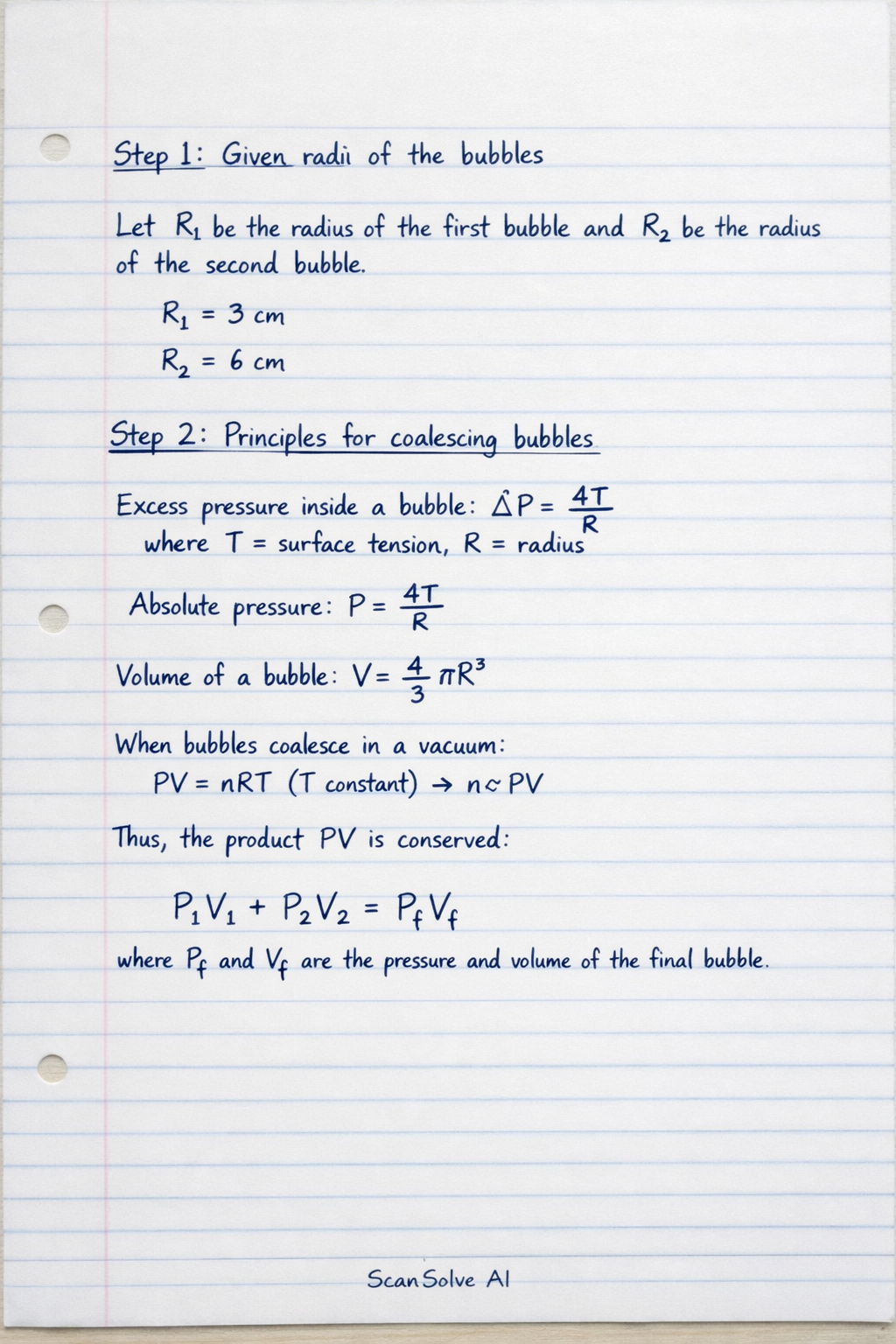
4 stepsIdentify the given radii of the two initial soap bubbles.
Let be the radius of the first bubble and be the radius of the second bubble.
Recall the physical principles for coalescing soap bubbles in a vacuum under isothermal conditions.
For a soap bubble, the excess pressure inside is given by , where is the surface tension and is the radius. Since the bubbles are in a vacuum, the external pressure is 0, so the absolute pressure inside the bubble is .
The volume of a spherical bubble is .
When two bubbles coalesce under isothermal conditions, the total number of moles of gas inside is conserved. From the ideal gas law (), since is constant, . Therefore, the product is conserved:where and are the pressure and volume of the final bubble.
Substitute the expressions for pressure and volume into the conservation equation.
Cancel the common factor from all terms:
Calculate the radius of the final bubble ().
Substitute the given values for and :
The numerical value is approximately:
The radius of the bubble formed is
\boxed{\text{3\sqrt{5} cm}}.
Still stuck on this one?
Ask a follow-up, and the answer starts from this question.
More Physics Questions
Handwritten Step-by-Step Solution
Get this as a handwritten image on WhatsApp — like a tutor wrote it for you.
Try on WhatsApp