
We read your photo as:
Two wires of the same length and of the same materials have different diameters, d, and d2 (d,<d2) determine which wire has greater (i) conductivity? (ii) Conductance? 8. a. (i) State the fundamental laws of conservation of electric charges. (ii) What will happened to a
ScanSolve AI Answer
Step-by-step solution
6 stepsHere are the solutions to the questions from the image:
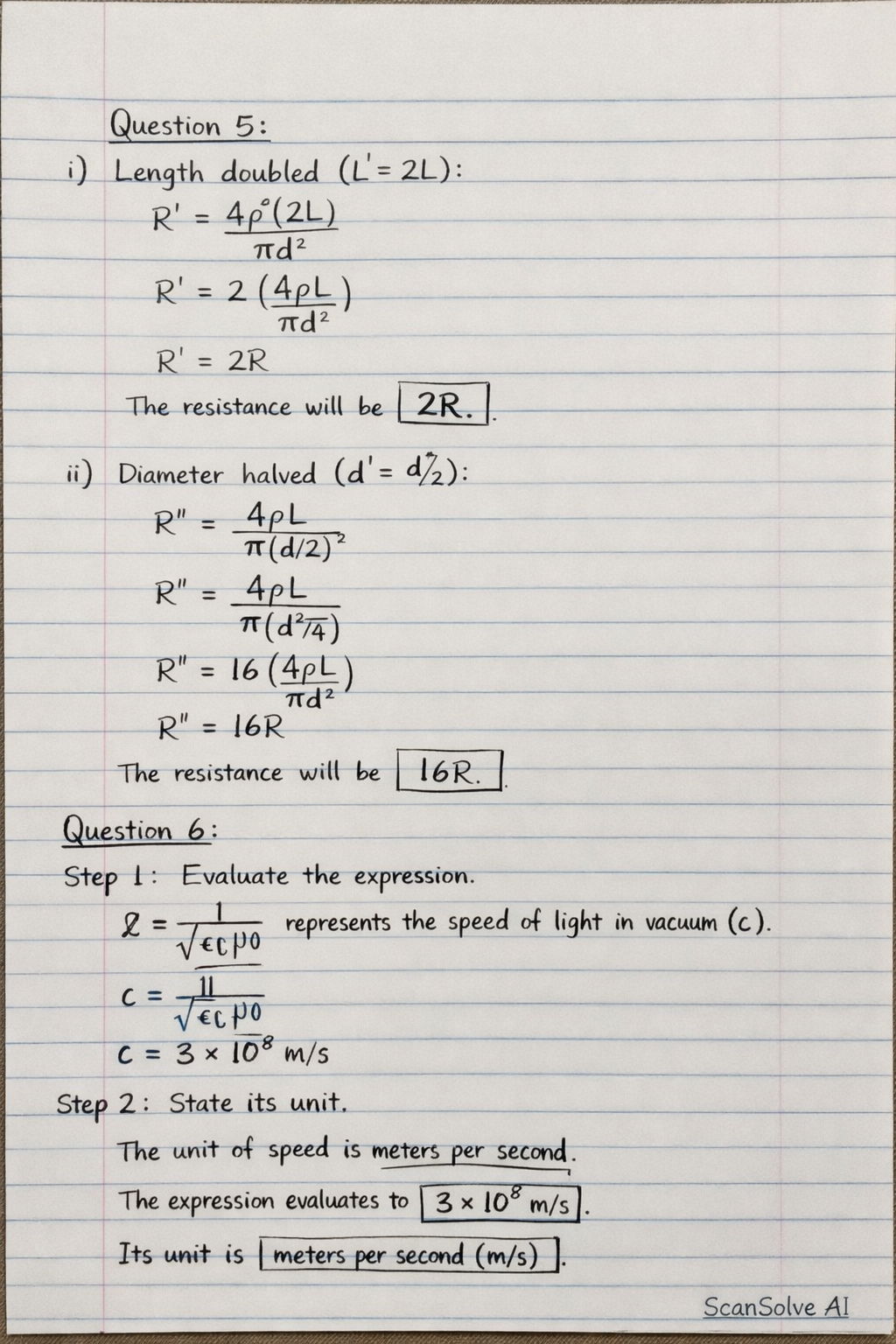
Question 5:
The resistance of a wire is .
i) If its length is doubled ():
Calculate the new resistance .
The resistance will be .
ii) If its diameter is halved ():
Calculate the new resistance .
The resistance will be .
Question 6:
Evaluate the expression.
The expression represents the speed of light in vacuum ().
State its unit.
The unit of speed is meters per second.
The expression evaluates to .
Its unit is .Question 7:
Given: Two wires of the same length () and same material (resistivity , conductivity ). They have different diameters and , with .i) Which wire has greater conductivity?
Compare conductivities.
Conductivity () is an intrinsic property of the material. Since both wires are made of the same material, their conductivities are equal.
The wire with greater conductivity is .ii) Which wire has greater conductance?
Compare conductances.
Conductance () is the reciprocal of resistance (), .
Since and , the wire with the larger diameter () will have greater conductance.
The wire with greater conductance is .Question 8:
a) (i) State the fundamental laws of conservation of electric charges.
The law of conservation of electric charge states that the net electric charge of an isolated system remains constant. Charge can neither be created nor destroyed, but it can be transferred from one object to another.a) (ii) What will happened to a
This question is incomplete and cannot be answered.
Still stuck on this one?
Ask a follow-up, and the answer starts from this question.
More Physics Questions
Handwritten Step-by-Step Solution
Get this as a handwritten image on WhatsApp — like a tutor wrote it for you.
Try on WhatsApp