
We read your photo as:
Two wires of the same material have resistances R1 and R2. The first wire has length L1 and diameter D1. The second wire has length L2 and diameter D2. Express R2/R1 in terms of L1, L2, D1, D2.
ScanSolve AI Answer
Answers
3 partsStep-by-step solution
12 stepsPart 15· 6 steps
Resistance of a wire
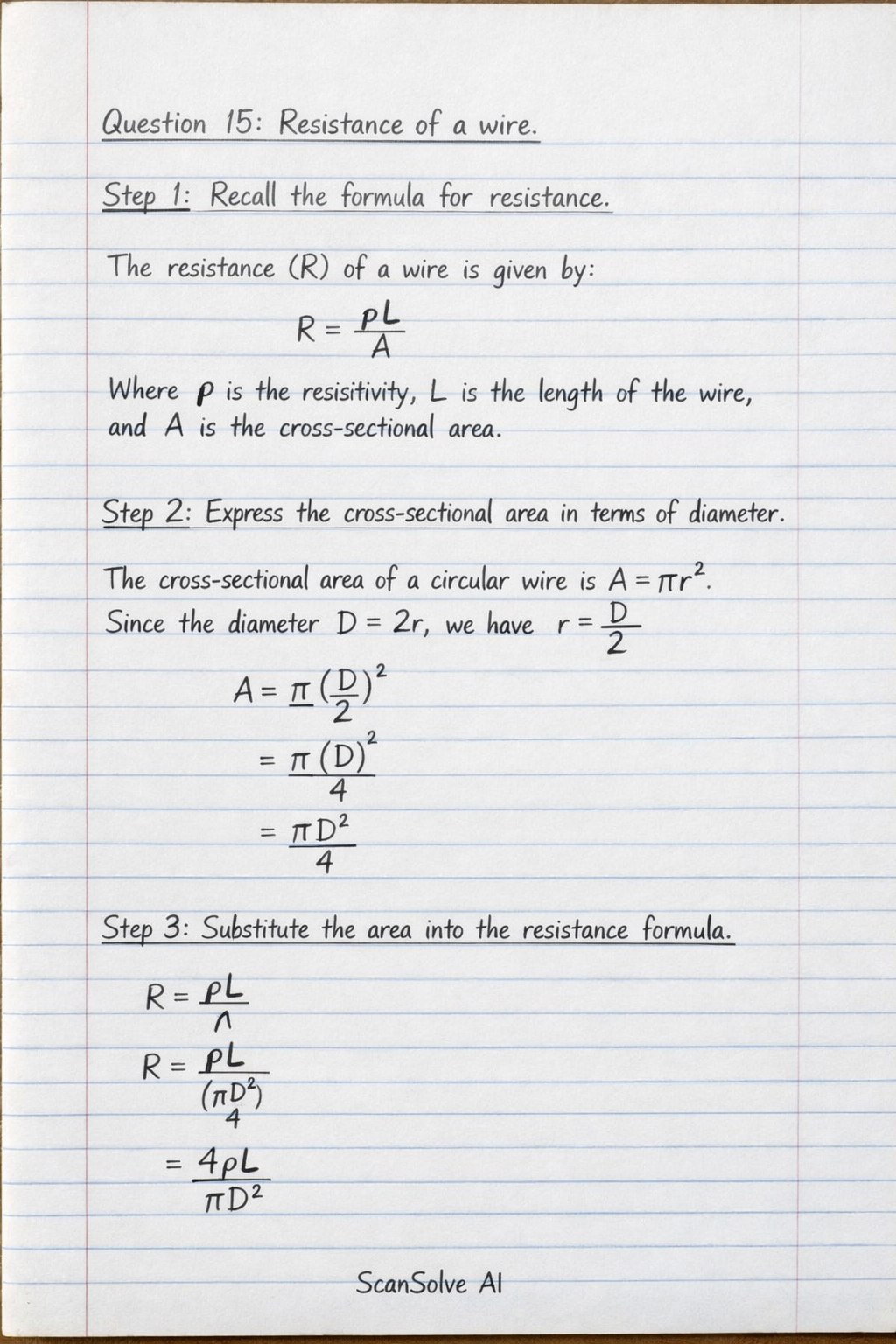
Recall the formula for resistance.
The resistance () of a wire is given by:
Where is the resistivity of the material, is the length of the wire, and is the cross-sectional area.
Express the cross-sectional area in terms of diameter.
The cross-sectional area of a circular wire is , where is the radius. Since the diameter , we have .
Substitute the area into the resistance formula.
Set up a ratio for the two wires.
Since both wires are made of the same material, their resistivity () is the same. The term is constant for both wires.
Let be the resistance, length, and diameter of the first wire, and for the second wire.Substitute the given values.
Given:
Solve for .
Comparing this value to the options, is closest to .
The resistance of the second wire is approximately .
Part 16
Acceleration of an object with constant velocity
Understand the definition of acceleration.
Acceleration is the rate of change of velocity.
Apply the definition to constant velocity.
If an object moves with a constant velocity, it means its velocity is not changing. Therefore, the change in velocity () is zero.
Calculate the acceleration.
Since , the acceleration () must be zero.
The acceleration of the object is .
Part 17
Distance directly proportional to time
Interpret "distance covered by an object is directly proportional to time".
This means that if is distance and is time, then:
This can be written as , where is a constant of proportionality.
Relate this to velocity.
Velocity () is defined as the rate of change of distance with respect to time:
If , then differentiating with respect to time gives:
Since is a constant, the velocity () is constant.
Conclude the type of motion.
An object moving with constant velocity is said to travel with constant speed (assuming the direction is also constant, which is implied by "distance covered" in a single direction).
The object is said to travel with .
Try one yourself
A new problem that tests the same skill.
Still stuck on this one?
Ask a follow-up, and the answer starts from this question.
More Physics Questions
Handwritten Step-by-Step Solution
Get this as a handwritten image on WhatsApp — like a tutor wrote it for you.
Try on WhatsApp