Using step by step method to solve all the questions

Physics

ScanSolve AI Answer

Answer

RAx=15 kN (to the left)R_{Ax} = 15 \text{ kN (to the left)}

RB≈30.71 kN (upward)R_B \approx 30.71 \text{ kN (upward)}

RAy≈29.29 kN (upward)R_{Ay} \approx 29.29 \text{ kN (upward)}

Step-by-step solution

4 steps

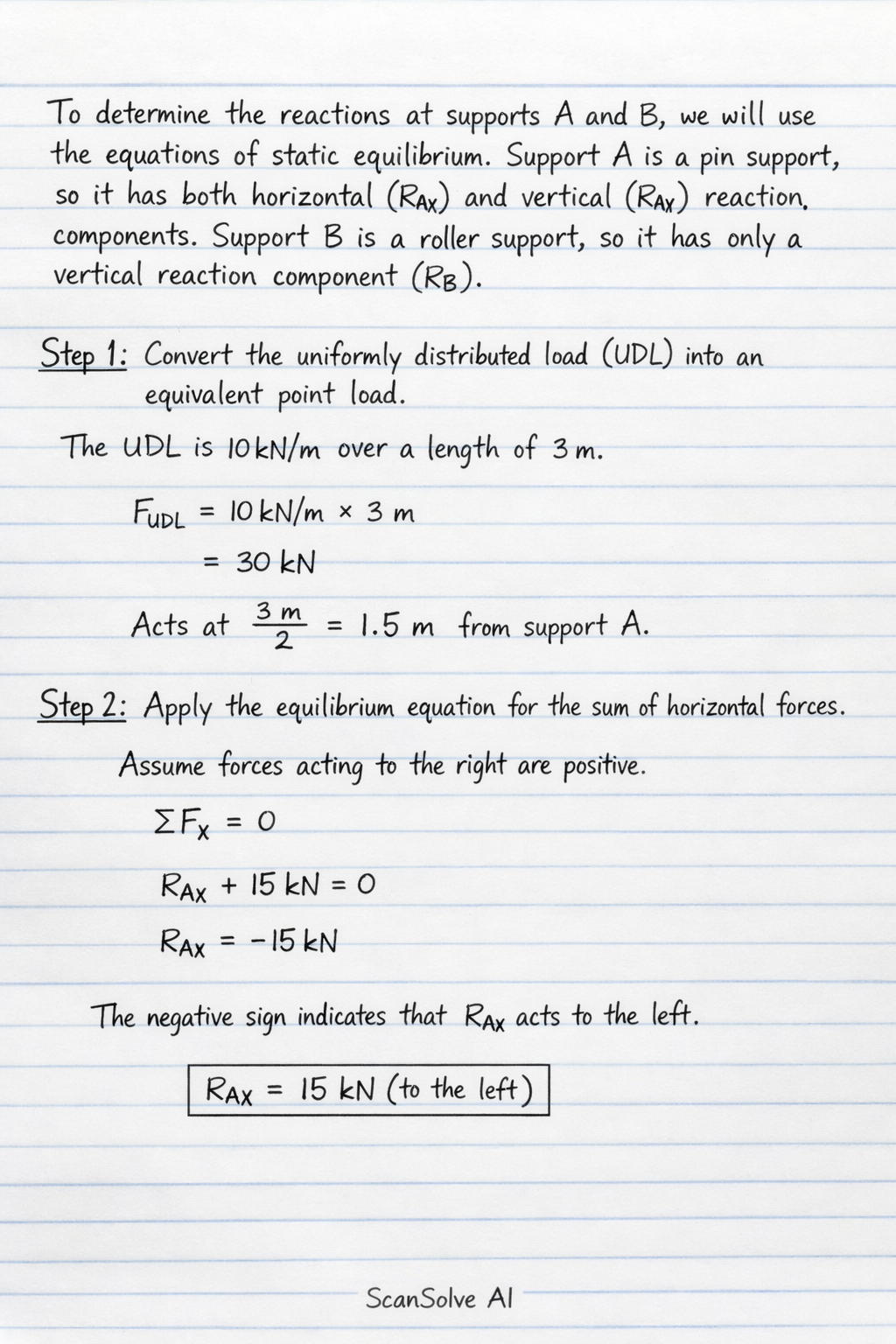
To determine the reactions at supports A and B, we will use the equations of static equilibrium. Support A is a pin support, so it has both horizontal (RAxR_{Ax}) and vertical (RAyR_{Ay}) reaction components. Support B is a roller support, so it has only a vertical reaction component (RBR_B).

  1. Convert the uniformly distributed load (UDL) into an equivalent point load.

    The UDL is 10 kN/m10 \text{ kN/m} over a length of 3 m3 \text{ m}.
    The equivalent point load FUDLF_{UDL} is:

    FUDL=10 kN/m×3 m=30 kNF_{UDL} = 10 \text{ kN/m} \times 3 \text{ m} = 30 \text{ kN}

    This equivalent load acts at the centroid of the UDL, which is 3 m/2=1.5 m3 \text{ m} / 2 = 1.5 \text{ m} from support A.

  2. Apply the equilibrium equation for the sum of horizontal forces.

    Assume forces acting to the right are positive.

    ∑Fx=0\sum F_x = 0 RAx+15 kN=0R_{Ax} + 15 \text{ kN} = 0 RAx=−15 kNR_{Ax} = -15 \text{ kN}

    The negative sign indicates that RAxR_{Ax} acts to the left.

    RAx=15 kN (to the left)\boxed{R_{Ax} = 15 \text{ kN (to the left)}}
  3. Apply the equilibrium equation for the sum of moments about point A.

    Assume counter-clockwise moments are positive. The horizontal force of 15 kN15 \text{ kN} passes through point A's horizontal line of action, so it creates no moment about A.

    ∑MA=0\sum M_A = 0 −(FUDL×1.5 m)−(20 kN×5 m)−(10 kN×7 m)+(RB×7 m)=0-(F_{UDL} \times 1.5 \text{ m}) - (20 \text{ kN} \times 5 \text{ m}) - (10 \text{ kN} \times 7 \text{ m}) + (R_B \times 7 \text{ m}) = 0 −(30 kN×1.5 m)−(20 kN×5 m)−(10 kN×7 m)+(RB×7 m)=0-(30 \text{ kN} \times 1.5 \text{ m}) - (20 \text{ kN} \times 5 \text{ m}) - (10 \text{ kN} \times 7 \text{ m}) + (R_B \times 7 \text{ m}) = 0 −45 kNm−100 kNm−70 kNm+7RB m=0-45 \text{ kNm} - 100 \text{ kNm} - 70 \text{ kNm} + 7 R_B \text{ m} = 0 −215 kNm+7RB m=0-215 \text{ kNm} + 7 R_B \text{ m} = 0 7RB=215 kN7 R_B = 215 \text{ kN} RB=2157 kNR_B = \frac{215}{7} \text{ kN} RB≈30.71 kN (upward)\boxed{R_B \approx 30.71 \text{ kN (upward)}}
  4. Apply the equilibrium equation for the sum of vertical forces.

    Assume upward forces are positive.

    ∑Fy=0\sum F_y = 0 RAy+RB−FUDL−20 kN−10 kN=0R_{Ay} + R_B - F_{UDL} - 20 \text{ kN} - 10 \text{ kN} = 0 RAy+2157 kN−30 kN−20 kN−10 kN=0R_{Ay} + \frac{215}{7} \text{ kN} - 30 \text{ kN} - 20 \text{ kN} - 10 \text{ kN} = 0 RAy+2157 kN−60 kN=0R_{Ay} + \frac{215}{7} \text{ kN} - 60 \text{ kN} = 0 RAy=60 kN−2157 kNR_{Ay} = 60 \text{ kN} - \frac{215}{7} \text{ kN} RAy=60×7−2157 kNR_{Ay} = \frac{60 \times 7 - 215}{7} \text{ kN} RAy=420−2157 kNR_{Ay} = \frac{420 - 215}{7} \text{ kN} RAy=2057 kNR_{Ay} = \frac{205}{7} \text{ kN} RAy≈29.29 kN (upward)\boxed{R_{Ay} \approx 29.29 \text{ kN (upward)}}
Was this helpful?

Try one yourself

A new problem that tests the same skill.

Still stuck on this one?

Ask a follow-up, and the answer starts from this question.

Got a different question?Ask your own question
Handwritten step-by-step solution preview

Handwritten Step-by-Step Solution

Get this as a handwritten image on WhatsApp — like a tutor wrote it for you.

Try on WhatsApp