
We read your photo as:
Using the principle of homogeneity, determine the dimensions of the constant 'a' in the van der Waals equation.
ScanSolve AI Answer
Answer
Step-by-step solution
4 stepsUnderstand the Principle of Homogeneity.
The Principle of Homogeneity states that for an equation to be dimensionally consistent, all terms added or subtracted must have the same dimensions. In the given van der Waals equation:
For the term , the dimensions of must be the same as the dimensions of .
Therefore, we can write:Express the relationship to find the base units of .
From the equality above, we can rearrange to solve for the base units of :
Determine the base units for Pressure () and Volume ().
-
Pressure () is defined as Force per unit Area. Force () has base units of (from ). Area () has base units of . So, the base units of .
-
Volume () has base units of .
-
Substitute the base units into the expression for .
Combine the powers of :
The final answer is .
Try one yourself
A new problem that tests the same skill.
Still stuck on this one?
Ask a follow-up, and the answer starts from this question.
More Physics Questions
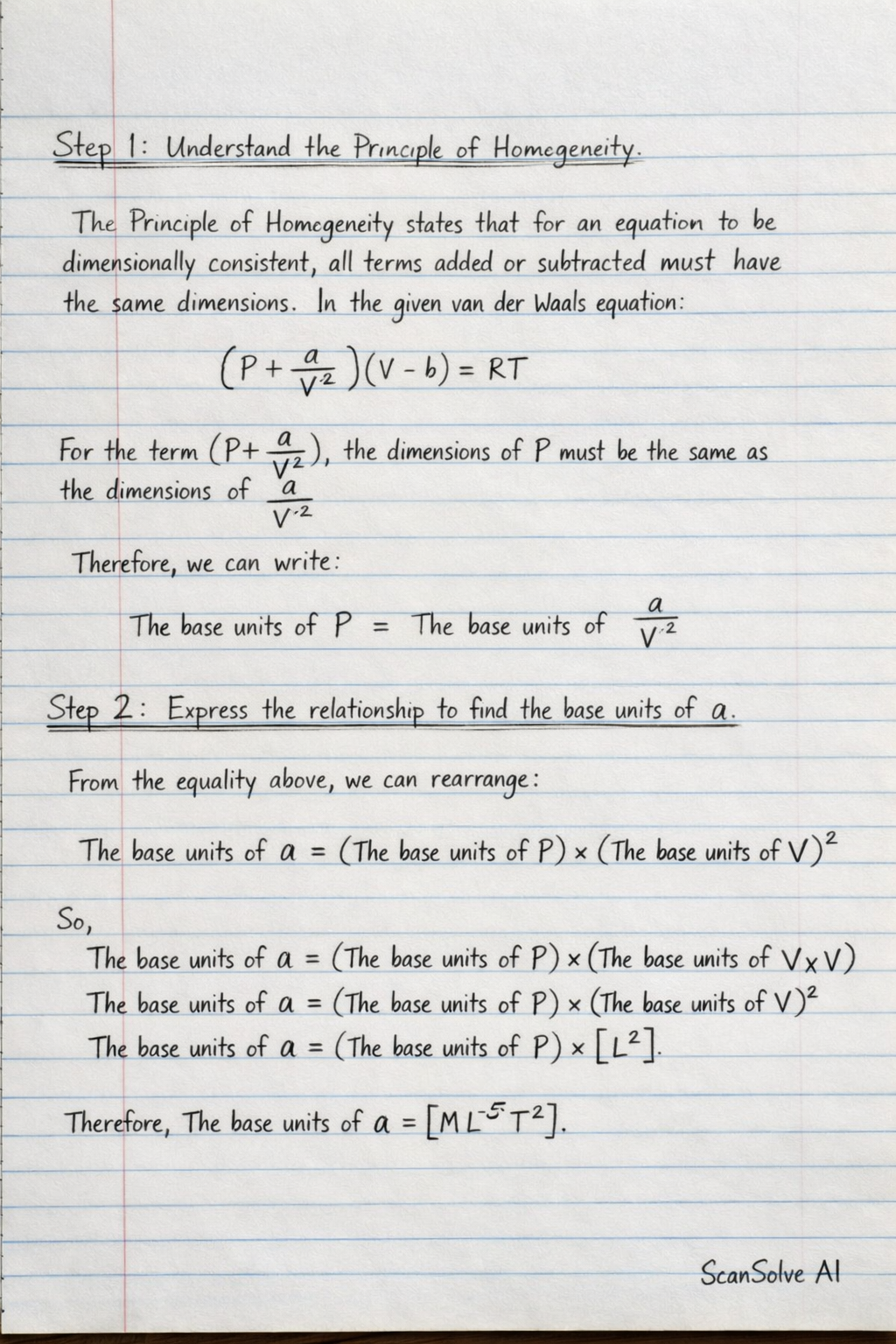
Handwritten Step-by-Step Solution
Get this as a handwritten image on WhatsApp — like a tutor wrote it for you.
Try on WhatsApp