
Using this slove for stand deviation during mixing
ScanSolve AI Answer
Answer
Step-by-step solution
2 stepsCalculate the standard deviation at perfect mixing ().
For a perfectly mixed binary system, the concentration of yeast in any sample is ideally uniform and equal to the overall average concentration . Therefore, the standard deviation of concentrations in a perfectly mixed system is zero.
Express the standard deviation during mixing () in terms of the mixing index ().
The standard deviation during mixing () represents the actual measured standard deviation of samples taken at a particular point in time during the mixing process. It is related to the standard deviation at the start of mixing () and the mixing index () by the formula:
From the previous calculation, . Substituting this value and into the formula:
Rearranging the equation to solve for :
Since no value for the mixing index () or experimental data from during mixing is provided, a specific numerical value for cannot be determined from the information given.
Try one yourself
A new problem that tests the same skill.
Still stuck on this one?
Ask a follow-up, and the answer starts from this question.
More Physics Questions
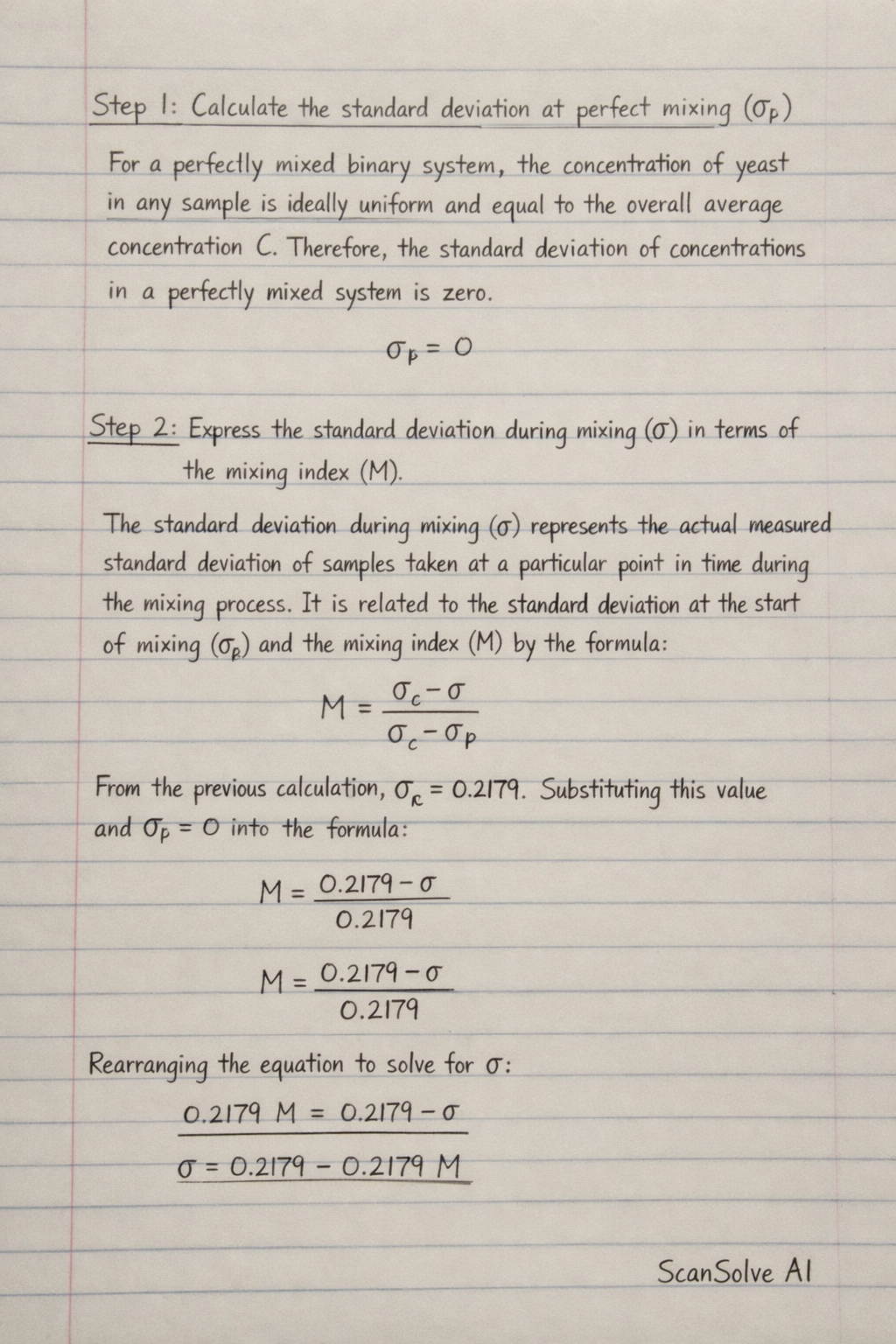
Handwritten Step-by-Step Solution
Get this as a handwritten image on WhatsApp — like a tutor wrote it for you.
Try on WhatsApp