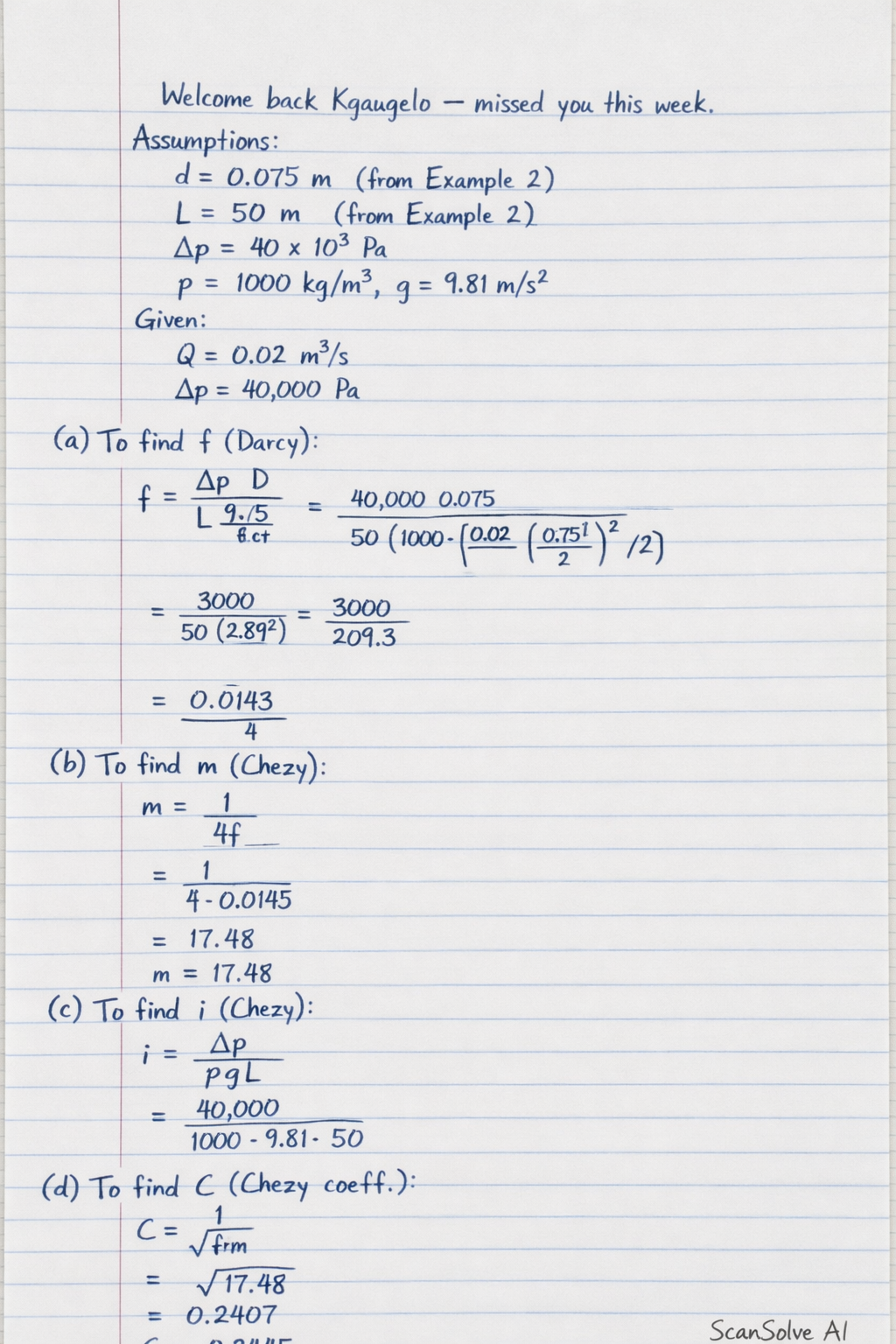
We read your photo as:

Calculate the values for the above conditions using Chezy's formula.

Physics

ScanSolve AI Answer

Step-by-step solution

7 steps

To solve this problem, we need to make some assumptions due to missing information in the "Data given" section for this specific problem. We will assume the pipe diameter dd and length LL are the same as in Example 2, and that the given pressure pp represents the pressure drop Δp\Delta p.

Assumptions:

  • Pipe diameter d=0.075 md = 0.075 \text{ m} (from Example 2).
  • Pipe length L=50 mL = 50 \text{ m} (from Example 2).
  • The given pressure p=40×103 Pap = 40 \times 10^3 \text{ Pa} is the pressure drop Δp\Delta p over the length LL.
  • The fluid is water, with density ρ=1000 kg/m3\rho = 1000 \text{ kg/m}^3 and acceleration due to gravity g=9.81 m/s2g = 9.81 \text{ m/s}^2.

Given:

  • Q=20 l/s=0.02 m3/sQ = 20 \text{ l/s} = 0.02 \text{ m}^3/\text{s}
  • Δp=40×103 Pa\Delta p = 40 \times 10^3 \text{ Pa}

Data wanted:

Part a

f (Darcy)f \text{ (Darcy)}

Part b

m (Chezy)m \text{ (Chezy)}

Part c

i (Chezy)i \text{ (Chezy)}

Part d· 7 steps

The Chezy coefficient CC

  1. Calculate the cross-sectional area of the pipe AA.

    A=πd24=π(0.075 m)24A = \frac{\pi d^2}{4} = \frac{\pi (0.075 \text{ m})^2}{4} A≈0.00441786 m2A \approx 0.00441786 \text{ m}^2
  2. Calculate the flow velocity vv.

    v=QA=0.02 m3/s0.00441786 m2v = \frac{Q}{A} = \frac{0.02 \text{ m}^3/\text{s}}{0.00441786 \text{ m}^2} v≈4.5271 m/sv \approx 4.5271 \text{ m/s}
  3. Calculate the hydraulic mean depth mm.

    (Part b)
    For a circular pipe, the hydraulic mean depth is m=d4m = \frac{d}{4}.

    m=0.075 m4m = \frac{0.075 \text{ m}}{4} m=0.01875 mm = \boxed{\text{0.01875 m}}
  4. Calculate the head loss hfh_f from the pressure drop.

    Using the relationship Δp=ρghf\Delta p = \rho g h_f:

    hf=Δpρg=40×103 Pa1000 kg/m3×9.81 m/s2h_f = \frac{\Delta p}{\rho g} = \frac{40 \times 10^3 \text{ Pa}}{1000 \text{ kg/m}^3 \times 9.81 \text{ m/s}^2} hf≈4.0775 mh_f \approx 4.0775 \text{ m}
  5. Calculate the hydraulic gradient ii.

    (Part c)

    i=hfL=4.0775 m50 mi = \frac{h_f}{L} = \frac{4.0775 \text{ m}}{50 \text{ m}} i≈0.08155i \approx \boxed{\text{0.08155}}
  6. Calculate the Chezy coefficient CC.

    (Part d)
    Using Chezy's formula v=Cmiv = C \sqrt{mi}, rearrange to solve for CC:

    C=vmi=4.5271 m/s0.01875 m×0.08155C = \frac{v}{\sqrt{mi}} = \frac{4.5271 \text{ m/s}}{\sqrt{0.01875 \text{ m} \times 0.08155}} C=4.52710.00152906C = \frac{4.5271}{\sqrt{0.00152906}} C=4.52710.039103C = \frac{4.5271}{0.039103} C≈115.77 m1/2/sC \approx \boxed{\text{115.77 m}^{1/2}/\text{s}}
  7. Calculate the Darcy friction factor ff.

    (Part a)
    Using the relationship between Chezy's coefficient CC and Darcy's friction factor ff: C=8gfC = \sqrt{\frac{8g}{f}}. Rearrange to solve for ff:

    f=8gC2=8×9.81 m/s2(115.77 m1/2/s)2f = \frac{8g}{C^2} = \frac{8 \times 9.81 \text{ m/s}^2}{(115.77 \text{ m}^{1/2}/\text{s})^2} f=78.4813402.69f = \frac{78.48}{13402.69} f≈0.005855f \approx \boxed{\text{0.005855}}
Was this helpful?

Still stuck on this one?

Ask a follow-up, and the answer starts from this question.

Got a different question?Ask your own question
Handwritten step-by-step solution preview

Handwritten Step-by-Step Solution

Get this as a handwritten image on WhatsApp — like a tutor wrote it for you.

Try on WhatsApp