
We read your photo as:
Determine the velocity ratio of the machine.
ScanSolve AI Answer
Answer
Step-by-step solution
4 stepsDetermine the velocity ratio of the machine.
Based on the pulley system shown in the previous question, there are 6 rope segments supporting the movable block.
Therefore, the velocity ratio (VR) is:Determine the efficiency of the pulley system.
Given:
Load, (from previous question)
Effort,
Velocity Ratio, VR = 6First, calculate the Mechanical Advantage (MA):
Next, calculate the efficiency ():
Rounding to three significant figures:
Sketch a graph of efficiency against load for the system.
The provided sketch shows a typical graph of efficiency versus load for a machine. The efficiency generally increases with the load up to a certain point, after which it tends to level off. This is because the constant frictional forces become a smaller proportion of the total work done as the load increases.
Determine how high the block will rise.
Given:
Force,
Mass,
Time,
Acceleration due to gravity,First, calculate the acceleration of the block using Newton's second law:
Next, calculate the velocity of the block after the force acts for (assuming it starts from rest):
Finally, use the conservation of energy to find the maximum height the block rises. The kinetic energy at the bottom of the swing is converted into potential energy at the maximum height:
Divide both sides by :
Solve for :
Rounding to three significant figures:
Still stuck on this one?
Ask a follow-up, and the answer starts from this question.
More Physics Questions
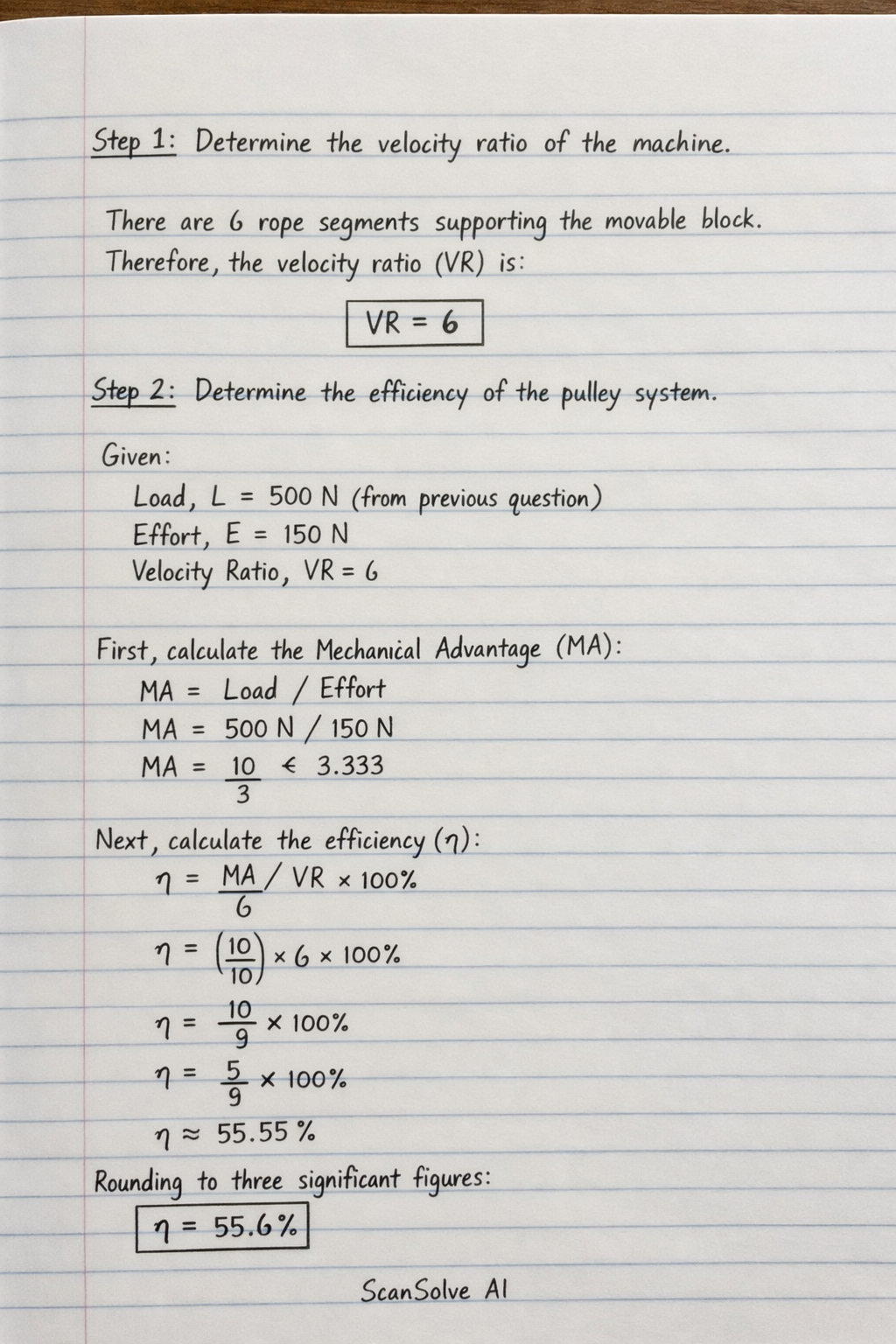
Handwritten Step-by-Step Solution
Get this as a handwritten image on WhatsApp — like a tutor wrote it for you.
Try on WhatsApp