
We read your photo as:
Calculate the velocity ratio, weight of cement bag, mechanical advantage, and efficiency of the pulley system shown in Figure 4, given the effort is 300 N and the cement bag's mass is 50 kg.
ScanSolve AI Answer
Step-by-step solution
7 stepsPart a· 1 step
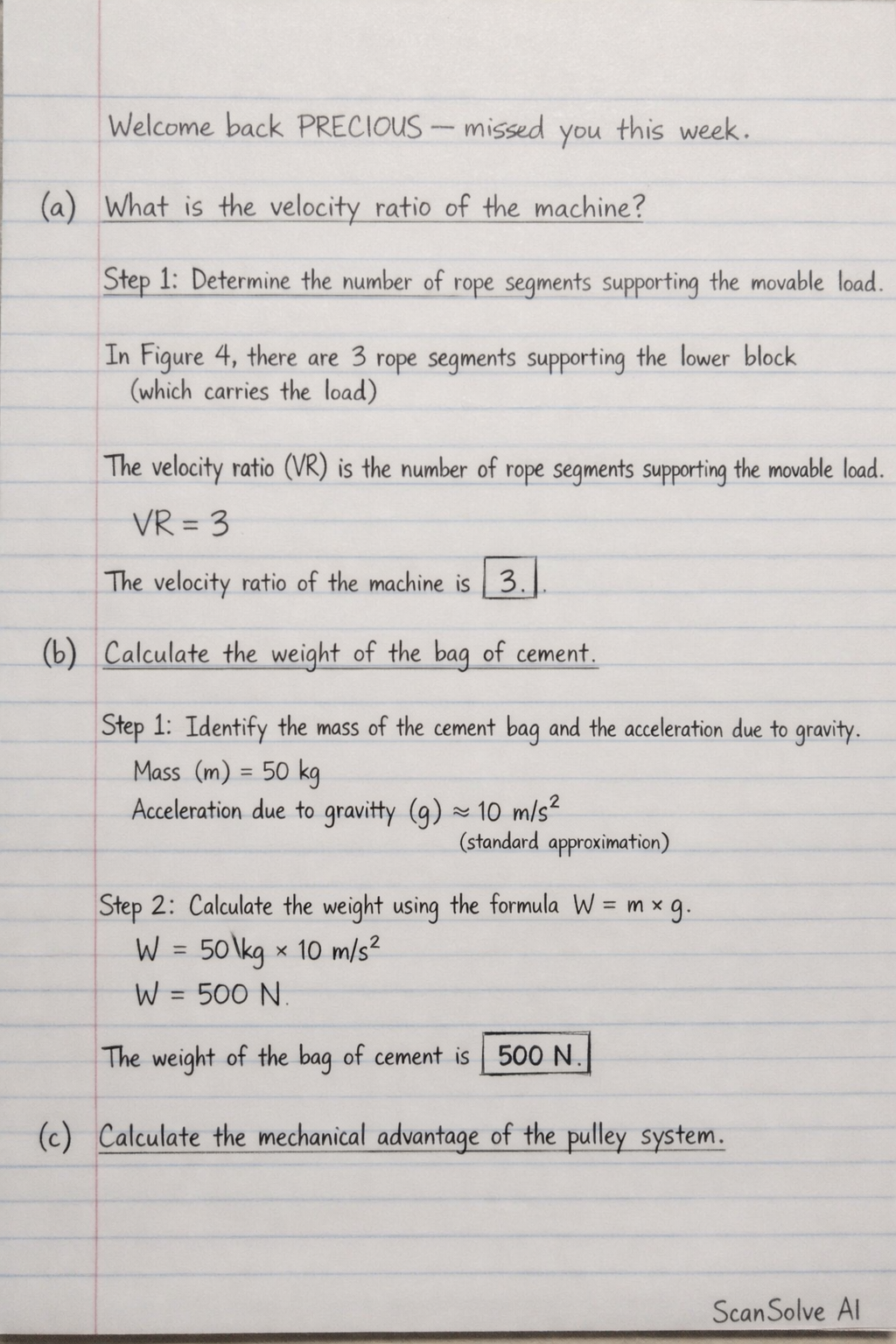
What is the velocity ratio of the machine?
Determine the number of rope segments supporting the movable load.
In Figure 4, there are 3 rope segments supporting the lower block (which carries the load).
The velocity ratio (VR) is the number of rope segments supporting the movable load.
The velocity ratio of the machine is .
Part b· 2 steps
Calculate the weight of the bag of cement.
Identify the mass of the cement bag and the acceleration due to gravity.
Mass () = 50 kg
Acceleration due to gravity () (standard approximation for such problems unless specified otherwise).Calculate the weight using the formula .
The weight of the bag of cement is .
Part c· 2 steps
Calculate the mechanical advantage of the pulley system.
Identify the load and the effort.
Load () = Weight of the bag of cement = 500 N (from part b)
Effort () = 300 N (given in the problem description)Calculate the mechanical advantage (MA) using the formula .
The mechanical advantage of the pulley system is .
Part d· 2 steps
Calculate the efficiency of the pulley system.
Identify the mechanical advantage (MA) and velocity ratio (VR).
MA = 1.67 (from part c)
VR = 3 (from part a)Calculate the efficiency () using the formula .
The efficiency of the pulley system is .
Still stuck on this one?
Ask a follow-up, and the answer starts from this question.
More Physics Questions
Handwritten Step-by-Step Solution
Get this as a handwritten image on WhatsApp — like a tutor wrote it for you.
Try on WhatsApp