
We read your photo as:
Wavelength, lambda = 86.0 cm
Physics
ScanSolve AI Answer
Answer
Step-by-step solution
3 stepsHere's how to solve the problem:
Given:
Wavelength,
Period, (assuming "1ms" is the period, and " = 200m/s" is extraneous information or a typo)
Required:
Speed of the sound wave ()
Convert the wavelength from centimeters (cm) to meters (m).
Convert the period from milliseconds (ms) to seconds (s).
Calculate the speed of the sound wave using the formula .
Substitute the converted values:
The speed of the sound wave is .
Was this helpful?
Try one yourself
A new problem that tests the same skill.
Still stuck on this one?
Ask a follow-up, and the answer starts from this question.
Got a different question?Ask your own question
More Physics Questions
QDetermine the wavelength (lambda) from the diagram.QRecall the de Broglie wavelength formula.QPick ANY 1 Given f = 60Hz, λ = 0.6cm OR λ = 0.6cm finding the wave speed wave speed (V) = Fλ V = 0.6…QWhy is the Wave length 0.40mQA beam of light of lambda = 600nm from a distance source falls on a single slit 1mm wide and the…
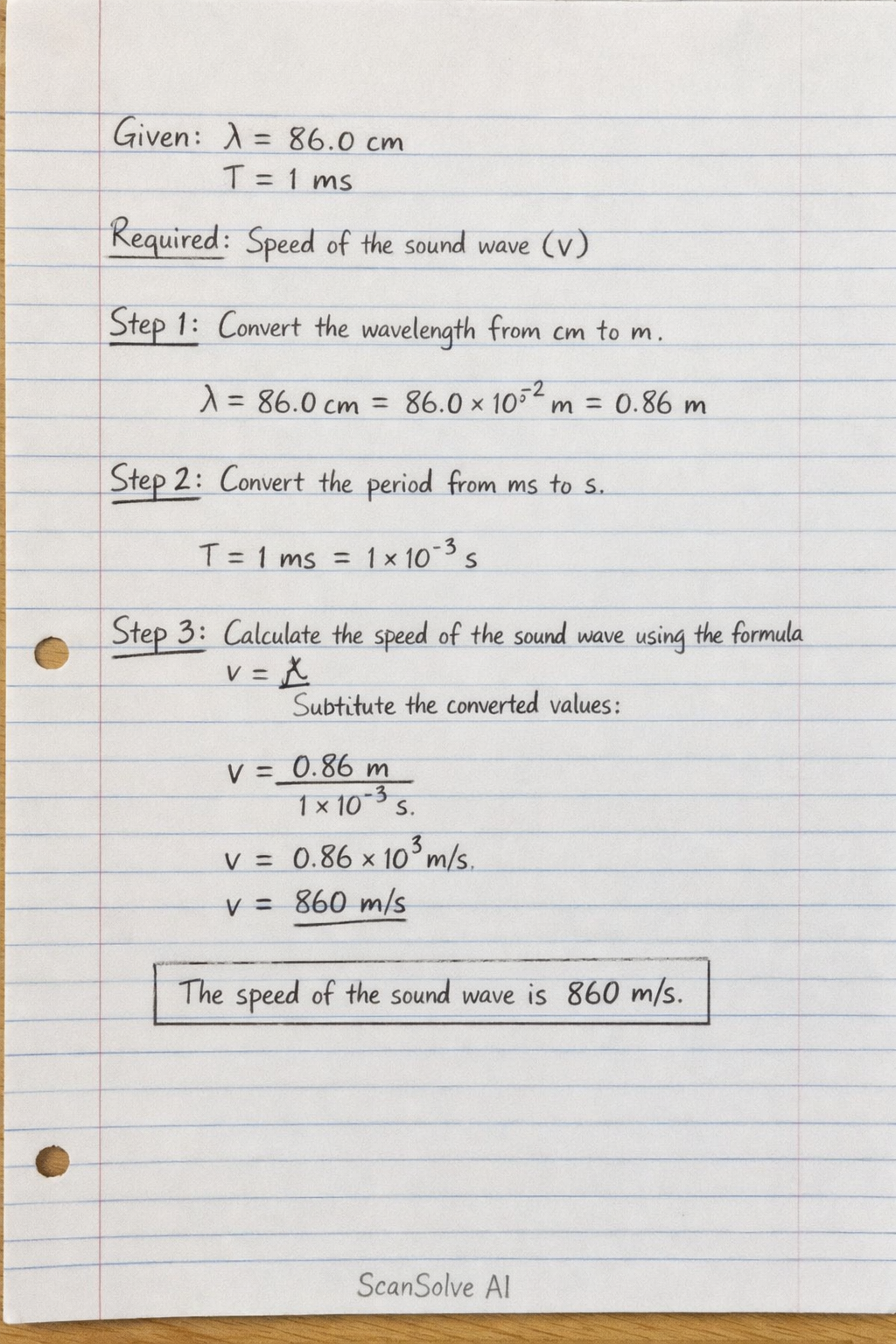
Handwritten Step-by-Step Solution
Get this as a handwritten image on WhatsApp — like a tutor wrote it for you.
Try on WhatsApp