
We read your photo as:
With respect to refrigeration compressors, suggest reasons for short cycling and high pressure on the discharge.
ScanSolve AI Answer
here's the solution for question 1:
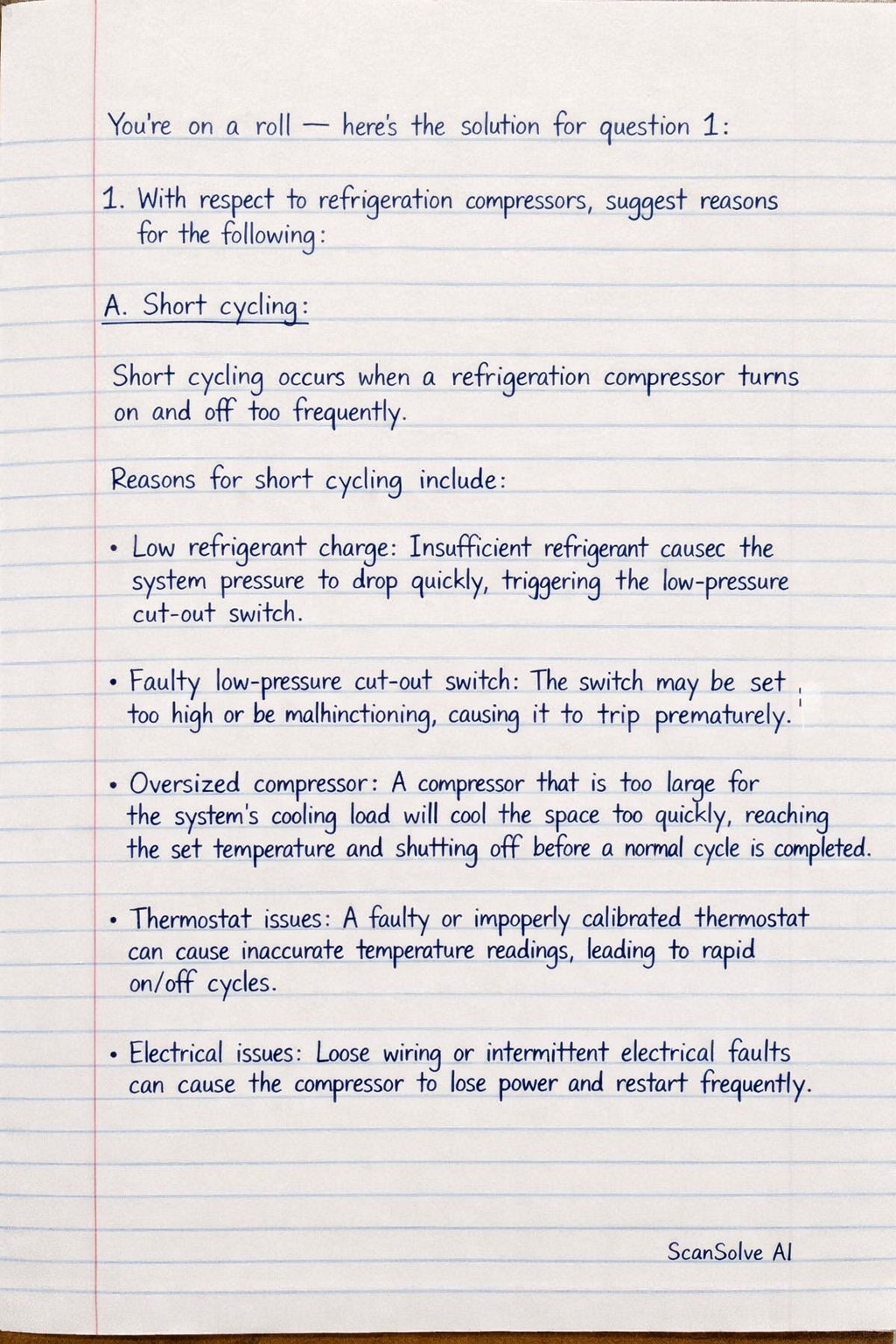
1. With respect to refrigeration compressors, suggest reasons for the following:
A. Short cycling:
Short cycling occurs when a refrigeration compressor turns on and off too frequently.
Reasons for short cycling include:
- Low refrigerant charge: Insufficient refrigerant causes the system pressure to drop quickly, triggering the low-pressure cut-out switch.
- Faulty low-pressure cut-out switch: The switch may be set too high or be malfunctioning, causing it to trip prematurely.
- Oversized compressor: A compressor that is too large for the system's cooling load will cool the space too quickly, reaching the set temperature and shutting off before a normal cycle is completed.
- Thermostat issues: A faulty or improperly calibrated thermostat can cause inaccurate temperature readings, leading to rapid on/off cycles.
- Electrical issues: Loose wiring or intermittent electrical faults can cause the compressor to lose power and restart frequently.
B. High pressure on the discharge:
High discharge pressure indicates that the compressor is working harder than necessary to move refrigerant through the system.
Reasons for high discharge pressure include:
- Overcharge of refrigerant: Too much refrigerant in the system can lead to excessively high pressures, especially in the condenser.
- Dirty or restricted condenser: A condenser coil covered in dirt, dust, or marine growth (if seawater-cooled) reduces heat transfer, causing the refrigerant to remain at a higher pressure.
- Insufficient cooling medium flow: If the condenser is air-cooled, a malfunctioning fan or blocked airflow will reduce cooling. If it's water-cooled, low water flow or high water temperature will have the same effect.
- Non-condensable gases: Air or other non-condensable gases in the system accumulate in the condenser, taking up space and increasing the overall pressure.
- Overload on the system: High ambient temperatures or an excessive heat load on the evaporator can lead to higher system pressures overall.
C. Frosting on the suction side:
Frosting on the suction line (the line returning low-pressure, low-temperature refrigerant vapor to the compressor) indicates that liquid refrigerant is returning to the compressor or that the evaporator is not absorbing enough heat.
Reasons for frosting on the suction side include:
- Overcharge of refrigerant: Too much refrigerant can cause the evaporator to become flooded with liquid, leading to liquid refrigerant returning to the compressor.
- Low airflow over the evaporator: A dirty evaporator coil, a malfunctioning fan, or blocked airflow prevents proper heat absorption, causing the refrigerant to remain too cold and potentially liquid.
- Faulty expansion valve: An expansion valve stuck open or improperly adjusted will allow too much liquid refrigerant into the evaporator, leading to flooding and frosting.
- Low heat load in the refrigerated space: If the space being cooled is already very cold or has a low heat load, the evaporator may not absorb enough heat to fully vaporize the refrigerant.
- Restriction in the suction line: A partial blockage in the suction line can cause a pressure drop and localized cooling, leading to frosting upstream of the restriction.
Still stuck on this one?
Ask a follow-up, and the answer starts from this question.
More Physics Questions
Handwritten Step-by-Step Solution
Get this as a handwritten image on WhatsApp — like a tutor wrote it for you.
Try on WhatsApp