We read your photo as:

Calculate the work done to move a charge of 0.05 microcoulomb from a distance of 10 cm to 50 cm from a source charge of 2 microcoulomb.

Physics

ScanSolve AI Answer

This answer stops before the end.

It was cut off when it was first written. Ask ScanSolve this question again for the full working.

To solve this problem, we will use the formula for electric potential due to a point charge and the formula for work done in moving a charge in an electric field.

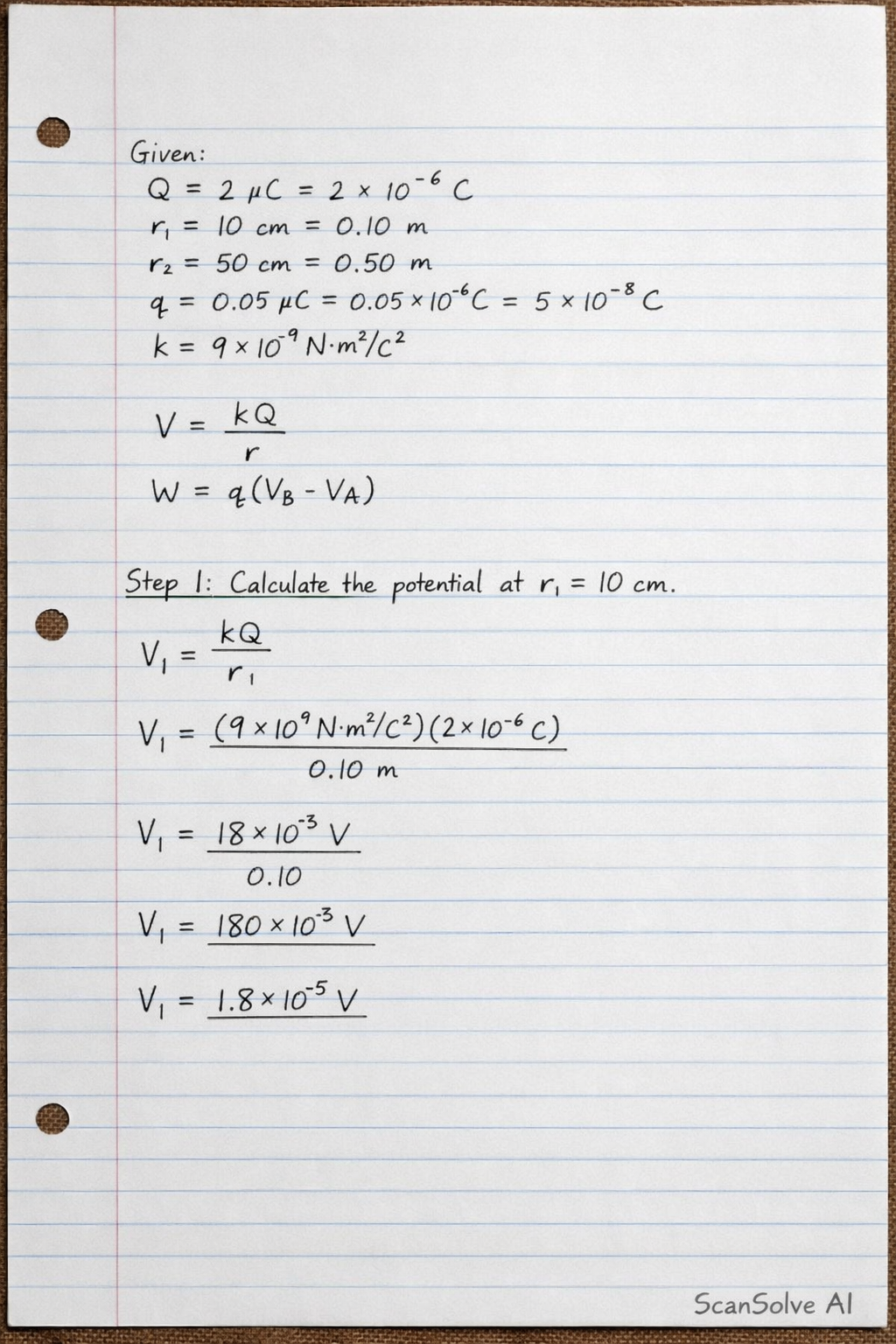
Given:
Source charge Q=2 microcoulomb=2×10⁻⁶ CQ = 2 \text{ microcoulomb} = 2 \times 10^{-6} \text{ C}
Distance r1=10 cm=0.10 mr_1 = 10 \text{ cm} = 0.10 \text{ m}
Distance r2=50 cm=0.50 mr_2 = 50 \text{ cm} = 0.50 \text{ m}
Charge to be moved q=0.05 microcoulomb=0.05×10⁻⁶ C=5×10⁻⁸ Cq = 0.05 \text{ microcoulomb} = 0.05 \times 10^{-6} \text{ C} = 5 \times 10^{-8} \text{ C}
Coulomb's constant k=9×10⁹ N m2/C2k = 9 \times 10^9 \text{ N m}^2/\text{C}^2

The formula for absolute electric potential VV at a distance rr from a point charge QQ is:

V=kQrV = \frac{kQ}{r}

The formula for work WW required to move a charge qq from an initial potential VAV_A to a final potential VBV_B is:

W=q(VB−VA)W = q(V_B - V_A)

Step 1: Calculate the absolute potential at r1=10 cmr_1 = 10 \text{ cm}.

V1=kQr1V_1 = \frac{kQ}{r_1} V1=(9×10⁹ N m2/C2)(2×10−6 C)0.10 mV_1 = \frac{(9 \times 10^9 \text{ N m}^2/\text{C}^2)(2 \times 10^{-6} \text{ C})}{0.10 \text{ m}} V1=18×1030.10 VV_1 = \frac{18 \times 10^3}{0.10} \text{ V} V1=180×103 VV_1 = 180 \times 10^3 \text{ V} V1=1.8×10⁵ VV_1 = 1.8 \times 10^5 \text{ V}

Step 2: Calculate the absolute potential at r2=50 cmr_2 = 50 \text{ cm}.

V2=kQr2V_2 = \frac{kQ}{r_2} V2=(9×10⁹ N m2/C2)(2×10−6 C)0.50 mV_2 = \frac{(9 \times 10^9 \text{ N m}^2/\text{C}^2)(2 \times 10^{-6} \text{ C})}{0.50 \text{ m}} V2=18×1030.50 VV_2 = \frac{18 \times 10^3}{0.50} \text{ V} V2=36×103 VV_2 = 36 \times 10^3 \text{ V} V2=3.6×10⁴ VV_2 = 3.6 \times 10^4 \text{ V}

Step 3: Calculate the work required to carry the 0.05 microcoulomb0.05 \text{ microcoulomb} charge from r=50 cmr=50 \text{ cm} to r=10 cmr=10 \text{ cm}.
The initial potential is VA=V2V_A = V_2 and the final potential is VB=V1V_B = V_1.

W=q(V1−V2)W = q(V_1 - V_2) W=(5×10⁻⁸ C)(1.8×10⁵ V−3.6×10⁴ V)W = (5 \times 10^{-8} \text{ C})(1.8 \times 10^5 \text{ V} - 3.6 \times 10^4 \text{ V})
Was this helpful?

Still stuck on this one?

Ask a follow-up, and the answer starts from this question.

Got a different question?Ask your own question
Handwritten step-by-step solution preview

Handwritten Step-by-Step Solution

Get this as a handwritten image on WhatsApp — like a tutor wrote it for you.

Try on WhatsApp