

This physics problem tests your understanding of fundamental physical laws and their applications. The step-by-step solution below breaks down the problem using relevant equations and physical reasoning.
ScanSolve AI Answer
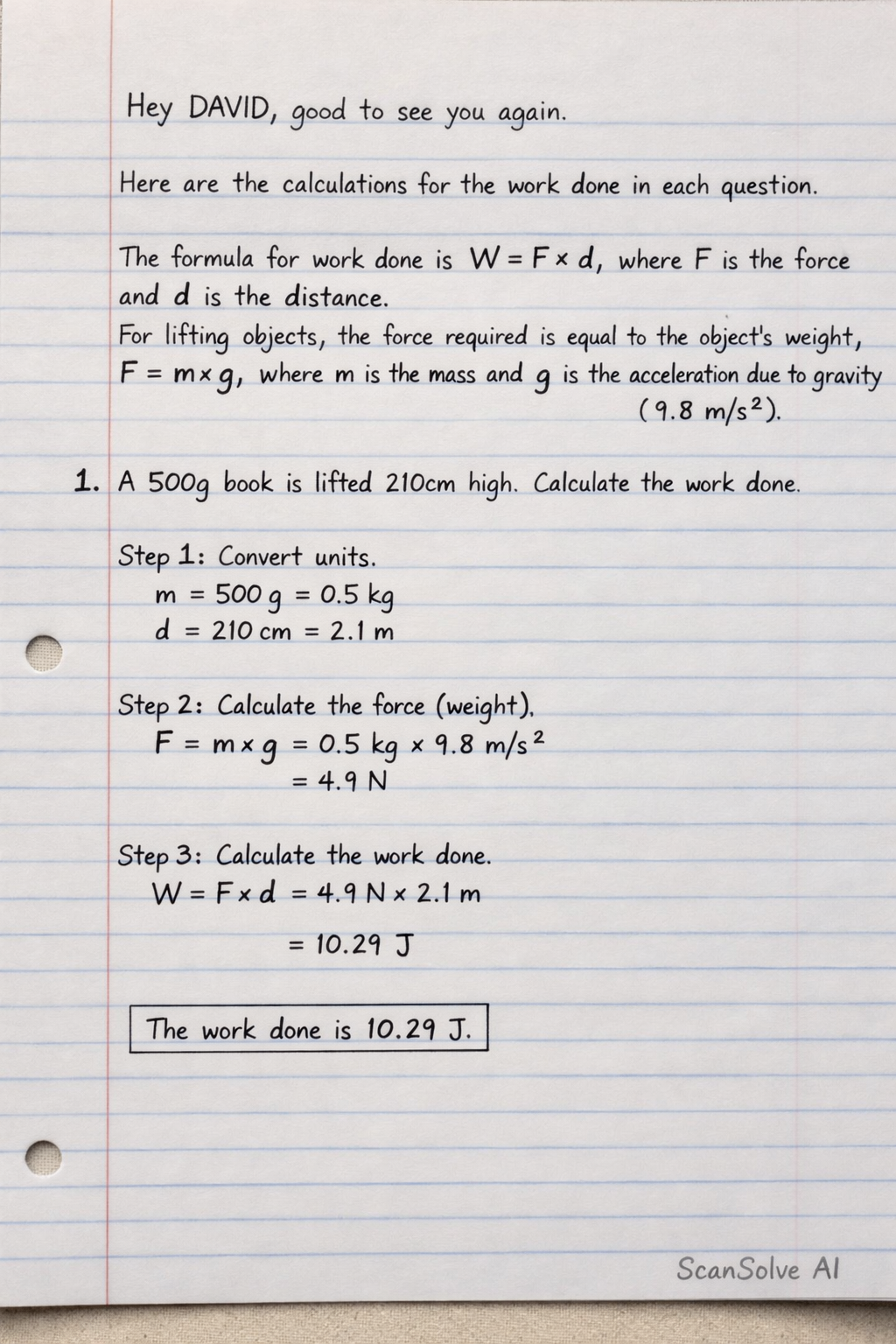
Hey DAVID, good to see you again. Here are the calculations for the work done in each question. The formula for work done is W = F × d, where F is the force and d is the distance. For lifting objects, the force required is equal to the object's weight, F = mg, where m is the mass and g is the acceleration due to gravity (9.8 m/s^2). 1. A 500g book is lifted 210cm high. Calculate the work done. Step 1: Convert units. m = 500 g = 0.5 kg d = 210 cm = 2.1 m Step 2: Calculate the force (weight). F = m × g = 0.5 kg × 9.8 m/s^2 = 4.9 N Step 3: Calculate the work done. W = F × d = 4.9 N × 2.1 m = 10.29 J The work done is 10.29 J. 2. A 2kg ball is lifted 50cm from the floor. Calculate the work done. Step 1: Convert units. d = 50 cm = 0.5 m Step 2: Calculate the force (weight). F = m × g = 2 kg × 9.8 m/s^2 = 19.6 N Step 3: Calculate the work done. W = F × d = 19.6 N × 0.5 m = 9.8 J The work done is 9.8 J. 3. A 1500g load is lifted 2m high. Calculate the work done. Step 1: Convert units. m = 1500 g = 1.5 kg Step 2: Calculate the force (weight). F = m × g = 1.5 kg × 9.8 m/s^2 = 14.7 N Step 3: Calculate the work done. W = F × d = 14.7 N × 2 m = 29.4 J The work done is 29.4 J. 4. A 3kg box is pushed 250cm across the floor. Calculate the work done. Note: For horizontal motion, work done depends on the applied force and friction. Since no friction or applied force is given, and given the context of other problems involving lifting, we will assume the question implies the work done if the force applied is equal to the object's weight, or if it were lifted by that distance for simplification. Step 1: Convert units. d = 250 cm = 2.5 m Step 2: Calculate the force (weight). F = m × g = 3 kg × 9.8 m/s^2 = 29.4 N Step 3: Calculate the work done. W = F × d = 29.4 N × 2.5 m = 73.5 J The work done is 73.5 J. 5. A 750g object is lifted 1.5m high. Calculate the work done. Step 1: Convert units. m = 750 g = 0.75 kg Step 2: Calculate the force (weight). F = m × g = 0.75 kg × 9.8 m/s^2 = 7.35 N